Copyright © Hans Högman 2025-12-29
A brief overview of Swedish
history
Introduction
The following historical section is by no means
complete from a historical perspective.
The purpose of this page is to provide a
chronological historical overview of events in
Sweden that may have had a connection with or
impact on the lives and livelihoods of my and others’
Swedish ancestors.
Swedish History in
Brief (1900s-1)
Related Links
•
Swedish history - 1500s - 1600s
•
The Reformation and King Gustav I
•
Swedish history - 1700s
•
Swedish history - 1800s
•
Swedish history - 1900s, Part 1
•
Swedish history - 1900s, Part 2
•
The New Sweden Colony in North America
•
Swedish Witch Trials
•
The Allotment System
•
Swedish School System
•
Swedish Banking
•
Swedish Monetary System
•
History of the Swedish Police System
•
Poor Relief in the past
•
Health Care and Diseases in the Past
•
The Many Swedish Wars
•
Swedish Inventions
•
Inns and Stage Services
•
History of Railways in Sweden
•
History of Church of Sweden
•
History of the Swedish Riksdag (Parliament)
Source References
•
Wikipedia
•
Svenska krig 1521 – 1814. Ulf Sundberg, 1998
•
Svenska freder och stillestånd 1249 - 1814, Ulf
Sundberg, 1997
•
Ånga och Dynamit, Historien om Sverige,
Herman Lindqvist, 1999
•
När Sverige blev stormakt, Historien om Sverige,
Herman Lindqvist, 1994
•
Ofredsår, Peter Englund, 1993
•
Trolldomsprocesserna i Sverige av Bengt
Ankarloo, 1996.
Top of page
1900s - Part 1
The 20th century began somewhat dramatically for
Sweden with the dissolution of the union with
Norway in 1905.
Furthermore, the military allotment system (with its
standing army) was abolished in 1901 in favor of a
conscript army, i.e., universal conscription. The 20th
century also saw two major conflicts: World War I
and World War II.
The Military Allotment System is Abolished
in 1901 – Universal Conscription is
Introduced
The military allotment system, which was
established in 1682, was abolished in 1901 and
replaced by universal conscription.
At the same time, the Beväringen—the older
conscription system used during the 19th
century—was also abolished.
On June 14, 1901, the Swedish Parliament (Riksdag)
passed a bill to abolish the military allotment system
and instead establish a system based on universal
conscription and a smaller corps of commissioned
officers. The training period for conscripts was
extended to 240 days, and the number of conscript
classes was set at 12.
The officer corps was expanded to include reserve
officers, among others.
The allotted and enlisted regiments were now
replaced by a conscript army.
The first conscripts under the new system were
called up for military training in the spring of 1902.
The vast majority of the conscripted recruits were
then assigned to the Army.
Universal conscription also meant longer,
continuous periods of training, which included the
winter months. This necessitated better barracks. For
each regiment, a town was designated in the
province where the regiment was stationed, known
as a garrison town.
In these garrison towns, construction of barracks for
conscripts was now underway. Whereas the allotted
soldiers had previously been scattered throughout
the countryside, the conscript soldiers were now
gathered in the regimental towns. At this time, many
regimental or garrison
towns, including
Boden, Sollefteå,
Enköping, Strängnäs,
Eksjö, and others were
established.
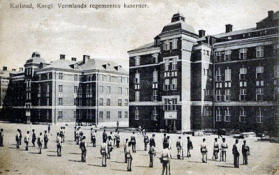
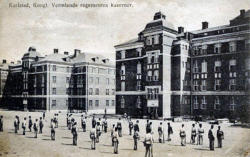
The image shows newly
built barracks at the Värmland Regiment, Karlstad, in
the 1920s.
In the allotment system and the early conscript
service (Beväringen), soldiers trained exclusively
during the summer at their respective regiments’
training grounds, such as the Södermanland
Regiment’s training ground, Malmahed, in
Malmköping.
More information are available on the pages:
Universal Conscription, and Swedish Armed Forces
during the Conscription Period 1901 - 2010
The dissolution of the Union with Norway in
1905
Denmark was forced to cede Norway to Sweden
through the Treaty of Kiel on January 15, 1814. The
Convention of Moss of August 14, 1814, meant that
Danish King Kristian Fredrik abdicated the
Norwegian throne and that Norway entered into a
personal union with Sweden. Sweden's King Karl XIII
became the joint king of both Sweden and Norway. A
personal union is a union between two or more states
with a common head of state, in this case, the King of
Sweden.
Several decades of tension between Norway and
Sweden preceded the Union Crisis of 1905. Norway
demanded greater self-determination, which Sweden
opposed. Furthermore, Norway wanted its own
consular service. Swedish King Oscar II, who reigned
over both Sweden and Norway, and the Swedish
government were opposed to this; all foreign policy
matters were to be handled from Stockholm,
Sweden.
In actuality, the consulate issue was more about
Norway's claim to be treated on an equal footing
with Sweden than it was about Norway's formal
requests for the creation of its own consular service.
On June 7, 1905, Norway passed a law that
effectively dissolved the union. Norway’s unilateral
dissolution of the union led to tensions and
military mobilization on both sides of the border.
Both sides now began military preparations. Sweden
recruited espionage agents among military
personnel, border residents, forest rangers, border
guards (customs officers), and employees of the
telecommunications, postal, and railway services.
The entire situation escalated, leading Sweden to
carry out a partial mobilization on July 17, 1905.
The Chief of the General Staff, Axel Rappe, devised
an attack plan against Norway.
On August 31, 1905, the Karlstad negotiations
between Sweden and Norway began, but the
negotiations soon became bogged down.
About 50,000 soldiers were mobilized in mid-
September, further increasing Swedish military
readiness. A Swedish naval squadron of 42
warships was dispatched along the west coast to
Gothenburg, which is near the Norwegian border. On
September 13 and 14, Norway conducted a partial
mobilization, and a significant portion of the
Norwegian armed forces—22,000 men—were now
under arms in Norway.
However, during the negotiations in Karlstad, an
agreement was made to create a demilitarized zone
on both sides of the border.
Following tough negotiations in Karlstad in August
and October 1905, the union was dissolved
peacefully. On September 23, 1905, the Karlstad
Convention was signed, and the threat of war was
averted. The terms for the dissolution of the union
were agreed upon, and Sweden recognized Norway’s
independence.
In October 1905, the outcome of the negotiations
was approved by both countries, and on October 26,
it was signed by Sweden’s Minister for Foreign
Affairs, Fredrik Wachtmeister, and Norway’s
representative, Thor von Ditten.
More information about the union and its dissolution
can be found on the page: The Swedish-Norwegian
Union
Sweden's Defense During World War I,
1914–1918
World War I broke out on July 28, 1914, and lasted
until November 11, 1918.
Sweden, along with Denmark and Norway, declared
its neutrality during World War I. Finland had been
part of Tsarist Russia since 1809, which meant that
Sweden shared a land border with one of the
belligerent great powers.
By the outbreak of World War I in 1914, the allotted
military force had been almost completely
disbanded, although many allotted soldiers were still
on active duty and were even called up for duty
during the war, the Neutrality Guard.
In 1914, on the eve of World War I, the training
period for duty in the infantry was extended to 340
days (250 days of basic training plus three 30-day
refresher courses).
The conscription age was also extended by one year
by lowering the age of conscription from 21 to 20.
To protect neutrality, conscripts and certain units of
the “Land storm“ units (older conscripts) were called
up shortly after the war began. Navy ships were
stationed along the coast to prevent violations of
neutrality on Swedish territory. Time and again,
Sweden had to take action against violations of
neutrality by the belligerents.
Stricter Swedish neutrality regulations
were enacted, and in 1916, submarines
belonging to the belligerent nations
were prohibited from entering Swedish
waters, except in certain exceptional
cases. Approximately 100,000 young
men were drafted in Sweden during the
war years.
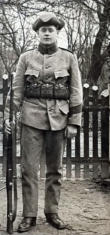
The image shows a Swedish soldier in
the 1910-style uniform, carrying a rifle
and an ammunition belt. Photo owned
by me.
Meat, pork, eggs, butter, and fish were subject to
rationing, and their sale was regulated. There was
also a shortage of gasoline during the war, which led
to a ban on all private use of gasoline-powered cars,
motorcycles, and motorboats.
“Neutrality Guard” is a term used to describe the
Swedish Armed Forces' combined resources and
operations during both World War I and World War II.
During the early stages of the Neutrality Guard, the
so-called “land storm men” became the most popular
symbol of Sweden's determination to defend itself.
The land storm relied heavily on volunteer efforts.
Later in the fall of 1914, the land storm was replaced
by regular troops, a move that became necessary as
winter approached; the land storm lacked the
necessary equipment for that season.
The heaviest burden fell on the naval forces, i.e., the
Navy. They escorted both Swedish and foreign
merchant ships in the Baltic Sea. Throughout the
war, mine sweeping and the search for drifting mines
were a very important part of the navy’s duties.
Universal Suffrage
Bicameral Parliament from 1866
The medieval Swedish Estates Parliament,
comprising the four estates, was abolished in 1865,
and a bicameral parliament was established,
consisting of the First Chamber and the Second
Chamber.
On June 22, 1866, the new parliamentary
representation reform took effect.
The members of the First Chamber were indirectly
elected by the members of the country's County
Councils (Swedish: Landsting), while the members of
the Second Chamber were directly elected by
eligible voters.
Women did not have the right to vote, and men’s
right to vote was restricted. The right to vote was
based on income or wealth, and only 20% of adult
men were eligible to vote.
The Second Chamber was elected in single-member
constituencies, much like the British or American
electoral systems today.
To be eligible to vote, a person had to have an
assessed annual income of at least 800 kronor, or
real property with an assessed value of at least 1,000
kronor, or a lease on agricultural property of a
specified value. Only men over the age of 21 were
eligible to vote for the Second Chamber, and an
additional requirement was that taxes had been paid
for the past 10 years.
Just over 20% of the adult male population had the right
to vote in 1866, but due to rising incomes, that
percentage had risen to about 60% by 1908.
The Parliament Buildings:
At the end of the 1800s, the Riksdag (the Parliament)
still convened at the House of the Estates (Swedish:
Riksens Ständers hus) on Birger Jarl’s Square on
Riddarholmen, also known as the Old Parliament
Building. Both chambers of the Riksdag were housed
there until 1905, when a new Parliament Building
on Helgeandsholmen was completed.
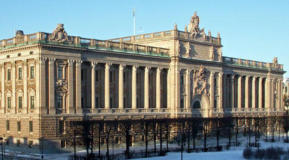
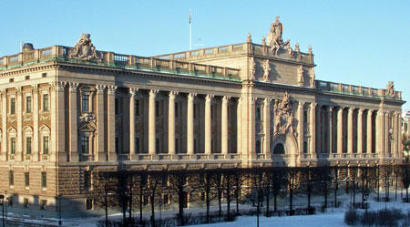
The image shows the current Parliament building on
Helgeandsholmen in Stockholm. Image: Wikipedia.
Universal suffrage for men in 1909:
Following a decision by the Parliament in 1909, the
proportion of men eligible to vote increased.
At that time, the Parliament decided to abolish the
so-called property qualifications—that is, the
requirement to have an annual income above a
certain amount or to own or lease a property with a
certain assessed value. This meant that a greater
number of men in the country gained the right to
vote.
It is therefore considered that universal suffrage
for men was introduced in 1909.
The voting age was 24. However, anyone who had
not paid their taxes or was dependent on social
services was ineligible to vote.
In 1909, a proportional representation system was
introduced for elections to the Second Chamber of
the Riksdag (Parliament). Prior to that, elections to
the Riksdag had been conducted as first-past-the-
post elections, primarily in single-member districts.
Universal suffrage for women:
•
On December 17, 1918, a specially convened
parliament (the Urtima Riksdag) decided to
introduce universal and equal suffrage for men
and women. This laid the groundwork for the
legislative changes that would grant women the
right to vote.
The right to vote is incorporated in the
Constitution, and altering it requires two legislative
votes, with a general election in between.
•
On May 24, 1919, the Parliament passed the first
of the two necessary parliamentary
resolutions to amend the Constitution to grant
women the right to vote (equal suffrage for men
and women). The voting age was lowered to 23.
The conditions were that men had completed
military service, were not bankrupt, were not
under the care of the poor relief system, and were
not serving a criminal sentence.
•
In the fall of 1920, a general election was held (in
which only men were still eligible to vote).
•
On January 26, 1921, the Riksdag passed the
second and confirmatory parliamentary
resolution on women’s suffrage. This amended
the Constitution, granting women the right to vote.
•
The first parliamentary election in which
women had the right to vote took place on
September 12, 1921.
This was also the first parliamentary election in
which women could be elected to the Riksdag.
So, by 1921, universal
suffrage for both men
and women had been
fully established in
Sweden.
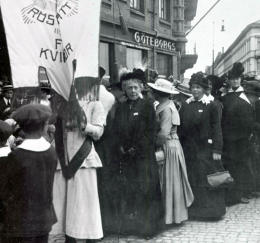
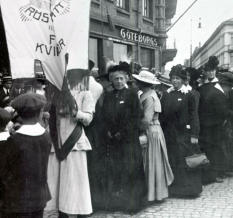
The image shows a
demonstration march for
women's suffrage in
Gothenburg, Sweden, in
June 1918. Photo:
Wikipedia.
Restrictions on the right to vote:
However, universal suffrage does not mean that
everyone has the right to vote. In 1921, the voting
age was 23. Today, the voting age is 18. Furthermore,
Swedish citizenship is required to vote in
parliamentary elections.
Anyone who had been declared bankrupt or placed
under the care of poor relief could not vote before
1945. Furthermore, until 1937, convicts lost their
right to vote, as those convicted of a serious crime
also lost the civic trust required to exercise that right.
The requirement to have completed military service
(conscription) in order to vote was abolished in 1924.
Until 1989, individuals could be declared legally
incompetent, in which case they lost their right to
vote.
In 1945, the voting age was lowered to 21; from
1965, it was 20; from 1969, 19; and finally, 18 from
1975 onward.
For more information, visit the page: The History of
the Swedish Riksdag
The Spanish Flu of 1918
In 1918, a severe influenza epidemic spread across
the globe and came to be known as the Spanish flu.
It reached Sweden in late June or early July 1918. The
total number of deaths caused by the disease in
Sweden has been estimated at just over 38,000.
However, the statistics are uncertain.
There was no specific cure. Food shortages during
the war, malnutrition (especially among the urban
population), and the resulting weakened immune
systems contributed to the rapid progression of the
disease. Symptoms of the Spanish flu included lower
back pain, high fever, sore throat, severe and rapidly
developing pneumonia, and even heart failure.
For more information, visit the page: Health Care and
Diseases in the Past
The Discovery of Penicillin
In 1928, the British scientist Alexander Fleming
discovered that the mold Penicillium notatum
produced a substance that killed bacteria. He named
it penicillin.
In 1939, Ernst Boris Chain and Howard Walter Florey
began experiments to produce larger quantities of
penicillin from broth cultures. Its bactericidal effect
was confirmed in large-scale clinical trials in 1942.
Mass production soon began in the United States,
saving the lives of tens of thousands of Allied
soldiers during World War II.
The first treatment with penicillin in Sweden took
place at Sabbatsberg Hospital, Stockholm, in 1944.
In 1945, Alexander Fleming was awarded the Nobel
Prize in Physiology and Medicine, along with Ernst
Boris Chain and Howard Walter Florey.
Major Cutbacks in the Swedish Armed
Forces in 1925
After the end of World War I in 1918, Sweden and
many other countries were convinced that the world
had learned its lesson and that no more world wars
would break out in the foreseeable future.
In a war-weary Europe, the slogan “No more war!”
rang out. The 1920s witnessed a period of détente
and disarmament. The threat from Germany and the
Soviet Union was now extremely minimal, and the
economic situation necessitated austerity measures.
But this peaceful coexistence was not to last very
long. In 1939, World War II broke out.
In 1925, the downsizing of the Swedish armed
forces began.
The Defense Review had completed its work in 1923
and presented a proposal on how to reduce the size
of the armed forces. The proposal advocated for the
armed forces to be tailored to the current situation.
The Swedish Parliament passed the Defense Act on
May 26, 1925, which went into effect on January 1,
1928.
The defense decision meant that Sweden adopted a
new military organization, which resulted in a
significant reduction of the defense forces, leading to a
decrease in the number of army units as well as a sharp
reduction in the training time for conscripts.
The 1925 Defense Decision remained in effect, for
the most part, until the 1936 Defense Decision.
In total, 10 infantry regiments, 8 cavalry
regiments, 3 artillery regiments, and 4 regiments
from the Army Maintenance and Supply Troops,
Army Engineers, and the Quartermaster Corps
were disestablished.
Examples of infantry regiments that were disbanded
as a result of the 1925 defense decision include the
Göta Life Guard, the Västmanland Regiment, the
Jönköping Regiment, the Kalmar Regiment, the Västgöta
Regiment, and others.
The main difference among the infantry regiments
that remained was that they were reduced by one or
two battalions from their previous strength of three
battalions.
Although the 1925 defense decision entailed a
significant reduction in military forces, it also marked
a transition to a new and more modern defense
system.
New Armed Service of the Armed Forces:
The Army Air Corps and the Navy Air Service were
separated from the Army and the Navy and formed a
separate armed service of the armed forces, the Air
Force, on July 1, 1926.
In 1928, the first anti-aircraft regiment was
organized within the Artillery Branch (A9) of the
service. In 1937, the anti-aircraft was granted
independent status within the artillery , and in 1942,
it became a separate branch of the army.
Motbok - A Way of Controlling Alcohol
Consumption Introduced in 1917
In Sweden, a system of controlling alcohol
consumption by rationing liquor, known as the Bratt
system, was introduced in 1917. The system was in
force until 1955, when it was abolished.
Every citizen allowed to consume alcohol was given a
booklet called a “motbok”, in which a stamp was
added each time a purchase was made at a liquor
store (Systembolaget).
The Motbok system, or Bratt system, was an
attempt to reduce alcohol consumption in
Sweden by regulating alcohol use. During the 1910s,
the physician and liberal politician Ivan Bratt
campaigned for regulations on alcohol sales to curb
alcohol abuse.
On August 27, 1922, a referendum was held on
whether Sweden should ban alcoholic beverages.
After the prohibitionists narrowly lost the
referendum, the permanent adoption of the motbok
system became a political
compromise between the two
sides.
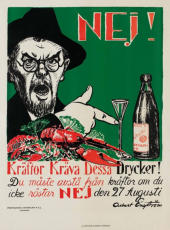
The image to the left shows a
campaign poster for the “No”
campaign against a ban on
alcoholic beverages, titled
“Crayfish Demand These Beverages.”
The poster was created by artist
and author Albert Engström.
Image: Wikipedia.
The Bratt system was a rationing system, so a
passbook, called “motbok,” was needed to record
purchases. Initially, the passbook was used only for
spirits, but it was later used for wine as well.
The liquor control system was fully implemented in
1917, and the state-run liquor stores, known as
Systembolaget, were granted a monopoly on all
alcohol sales.
The passbook (motbok) was a booklet with space
for stamps, where purchases were recorded to keep
track of the allocated rations. A passbook was strictly
personal and could not be lent to anyone else. To
obtain a passbook, one had to submit an application
to the relevant liquor store (Systembolag) and was
then registered as a customer. Purchases then had
to be made at that specific store.
The ration for alcoholic beverages was initially one or
two liters per month but was later increased to a
standard three liters.
However, it was the
individual’s social status
that determined the size
of the ration. Additional
allocations for weddings,
birthdays, and
entertainment were
routinely granted upon
request.
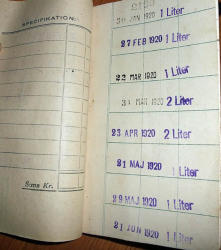
The image shows an
excerpt from a “motbok” at
the Åmål Systembolag in 1920, the purchases
section. Image: Wikipedia.
The Bratt system was completely abolished in
1955.
Systembolaget - Government-Run Liquor Stores:
In the mid-19th century, Sweden’s—and the
world’s—first alcohol monopoly was established in
Falun City through a private initiative by local miners
and a government decision. All alcohol sales in the
city were regulated and were to be conducted on a
non-profit basis.
In 1860, it became illegal to sell alcoholic beverages
to individuals under the age of 18, and the Alcohol
Production Ordinance prohibited home distillation.
In 1865, a state-regulated tavern, AB
Göteborgssystemet, also opened in Gothenburg.
AB Stockholmssystemet was a company founded in
1913, headed by the physician and politician Ivan
Bratt. Its purpose was to implement his temperance
policy, which was primarily characterized by limiting
the right to purchase a certain quantity of alcoholic
beverages per month.
During World War I, alcoholic beverages were heavily
rationed. An advisory referendum on the outlawing
of alcoholic beverages was conducted in 1922.
Opponents of prohibition won the vote. The Riksdag
subsequently decided not to ban wine, spirits, and
beer, but also to continue a restrictive alcohol policy.
The various Systembolaget liquor stores that existed
at that time were local companies with a monopoly
on alcohol sales in the respective cities where they
were located; in other words, they were separate
companies with slightly different names.
In 1955, the government merged the local
monopolies on alcohol sales into a new
government-owned company, Systembolaget,
which now held a monopoly on alcohol sales in
Sweden.
The “motbok” (passbook) was abolished as part of
this process, and the regulations were simplified and
clarified.
The government-owned Vin & Sprit (Wine &
Liquor) was founded in 1917 as Aktiebolaget
Spritcentralen, later AB Vin & Spritcentralen, in
connection with the introduction of the Bratt system.
When the Vin & Sprit Company was established, all
spirits producers and importers in Sweden were
compulsorily acquired and came under V&S’s control.
Existing brands were also taken over.
Vin & Sprit’s monopoly on the import and
wholesale trade of wine, spirits, and foreign strong
beer, as well as on the production and export of
spirits, was not lifted until 1994, in connection with
Sweden’s accession to the EU.
The Concept of Torp and Torpare (Croft and
Crofters)
In genealogy research for your Swedish roots, you
will eventually come across terms like "torp" (croft)
and "torpare" (crofter).
The term “torpare” has had slightly different
meanings over the centuries.
From the 17th century onward, the term “torp” also
came to refer to a small, tax-exempt agricultural unit.
It was usually located on private land, and the right
to use it was granted to a tenant (called a “torpare”)
who performed day labor or other services for the
landowner.
The crofting system, with its crofts and crofters,
became a way for the larger landed estates to secure
a labor force. The crofts were built on the estate’s land,
and the crofters were required to perform a certain
number of days’ work on the landowner’s estate each
year as payment for the lease. In other words, the
croft became a form of payment for labor on estates
and larger farms.
The crofters occupied an intermediate position
between the tenant farmers, who paid rent in cash,
and the farmhands and “statare,” who lived off work
paid for in kind.
Crofters, on the other hand, had their own
homestead—the crofts—as well as livestock and
associated farmland (which they leased). As
mentioned, the rent was paid in the form of days of
labor to the landowner. Crofts could be located far
from the estate.
The right to use the crofts was inherited.
There has been a similar system of crofts and
crofters in Scotland in the British Isles. However,
this system did not exist in England. So, the term
“crofter” is a British English term for a tenant farmer
who paid his tenancy with daily labor on the
landowner’s estate. The Swedish word “torp” is a
cognate with the English "thorp" (a secondary
settlement or small group of houses in the
countryside), which is found in many English
placenames.
The number of crofts (labor-tenure crofts) in Sweden
peaked in the 1860s, at around 100,000. However,
following the land reform of 1827 (“Laga Skifte”), the
rate of increase slowed. During the late 19th century
and early 20th century, the obligation to undertake
day labor was sometimes replaced by monetary rent,
and larger crofts often became tenant farms.
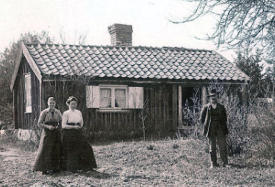
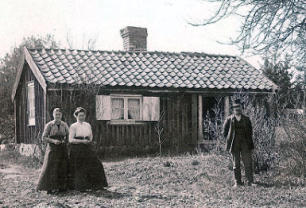
The image shows a
crofter with his
family in front of his
croft in Torsås
parish, Småland
(Kalmar County).
The image is used
with permission
from Morgan
Emilsson.
Day labor as a form of payment for the right to
use the crofts was banned in 1943 under the new
tenancy legislation. Thus, the crofter institution
came to an end.
For more information, see the page: Croft and
Crofters and The Old Agricultural Society and its
People
"Statare"—A Farm Laborer System Paid in
Kind
The “statare” farm laborer system emerged in the
mid-18th century and was not abolished until 1945.
The “statare” system originated in Södermanland
County and the Lake Mälaren region and was found
primarily in the vast plains of central and southern
Sweden. It did not exist at all in Norrland (the
northern half of Sweden).
The system of statare remained a phenomenon
associated with large landed estates, although the
occasional larger farm might also have had statare.
The “statare” were propertyless, landless, and
livestock-less; they were poor, married farm
laborers. They were typically hired on a one-year
contract basis and lived on the estates in special
farmhands' quarters, known as “statarlängor.” The
“statare” were married and were hired as a family
unit; that is, the wife was also expected to work.
Wages were paid mostly in kind, that is, in the
form of an agreed-upon benefit.
The one-year employment contract ran the last
week of October and remained in effect for one
year thereafter. It was during this week—known as
“slankveckan”—that they changed farms. When the
farmhand moved on, he received a leave of absence
form, which served as both a reference from his
former employer and proof that he was available for
employment.
Under the so-called "Legostadgan" (the Servant
Charter), the landowner may physically reprimand
and punish his employees. The “Legostadgan” was
not abolished until 1926.
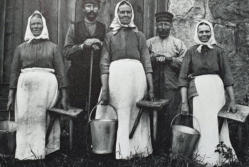
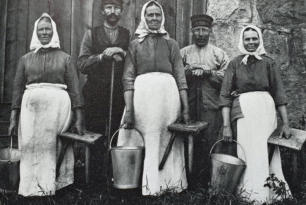
The image shows
“statare” farm laborers
(barnhands) and farm
maids (milkmaids) at
the Janslunda estate,
Ytterselö,
Södermanland, circa
1907. Photo by Martin
Söderholm.
The “statare” farm laborer system was finally
abolished in 1945.
For more information, see the pages: The Statare
System , Snickartorp (a statare lodging) under Berga
Estate
Sweden's Defense During World War II,
1939–1945
World War II was an armed conflict that lasted from
the fall of 1939 to the fall of 1945. The major powers
formed two opposing military alliances: the Allies
(primarily the United Kingdom, France, the United
States, and later the Soviet Union) and the Axis
powers (primarily Germany, Italy, and Japan).
World War II is considered to have begun on
September 1, 1939, with the German invasion of
Poland.
When World War II broke out on September 1, 1939,
Sweden, along with a number of other
countries—including Norway, Denmark, and
Finland—declared themselves neutral.
Thus during World War II, Sweden remained
neutral. Sweden did not actively participate in the
war, but the Swedish population was still indirectly
affected. Rationing was
introduced, civilian vehicles
were converted to run on
producer gas, and conscripts
were called up for military
service—the Neutrality Guard.
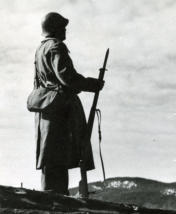
The image shows a Swedish
soldier on guard duty in
Värmland during the years of
heightened alert. Photo: Army
Museum.
On August 27, 1939, Sweden’s then-Prime Minister
Per Albin Hansson declared in a speech at Skansen
in Stockholm (open-air museum and zoo), with a
confident tone, that “our preparedness is excellent.”
The speech has often been quoted but also
misinterpreted. Following the 1925 defense decision,
which entailed major cutbacks in the
military—including the disbandment of regiments, a
shortened training period for conscripts, and officers
leaving the military—Sweden’s military strength was
not satisfactory. But what Per Albin Hansson was
referring to was rather Sweden’s civilian
preparedness, specifically the food and fuel supplies,
which were in excellent order.
The Swedish Armed Forces raised the alert level as
early as September 1, 1939, and a partial
mobilization was carried out, which meant that
conscripts were called up for standby duty in field
units as part of what was known as the Neutrality
Guard. Both younger and older conscripts were
required to perform standby duty for extended
periods. This entire period is also referred to as the
“years of readiness.”
The Finnish Winter War of 1939–1940:
After the Soviet Union and Germany signed the
Molotov–Ribbentrop Pact, the Soviet Union gained
considerable freedom of action with regard to the
Baltic states and Finland.
On November 30, 1939, the Soviet Union attacked
Finland, and the Finnish Winter War had begun. On
December 2, Sweden decided to mobilize an army
division of approximately 100,000 men to protect
the Swedish border with Finland.
When the Winter War broke out, Sweden made an
exception to its policy of neutrality, and in December
1939 the government declared that Sweden would be
a non-belligerent party alongside Finland in this
conflict. In other words, we sided with Finland in the
conflict without entering the war. This allowed
Sweden to send material support to Finland as well
as recruit Swedish volunteers to be deployed in
Finland.
The Swedish Volunteer Corps organized Swedish
citizens who had signed up as volunteers to fight on
Finland’s side in the Winter War. On December 21,
1939, the first troop of volunteers departed from
Stockholm. When the volunteers arrived in Finland
to serve in the Swedish Volunteer Corps, they were
required to sign an
employment contract, which
meant they were employed
by the Finnish armed forces.
The Swedish Armed Forces
had granted the Swedish
Volunteer Corps officers ans
soldiers leave of absence in
order for them to
participate.
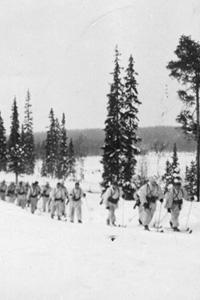
The image shows a combat
patrol from the Swedish
Volunteer Corps on skis in
snow gear, on duty at the
front in Finland during the Winter War. Photo:
Wikipedia.
A total of 8,260 Swedes were enlisted in the
Swedish Volunteer Corps. The Volunteer Corps
arrived at the Salla Front in late February 1940. The
Swedish Volunteer Air Wing in Finland, F 19
Finland, was a Swedish volunteer air unit that
formed an air wing (a fighter division and a bomber
division) that operated in Finland in 1940 during the
Winter War. On December 30, 1939, the Swedish
government decided to place war aircraft at the
disposal of the volunteer air unit.
Denmark and Norway were occupied by Nazi
Germany in 1940:
On April 9, 1940, German troops occupied
Denmark and Norway. At that time, the majority of
the Swedish armed forces were stationed along the
Finnish border in Norrbotten in the far north. On
April 11, 1940, general mobilization was therefore
initiated in Sweden, and the number of men under
arms was increased in a matter of weeks from
approximately 60,000 to 320,000.
From 1939 to 1945, more than one million Swedish
conscripts were called up for military alert service.
In February 1942, the February Crisis occurred,
when the Germans began building up a strike force
in Norway in preparation for a possible invasion of
Sweden. This was known in Sweden, as they were
able to intercept German communications, and in
response, a total of 300,000 men were mobilized for
a massive military exercise in Jämtland province near
the border with Norway. The units that were
mobilized were of a substantially different caliber
from those called up during the first state of
heightened readiness in 1939. They were well-
trained and highly skilled, and the mobilizations
proceeded quickly and efficiently.
In 1936, a modest rearmament program began,
focusing primarily on military weapons. Significant
resources were allocated to tanks, but the Air Force
was also modernized.
In 1942, the Riksdag enacted an important defense
resolution (FB 42), resulting in a significant increase
in the defense budget. Among other things, the
training period for conscripts was now increased to
450 days.
Starting on June 23, 1940, Swedish warships were
painted with white horizontal stripes on their decks
and sides so that they could be clearly identified as
neutral vessels.
After occupying Norway, the Germans demanded
access to Sweden’s telephone network to maintain
telephone communications with their forces in
Norway. Sweden consented to this, because it
enabled the Swedish military intelligence service to
intercept German communications. The
Cryptography Department, the predecessor to the
FRA (Swedish Defense Radio Establishment), was
responsible with intercepting German
communications.
However, German communications were encrypted
using a code that initially seemed impossible to
crack. This was due to the German G-cipher
machine. However, as early as the summer of 1940,
the Swedish Armed Forces' Cryptographic Unit IV
successfully cracked the German G-cipher in a
matter of weeks.
As a result, the Swedish intelligence service was able
to decode nearly 300,000 German messages over
the next few years.
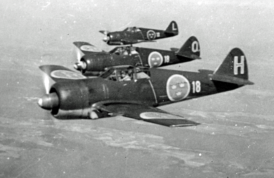
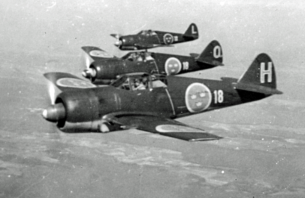
The Swedish Air Force was established as a
separate service of the armed forces on July 1,
1926. In 1936, a
major expansion of
the Air Force began
in accordance with
the 1936 defense
decision.
The image shows
three J22s, a
Swedish fighter
aircraft, during World War II.
As early as 1922, trials with tanks began in Sweden.
In 1928, a tank battalion was formed within the Göta
Life Guards (I 2). In 1939, the battalion was divided
into two armored battalions: one attached to the
Skaraborg Regiment (I 9) and one attached to the
Södermanland Regiment (I 10).
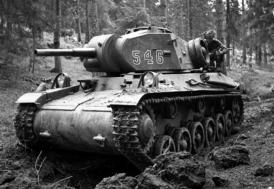
The Armored Troops were established as a
separate branch of the Swedish Army on October
1, 1942.
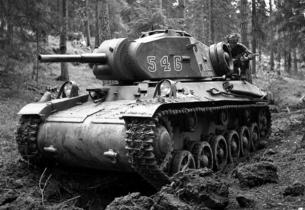
The image shows
the Swedish
M/1942 tank
equipped with a 7.5
cm gun during a
training exercise
during the years of
WWII. Image: The
Swedish Military
Archives.
In 1921, experiments with anti-aircraft defense
began within the artillery (A9). In 1928, the first anti-
aircraft regiment (A9) was organized. In 1937, anti-
aircraft defense was granted independent status
within the artillery, and in 1942, it became a
separate branch of the armed forces.
Following a parliamentary decision in 1940, the
Home Guard was established, thereby replacing the
former Landstorm. The Home Guard’s mission was to
serve as the first line of local defense in the event of
an enemy attack and to hold back the enemy until
reinforcements could arrive in the form of regular
troops.
Following the invasion of Norway, Germany
demanded that German personnel and equipment
be permitted to transit via Sweden before
reaching German troops in Norway. The government
initially refused this transit traffic, but before
negotiations were concluded, it permitted, from April
16 to June 10, 1940, that German soldiers on leave
and supplies be sent to Norway. Between June 1940
and 1943, large quantities of German supplies and
unarmed German soldiers were therefore
transported by train to and from Norway across
Swedish territory. On August 5, 1943, transit to
Norway was finally halted.
It should be mentioned, however, that German
fighter planes crossing the border into Sweden were
shot down without warning shots.
Rationing: A shortage of essential imported goods
soon arose in Sweden during the war. The National
Food Commission began distributing ration cards as
early as October 1939. The first rationing measures
took effect in March 1940 (coffee and tea). Sugar
was rationed in April of that same year, followed in
quick succession by most foodstuffs as well as
gasoline, firewood, and so on. After the peace in
1945, rationing gradually ceased, and the last item to
be deregulated was coffee (1951).
To compensate to some extent for the shortage of
motor fuels, many gasoline-powered vehicles were
converted to run on producer gas (wood gas).
Norwegian and Danish troops are being trained
in Sweden:
During WWII, approximately 50,000–60,000 refugees
came to Sweden from Norway, but a significant
number also arrived from Denmark (especially after
1943).
Drawing on this group of refugees, many of the
young Norwegian men were recruited, trained, and
equipped to form a Norwegian force in Sweden,
known as the “police troops.” In total, just over
15,000 Norwegians were trained in Sweden. The
Norwegian troops were issued a modified version of
the Swedish Army’s m/1939 field uniform. The
buttons, however, were replaced with new ones
bearing the Norwegian lion.
On January 12, 1945, approximately 1,300 men from
the Swedish-trained police troops entered Northern
Norway and relieved the Russian Red Army in
Kirkenes, Finnmark. At the end of the war, the
remaining troops were transferred to Norway, where
they were used for maintaining order and arresting
collaborators.
Just as Norwegian police units were deployed, a
Danish force—the Danish Brigade—was also
established in Sweden. However, there were
significantly fewer Danish refugees than Norwegian
ones. By the end of the war, the Danish Brigade
numbered approximately 3,600 men.
Since the deployment of foreign combat units in
Sweden conflicted with the declaration of neutrality
that Sweden had issued at the outbreak of war
between Germany and the Western powers in
September 1939, great effort was made to conceal the
true nature and scope of these operations from the
Germans; among other things, the term “police
troops” was used.
Operation Save Denmark:
Operation Save Denmark (RD) was a planned
Swedish military operation toward the end of World
War II aimed at liberating Denmark from German
forces stationed there. On May 4, 1945, Chief of
General Staff Major General C. A. Ehrensvärd
announced that planning for a landing in Denmark
was fully complete. The operation involved a landing
of significant Swedish army units supported by large
naval and air forces.
The objective was to crush all armed German
resistance on Zealand and to restore public order.
In May 1945, there were approximately 28,000
German troops stationed on Zealand, Denmark.
To accomplish this mission, substantial Swedish
forces would be deployed. In total, the Swedish
force comprised approximately 60,000 troops.
Additional military personnel included the crews of
the warships and Air Force personnel. The Danish
brigade was to be deployed in Operation Save
Denmark (RD) alongside the Swedish forces.
The plan was to launch the Swedish operation
around May 18, 1945. However, the German forces
in Denmark surrendered on May 5, 1945, before
the Swedish plan could be put into action; the
Germans were likely aware of what was in the works.
Immediately after the German troops in Denmark
surrendered on May 5, 1945, the Danish brigade
was transported by ship to Helsingør in
Denmark.
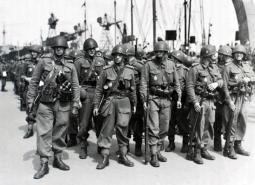
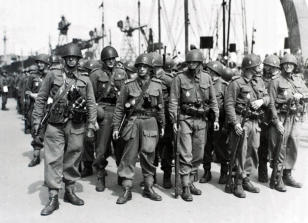
The image shows a
unit from the Danish
Brigade in the port of
Helsingør after
crossing over from
Sweden on May 5,
1945.
For more information,
visit the following pages: Sweden’s Military
Preparedness 1939 - 1945 , Swedish Military War
Units - WWII , The Norwegian and Danish Police
Troops in Sweden , The Organization of the Swedish
Armed Forces, 1900s , Swedish military intelligence
service , The Cryptography Department
Further: Swedish Volunteer Corps in Finland ,
Operation Save Denmark
The Cold War Era, 1945–1990
The Cold War was a period of intense confrontation,
though without conventional warfare, primarily
between the Soviet Union and the United States and
their respective allies, which lasted from around
1945 until around 1990, when the Berlin Wall fell
(November 9, 1989) and the Soviet Union
subsequently collapsed. The Cold War has, in various
ways, strongly influenced and shaped Europe.
During the Cold War, Sweden’s strategic geographical
and political position in Europe placed the country in
a delicate balancing act between the various power
blocs.
During the 1950s and beyond, approximately 60
modern coastal artillery batteries were built along
the Swedish coast. These were modern mountain
fortresses built in coastal rocks, and those
constructed in the late 1950s and later were
designed to withstand nuclear attacks as well as
chemical and biological attacks of that era. These
mountain fortresses were equipped with galleys,
canteens, storage rooms, sleeping quarters, toilets
and shower rooms, water and air purification
systems, diesel power plants, field hospitals
(including operating theaters), and rooms for staff
functions and fire
control.
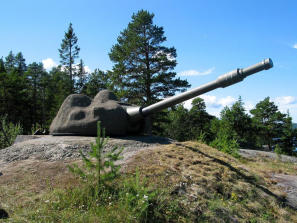
See also The History of
the Swedish Coast
Artillery
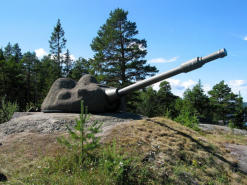
The image shows the
turret of a 7.5 cm
coastal artillery gun
(light turret gun) at
Hemsö Fortress during the Cold War.
The Swedish Security Service (Säpo) focused
primarily on monitoring the embassies of Eastern
European communist countries—particularly the
Soviet Union—as they were considered a threat to
Sweden’s security. Surveillance and wiretapping at
the Soviet Embassy provided Säpo with information
about their activities, including details on espionage
efforts and potential threats to national security.
In 1963, Sweden’s Air Force Colonel Stig
Wennerström was arrested after evidence emerged
that he was a spy for the Soviet Union.
NATO, the North Atlantic Treaty Organization, or the
Western defense alliance, was formed in 1949 and is
a military defense alliance based, among other
things, on collective defense, whereby members
have pledged to assist one another if any member
country is attacked.
After the Cold War:
After the end of the Cold War around 1990, a
gradual dismantling of Sweden’s defense forces
began. The dismantling of the Swedish defense
forces after 1990 is the largest such dismantling in
Sweden’s history to date. Sweden’s then-Social
Democratic government under Prime Minister
Göran Persson firmly asserted that now that the
Soviet Union had collapsed, there was no longer any
risk of war, and thus the Swedish defense forces
could be drastically downsized.
The Persson government believed there was no
reason to fund a defense force with the high level of
readiness that had previously been necessary. The
downsizing was so profound that a significant
portion of the Swedish military force was shut down.
Prime Minister Person silenced all opposition by
saying that if the security situation were to
deteriorate again in the future, they would simply
have to rearm.
The 2004 defense decision led to the largest unit
closures in Swedish history since the 1925 defense
decision. With a government led by the Moderate
Party (right-wing party) starting in 2006 under Prime
Minister Fredrik Reinfeldt, a rearmament would
have been very conceivable given the prevailing
security situation, with Russia heavily rearming. But
Reinfeldt had absolutely no interest in defense
issues; instead, he chose to gloss over the security
situation and had no plans to increase the defense
budget. He has said on several occasions that
defense was a “special interest” for him.
However, it became evident in the 2010s that a
military buildup cannot occur quickly. With
regiments disbanded, officers having left the service,
a significantly smaller number of soldiers, and
equipment and weapon systems that had been
scrapped or not replaced, the military buildup in the
2010s ended up taking a very long time.
The universal conscription system was inactivated
on July 1, 2010, in favor of a professional army
composed of voluntary enlisted soldiers contracted
for a specific time. No more draftees were called up
for military service after 2010.
However, the Swedish government decided on
March 2, 2017, to reactivate the conscription
system. The conscription system was never
disestablished in 2010, just inactivated.
Due to the security situation in our part of the world,
the government decided to strengthen the defense
capability by reactivating the conscription system.
Another reason to reactivate conscription was the
problem of recruiting enough soldiers voluntarily for
the professional units. The Armed Forces will
continue to consist primarily of professional soldiers
but will now also be supplemented by conscripts.
The new conscription system includes both men and
women.