History Hans Högman
Copyright © Hans Högman 2025-12-29

A brief overview of Swedish history

The following historical section is by no means complete from a historical perspective. The purpose of this page is to provide a chronological historical overview of events in Sweden that may have had a connection with or impact on the lives and livelihoods of my and others’ Swedish ancestors.

Swedish History in Brief (1800s)

xxxxx Swegen xxxxxxxxxxx

xxxxxxxxxxxxxxxxxxxxxxxx

1800s

The 19th century began dramatically for Sweden, but from 1814 onwards, the century was defined by peace. Gustav III was killed in 1792, and his son, Gustav IV Adolf, succeeded to the throne.

About Swedish Finland

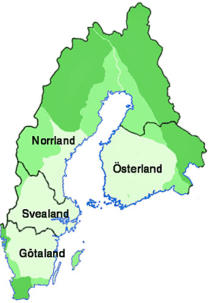
During the 12th century there was a Swedish expansion to the east. In the middle and at the end of the 13th century, we know there were Swedish crusades to Finland. Strongholds were constructed for the protection of the captured land, such as the castles at Åbo, Tavastehus, and Vyborg (east of the Gulf of Finland). A Swedish royal council was established, an administrative structure and a fiscal policy apparatus were created, and laws were codified during the 13th and 14th centuries. As a result, the “Eastern Land” (Österland) was firmly integrated into the Swedish Empire. In 1323, Sweden and Novgorod (Russia) signed a peace treaty that set the Sweden's eastern boundary. The western and southern parts of Finland became Swedish, while Russia gained the eastern parts. Finland now became a fully integrated part of Sweden and was under the same political and juridical administration as the rest of Sweden. So, Finland was never a “state” under Swedish rule but rather one of four Swedish so-called “greater regions”, or "lands" (Swedish: landsdelar), which included Svealand, Götaland, Norrland, and Finland. Swedish-speaking colonists settled down in the coastal regions of Finland. In 1362, the Finns were granted the power to send representatives to king elections, and in the 1500s, this right was expanded to include sending representatives to the Swedish parliament. Swedish was the primary language for administration, jurisdiction, the military, and higher education in Finland. Finnish was primarily a language spoken by farmers, clergy, and local courts in predominantly Finnish-speaking areas. Many regiments were established in the Finnish half of Sweden during the Swedish ”Great Power Period,” both infantry and cavalry. The soldiers in the regiments in Finland were Finnish, while the majority of the officers came from Sweden. The military command language was Swedish. There was a reason for this. When a soldier or an officer was transferred to another regiment, they had to understand the commands independent of where in Sweden the regiment was established. Gustav Vasa (reigned 1523–1560) made his second son, Johan, Duke of Finland. In 1594, the office of Governor-General of Finland was established as part of the restructuring of the administration of the Swedish Empire. Baron Clas Fleming was then appointed to the post. A governor-general was the senior military and civil authority over a region, which often included many provinces, and hence represented royal power. During the 17th century, several Swedish governorates were established both in the Baltic provinces and in Swedish border regions. After 1669, the appointment of governors-general over Finland ceased, except for 1710–1712, 1742- 1743, and 1747-1752. In 1634, administrative counties (Swedish: Län) were introduced in the Swedish Realm, which naturally also included the eastern half of the kingdom. During the Swedish period, which lasted until 1809, the region of Finland consisted of six provinces (and, from 1634, counties), and “the eastern half of the realm” constituted a so-called greater region in the same way as Götaland, Svealand, and Norrland in Sweden proper. The six provinces of Finland were called in Swedish: Egentliga Finland, Tavastland, Savolax, Karelen, Nyland, and Österbotten. In fact, there was no such thing as “Finland” early on during the Swedish era; instead, it was called Östra Rikshalvan” (the Eastern Half of the Realm) or “Österland” (the Eastern Land). However, there was one province in “Eastern Land” called “Egentliga Finland” (Proper Finland) or “Varsinais-Suomi” in Finnish. “Proper Finland” is located in the southwestern part of Finland (in the former county of Åbo och Björneborgs län), where Åbo (Turku) is the largest city. The map of Sweden shows the four greater regions (Swedish: Landsdel) of the Swedish kingdom until 1809. Image: Wikipedia. The stages of expansion are depicted in various shades of green, with borders at 1700. As can be seen, each of the greater region ends with the term "land," hence “landsdel” in Swedish. The name “Finland”: The origin of the name “Finland” is not really known, and it is not entirely clear when the Swedish name “Finland” began to be used as a term for the entire eastern half of the kingdom. During the 12th and 13th centuries, the name Finland referred only to one of the provinces in the eastern half, namely “Proper Finland” (Egentliga Finland). During the 14th century, the name “Österland” (the Eastern Land) began to be used as a term for the entire eastern half of the kingdom. However, during the 16th century, “Finland” began to be used more and more in parallel with “Österland.” For example, from 1556, John III was Duke of Finland (not Duke of “the Eastern Land”). From the 17th century until 1809, Finland, or “Eastern Half of the Kingdom,” was the established name for the region. Note, “Finland” is called “Suomi” in the Finnish language. So, Swedish and Finnish history are, of course, closely interrelated.

Loss of Finland in 1809

The War with Russia 1808-1809: The 19th century began with several wars for Sweden. Between 1805 and 1807, Sweden was at war with France in Swedish Pomerania in northern Germany, between 1808 and 1809 with Russia in Swedish Finland, and in 1808 with Denmark. Between 1813 and 1814, Sweden was at war with France and Denmark (the Napoleonic Wars) and in 1814 with Norway. The Finnish War was fought between Sweden and the Russian Empire from 1808 to 1809. Sweden was supported by the United Kingdom, whereas Russia was supported by the French Republic and its various allies (including Denmark-Norway). The war was fought as part of the Napoleonic Wars. The conflict broke out after Tsar Alexander I of Russia and Emperor Napoleon I of France signed a peace pact in Tilsit in July 1807. The agreement obliged Alexander I to attack Sweden if the country did not break off its relations with Great Britain and join Napoleon's trade blockade against Great Britain. Sweden had been in alliance with Great Britain since the Pomeranian War, and the Swedish monarch Gustav IV Adolf refused to agree to the French demands. In principle, Napoleon and Alexander divided Europe into different spheres of interest. Alexander was given free rein to invade Swedish Finland. On February 21, 1808, in the middle of a cold winter, Emperor Alexander's Russian troops cross the Swedish-Russian border into Finland. The Russian force numbered 24,000 men. The attack took place without an official declaration of war. The Swedish field army numbered approximately 21,000 men in Finland, of whom approximately 7,000 were stationed at the fortresses of Sveaborg and Svartholm. Since it was the middle of winter and the Gulf of Bothnia was frozen over, it was not possible to ship reinforcements from Stockholm to Finland at that time. The Swedish forces in Finland would have difficulty defending the whole of Finland against the Russians. The plan was for the Swedish army to retreat northwards in Finland while awaiting reinforcements, while the southern parts were abandoned and occupied by the Russians. The Swedish defense in the south was maintained with the support of the fortresses of Sveaborg and Svartholm. When spring arrived and the Swedish army was at full strength and reinforced, the plan was to launch a counterattack from the north and, with the help of the navy and the troops in the fortresses in the south, recapture the whole of Finland in a pincer movement. The Swedish fortress Sveaborg, located outside Helsinki (Helsingfors) in Finland, is one of the world's largest sea fortresses. It encompasses several islands at the entrance to Helsinki and is also known as the “Gibraltar of the North.” When the war began, Vice Admiral Carl Olof Cronstedt was commandant at Sveaborg. But Cronstedt turned out to be a traitor. The defense of Finland depended on Sveaborg holding out against the Russian siege. However, it was unlikely that the first Russian force alone would be able to capture Sveaborg as long as there was gunpowder in the fortress, where 7,000 men and the entire Swedish archipelago fleet with over 200 ships were stationed. In total, the fortress itself also had over 2,000 cannons. Russian troops entered Helsinki across the ice on March 2, 1808. On March 23, Cronstedt met with Russian negotiators, and on April 6, Cronstedt agreed to surrender to the Russian commander in Helsinki. This was completely contrary to Cronstedt's orders to hold the fort. He did not have the authority to do this. After the surrender, Cronstedt defected to the Russians. The surrender of Sveaborg was a heavy blow to Finland's defenses, and now it became even easier for the superior Russian forces to occupy Finland. Denmark has always had a habit of attacking Sweden when Sweden has been at war with other nations, and this time was no exception. On March 14, 1808, Denmark (aligned with France) declared war on Sweden, which tied up the main army in Sweden on the western border. This meant that Sweden now faced a two-front war. Throughout the conflict with Denmark, the British navy was a help to Sweden and posed a threat to any Danish landings. The war in Finland went badly for Sweden and led to Sweden having to cede its eastern half. The peace treaty was signed in Fredrikshamn on September 17, 1809. The Russians demanded the six provinces that made up Finland at the time, plus parts of Västerbotten County and the Åland Islands. The Finland region of Sweden consisted of six provinces in the southern and central parts of the eastern half of our country. The northern part of present-day Finland was then part of the Norrland region of Sweden, or more precisely, part of Västerbotten County. The Åland Islands, east of Stockholm, were part of the Svealand region of Central Sweden. Before 1809, the old border between Finland and the rest of Sweden ran considerably further south in Finland than it does today. In practice, what is now northern Finland was then part of the Västerbotten County. The final border between Sweden and what then became Russian Finland was drawn along the Torneå and Muonio rivers. The map shows Sweden’s borders after the peace in 1809. With the peace, Sweden lost around one-third of its territory and one-quarter of its inhabitants. In accordance with the peace treaty, Finland now came under Russian rule and formed the Russian Grand Duchy of Finland. The peace treaty with Denmark was signed in Jönköping on December 10, 1809, with no alterations to boundary borders.

Gustav IV Adolf is Deposed from the Swedish Throne

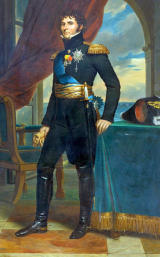
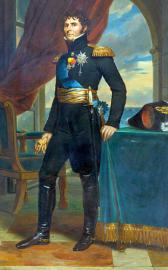
Gustav IV Adolf, Sweden's regent, had no admiration for Napoleon and the French Empire; quite the contrary. His distancing himself from Napoleon and his sometimes exaggerated and willful pride and self-image meant that his decisions were not always based on common sense and facts. As King of Sweden, Gustav IV Adolf led the military campaign. On March 13, 1809, Gustav IV Adolf was deposed from the throne in a coup d'état. Formally, pending a new heir to the throne, Duke Karl took power as Karl XIII. Karl XIII was a younger brother of Gustav III. The coup d'état of 1809 was a rebellion against Gustav IV Adolf. The background to the coup d'état was mainly the military defeats in the Finnish War and the growing dissatisfaction with how the country was being governed. Gustav IV Adolf's foreign policy was widely disliked, and his anti-French position had terrible implications for Sweden. However, the main reason was dissatisfaction with autocracy. His poor and ineffective leadership was also blamed for the unsuccessful war in Finland. The conspirators had their strongest power resources within the western army. It was agreed that as soon as word came from the conspirators' headquarters in Stockholm that the time was right, Lieutenant Colonel Georg Adlersparre would lead reliable troops in a march on the capital. Gustav IV Adolf decided to travel to Skåne in southern Sweden on March 13 to seek support from the army there, which was led by Johan Christopher Toll, who was more loyal to the king. Then a group of nobles led by Carl Johan Adlercreutz intervened and captured the king at Stockholm Palace. During the night, Gustav Adolf was taken as a prisoner of state to Drottningholm Palace, from where he was soon transferred to Gripsholm Castle. Among other things, the revolution resulted in the irreversible loss of the Swedish crown by the king, queen, and their heirs. Instead, Gustav Adolf's uncle Duke Karl became the new king. The king, queen, crown prince, and other royal children were stripped of their Swedish citizenship and expelled from Sweden for good. However, Karl XIII was in his sixties and had no children. This meant that there was no heir to the Swedish throne. New heir to the throne: On July 18, 1809, the Danish-Norwegian Prince Christian August was elected as the new heir to the Swedish throne and was to succeed the elderly and childless Karl XIII, who would wear the crown until his death. However, Crown Prince Karl August died unexpectedly on May 28, 1810, at the age of only 41. However, a few months later, something strange happened: a French military officer and nobleman was chosen as the new crown prince of Sweden instead. It was the Prince of Ponte Corvo, Jean Baptiste Bernadotte. When Karl XIII died in 1818, Bernadotte was crowned as king of Sweden with the royal name Karl XIV Johan. The image shows Sweden's Crown Prince Karl Johan wearing a Swedish general's uniform in 1811 (reigned as King Karl XIV Johan from 1818 to 1844). Painting by François Gérard. Image: Wikipedia.

1813–1814, War with France and Denmark

In accordance with the conventions of Saint Petersburg and Stockholm (April 5 and 9, 1812), Sweden committed itself to actively participating in the fight against Napoleon in exchange for Russia's promise to work toward Sweden's acquisition of Danish Norway. In the spring of 1813, Sweden transferred 30,000 men to Germany to participate in the war against Napoleon. Swedish Crown Prince Swedish Crown Prince Karl Johan was assigned leadership of the so-called Northern Army, which consisted of Swedes as well as approximately 95,000 Prussian and Russian soldiers. Under the circumstances, Karl Johan attempted to save the Swedish troops for the impending Swedish attack on Denmark (which was allied with France), when the Danes would be forced to cede Norway to Sweden. At the end of 1813, Karl Johan moved northwards to Holstein to force Denmark to capitulate. After the battle at Bornhöved on December 7, 1813, the surrender of Frederiksort on December 19, and Glückstadt's capitulation on January 4, 1814, Denmark was also forced to yield and, in the Treaty of Kiel on January 14, cede Norway to the King of Sweden.

Union Between Sweden and Norway

The Norwegian resistance to the Treaty of Kiel led to a Norwegian declaration of independence and the adoption of a Norwegian constitution, the Constitution of Eidsvoll, on May 17, 1814. From a Swedish perspective, this meant that Sweden had to subdue Norway by force unless the Swedes wanted to renounce the gains of the Treaty of Kiel. But giving up Norway was not an option for Crown Prince Karl Johan, which is why an invasion of Norway was planned. The battle-hardened Swedish main army of approximately 45,000 soldiers entered Norway at dawn on July 30 1814, with Fredriksten Fortress as their first target. On August 4, 1814, the Norwegian defenders of Fredrikstad raised a white flag on the fortress ramparts. At around eight o'clock in the evening on August 14, 1814, the Norwegian negotiators signed the Convention of Moss. Crown Prince Karl Johan, representing the Swedish king, secured an agreement with the Norwegian Parliament. In the weeks following the armistice, negotiations continued on how the Eidsvoll constitution should be adapted to the union solution, i.e., a revision of the Norwegian constitution to enable a personal union with Sweden. The Convention of Moss of August 14, 1814, meant that Danish King Kristian Fredrik abdicated the Norwegian throne and that Norway entered into a personal union with Sweden. Sweden's King Karl XIII became the joint king of both Sweden and Norway. A personal union is a union between two or more states with a common head of state, in this case, the King of Sweden. The union between Sweden and Norway was dissolved in 1905. More information about the union is available at Union Between Sweden and Norway

Conscription

One of the weaknesses of the military allotment system was the problem of obtaining sufficient reinforcements. During the war with Russia in 1808–1809, it became clear that something had to be done about the allotment system in order to obtain a sufficient number of reserve soldiers. On October 27, 1812, the Swedish Parliament passed an act that introduced a conscription system to supplement the regular army. The name of the conscription system was Beväringen. At the age of 21, young men were called up for registration and then underwent a short period of military training. Initially, the training period was only 12 days, but in the 1850s it was extended to 30 days. The military training period was subsequently extended several times, reaching 90 days in the 1890s.

Peace, the Vaccine, and Potatoes

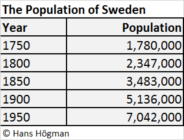
During the 17th and 18th centuries, Sweden was at war for very long periods of time. This had a very adverse impact on population growth. Since 1814, however, Sweden has enjoyed a long period of peace. This had a positive effect on population growth. In Sweden, between 1749 and 1800, 270,000 people died from smallpox. Edward Jenner, a Brit, developed a smallpox vaccine that may be used to prevent the disease. The Swedish authorities were early to take advantage of Edward Jenner's discovery. The first smallpox vaccination in Sweden was carried out on 23 October 1801. In 1816, Sweden became the first country in the world to legislate that all children under the age of two should be vaccinated against smallpox. The result was a reduction in mortality. However, there were other epidemics that were a problem during the 19th century, including cholera. Five epidemics ravaged Sweden between 1834 and 1873. There was no vaccine against cholera. Another reason for the decline in mortality was diet. This is where potatoes come into the picture. It was nutritious and naturally provided calories, but more importantly, it supplied vitamins that built resistance to many diseases. Another important reason for the decline in mortality was the realization of the importance of hygiene, particularly in connection with childbirth, which, above all, reduced the high infant mortality rate. The chart shows Sweden's population growth since the census began in the mid-1700s. From 1750 to 1850, the population roughly doubled. Agriculture remains the foundation of our economy but is undergoing major changes. Arable land is increasing through new cultivation. Drainage and crop rotation are increasing yields. Education and campaigns are introducing new crops such as potatoes, improved cultivation methods, and more efficient tools. So, it is fair to say that peace, the vaccine, and potatoes were three important prerequisites for development.

Society is being reformed

The mid-19th century was a time of many reforms. Examples include the Elementary School Act of 1842, equal inheritance rights for men and women in 1845, majority capacity for unmarried women in 1858, and the elimination of guilds in 1846. A bicameral parliament was established in 1865 to replace the ancient Parliament of the Four Estates. The nineteenth century also saw substantial land reforms, which resulted in significant improvements in agricultural.
Land Distribution Reforms

The arable land was expanded in the 1800s through land reclamation. Ditching and crop rotation raised the yield. During the same time, there were significant social changes, not least in farming. The gradual realization of the massive redistribution of land ownership helped agriculture. The purpose of the redistribution was to gather each farmer’s fields into as few as possible—rather one large field than several small ones. The sun distribution of land (Swedish: solskiftet) has regulated the farming of land in Sweden's rural settlements since the Middle Ages. In a so-called farming village, each farmer owned a portion of each individual piece of arable land and meadows owned by the village, forming a community of shared ownership. So, each farmer in the hamlet held a strip of land in each of the village's fields. The size and number of these strips of land were proportional to the farmer's share in the farming village. All farmhouses were grouped together like a village, often with a church in the center, hence the term "farming village." The farmland surrounded these farming villages. Every single field owned by the village was divided into several small bits of parcels and each villager had his share in the respective field. It was impossible to gain access to one's parcel of farmland if the parcel next to it was not harvested simultaneously. Even if an individual farmer wanted to change his farming methods, he couldn't unless the others did as well. This was, of course, counterproductive. Therefore, various land reforms were initiated to make agriculture more efficient. These land reforms were private initiatives but were supported by the government. It was voluntary for each farming village to adopt the reforms. The aim of the reforms was to give each farmer as large a contiguous area of arable land as possible, rather than several small parcels of land. There have been three major land reforms: Storskifte, Enskifte, and Laga skifte. The Storskifte Reform: The first modern land reform implemented in Sweden was the Storskifte reform. To modernize the farming and to get a better yield of the land, there was a parliament act taken in 1749 called "Storskifte" (The Great Redistribution of Land Holdings). According to the law of 1734, a new redistribution of land could not take place unless all the landowners in the farming village agreed to it. The 1749 law made it possible for a co-owner in a farming village to request a redistribution of land, which then also included the other owners' plots, i.e., an attempt to consolidate the farmers' land into larger parcels. The Storskifte reform was carried out in large parts of the country between 1758 and 1827. However, the redistribution wasn't radical enough. There were many compromises. The farmland was still split into many parcels of land, and the individual farmer was still dependent on his neighboring farmers. The Enskifte Reform: The Enskifte reform was initiated by Baron Rutger Maclean, owner of the Svaneholm Estate in Skåne province. Between 1782 and 1785, he divided his estate's land into quadratic parts, and the tenant farmhouses in each village on his land were relocated to each square, i.e., to each farm's attached farmland. So, on the Svaneholm Estate, each tenant farm was now located on each farmer's arable land, resulting in a coherent expanse of farmland. This way of distributing the land (the Svaneholm way) became the model of the next redistribution reform, the "enskiftet," which was established for southern Sweden in 1803-1804. The "enskifte reform" was a further development of the "strorskifte reform." The basic difference in the "enskifte" was that the farmhouses were moved into each farmer’s farmland. The "enskifte reform" was best applied on the plains of southern Sweden. The Laga Skifte Reform: In 1827, a land distribution law, known as "Laga Skifte," was passed, allowing land reform to be implemented across Sweden. The "laga skifte" was accomplished by the middle of the 1800s. This reform involved the relocation of many farmhouses from the farming villages into each farmer's allocated farmland. It was sufficient for one co-owner of a farming hamlet to request a land redistribution under the 1827 redistribution statute for the village's land to be redistributed. The land redistribution, including farm relocation, meant that farmers were no longer as reliant on each other as they had been in the farming villages, and they no longer needed to cross someone else's field to reach their own. When land redistribution was to be carried out in a village, a land surveyor was sent to measure the farmers' land, distribute it, and draw up land redistribution maps (Swedish: skifteskartor.) During the land redistribution process, a land classification was carried out to ensure a fair distribution of land. The landowner who was assigned land of lower quality could be compensated by receiving a larger plot of land. The total value of the homestead before and after the redistribution would be the same. The farmers were reimbursed for the cost of tearing down the old buildings, moving them, and rebuilding them at the new place. As a result, many countryside villages disappeared from the map. In parts of Sweden, the land reform was never carried out, especially not in Dalarna province. More information about the reforms is available at Swedish Land Reforms

Sweden Industrializes

Industrialization begins in the middle of the century. The sawmill industry is the first to start. Many sawmills are established along the Norrland coast. The old farming society of Sweden undergoes fundamental changes. New communities spring up, and an industrial working class emerges. By 1900, almost one in three wage earners works in industry. Several inventions contributed to industrialization, such as the steam engine, steel production, and, not least, the propeller. The steam engine made it possible to establish works where it was most convenient. Previously, works and mill had to be built along streams to harness water power. The industry had shifted to the cities, and so had the laborers. Around the city of Sundsvall in Medelpad province, Mid-Sweden, the country's first steam sawmill was built in 1849, and it was soon followed by so many other similar facilities that the Sundsvall district became one of Sweden's most important industrial areas with connections to countries all over the world. The establishment of steam sawmills was quickly followed by the establishment of pulp mills and paper mills. The poet Elias Sehlstedt coined the famous saying "Sawmill by sawmill I saw, wherever I looked" ("Och såg vid såg jag såg, varhelst jag såg") after visiting Sundsvall and being impressed by the large number of sawmills in the area. The railroads connected Sweden in a whole new way. Construction of railroads began in the middle of the century, and in 1862 the first line, the Western Trunk Line (Swedish: Västra stambanan) between Stockholm City and Gothenburg City, was inaugurated. Two years later, in 1864, the Southern Trunk Line (Södra stambanan) to Malmö City was opened. Goods could now also be transported by land using steam locomotives. The steam engine would also revolutionize shipping. Steamboats made people less dependent on the weather. However, it took until the turn of the century before the number of steamships reached the same level as sailing ships in the transport industry. Steamships could be built in iron and became both larger and faster. The Swedish Navy underwent major changes during the 19th century. The first steam-powered warship was the steam corvette HMS Thor, which was completed in 1841 and the first propeller-driven warship, one of the first in Europe, was the steam corvette HMS Gefle. The navy's first steam-powered iron ship was the paddle steamer HMS Kare, which was launched in 1847. The Swedish export of iron to the United States increased in the beginning of the 19th century and became quite significant by that time.

The Birth of Popular Movements

Social and economic changes are the backdrop to popular movements; the Working-class movement, Free Church movement and the Temperance movement. The goal was an eight-hour working day, the abolishment of the Swedish State Church, and alcohol prohibition. The demand for universal suffrage grew. The suffrage at the time was based on income or private means, and only 20% of the men of age had the right to vote. Universal suffrage for men was introduced in 1909, but not until 1919 did women receive the right to vote. The first Swedish general election when women could vote for the first time was held in 1921. When liberal Nils Edén and social democrat Hjalmar Branting formed a coalition government in 1917, parliamentarianism (i.e. power held by the majority in parliament) was put into reality.

1842 Elementary School Act

In 1842, a bill was passed introducing universal elementary education in Sweden. According to the 1842 Elementary School Act (Swedish: Folkskolestadgan), there was to be at least one school in every rural parish and urban municipality. This school was to be permanent and have an approved teacher. The requirements were thus one school per parish and at least one teacher per school. There was no division into classes; all age groups were to attend the same class. The school was to be run locally, i.e., by the local administration. It should be noted that when the public elementary school system was formed in 1842, children were not required to attend school. This was a concession to the peasantry in parliament to allow the Elementary School Act to be passed. The farming community, for whom the school was primarily intended, was moderately interested and not convinced that it was necessary. Compulsory schooling was first introduced with the 1882 Elementary School Act. More information is available at Swedish School History

The Emigration from Sweden

During the period beginning in 1850 and ending in 1930, about 1,250,000 Swedes emigrated from Sweden to North America. Roughly 200,000 of these emigrants returned to Sweden. There was an early emigration from Sweden to North America too, beginning in the 1830s, but this was a modest one. The huge wave of emigrants from Sweden started after the American Civil War, i.e. after 1865. During the 19th century, many Swedes began to dream of America. The early settlers went there in protest against Sweden. They were liberals, free church members, or teetotalers who protested against conservative Sweden. In the mid-1800s, a new wave of travelers set off for America. This time around, landless farmhands and farmers' sons set out to cultivate their own land in the new country. Two consecutive years of poor harvests and famine in the 1860s accelerated emigration, with 40,000 people emigrating in 1869 alone. Towards the end of the 19th century, most emigrants came from southwestern Sweden, but shortly after 1900, people from northern Sweden also began to leave. A large proportion of those who emigrated from Sweden to America settled in the state of Minnesota and in the city of Chicago (IL). The early emigrants had to organize the journey to the United States by themselves. There were no passenger ships across the Atlantic at this time. Instead, these emigrants had to travel as “ballast” aboard the cargo sailing ships carrying iron. This was not a comfortable way of traveling; the conditions were very bad, and the journey could take up to 3 months, or at least 1 1/2 months. From the 1860s there were pure passenger sailing ships, and from the 1880s there were fast steamships where the comforts of the passengers were in focus. The traveling time was reduced to between 16 and 24 days. There was no direct passenger traffic between Sweden and North America during the era of the mass emigration. Instead, the Swedish emigrants had to travel by ship from Gothenburg to England and from there on passenger ships to the United States. The first direct line from Sweden to the United States opened in 1915: the Swedish American Line (SAL). Between 1820 and 1930, over 1.2 million Swedes emigrated to America. This meant that in 1910, one in five Swedes lived in the USA. More information is available at The Emigration from Sweden to North America

1862: Local governments are being reorganized, and regional self-government is being introduced

Since medieval times, Sweden’s rural areas have been divided into smaller entities called “socken.” There were two purposes of the “socken”: the parish church and local administration. So, inside the same body, there was the church and its congregation (church socken) and an administrative section for local administration (worldly socken). "Socken" is translated into "parish" in English. The governance of cities and the churches within them was arranged differently. Local governments: Until 1863, local administration of the parish (Swedish: socken) was handled by the parish council (Sockenstämman). Sockenstämman” was the highest decision-making body in each “socken. The parish minister headed the local church and served as the obvious chair of the parish council (sockenstämman). So until 1863, the “socken” had two functions integrated into one and the same body, partly as a church parish (rural parish) and partly as a worldly socken (parish municipality), which was the local government. In 1862, a bill was passed in the parliament called kommunalförordningen (the municipal ordinance), which ended the concept of the socken. The parish was now broken up and divided into two separate units. The new ordinance came into force on January 1, 1863. The Municipal Ordinance of 1862 meant that the previous administrative body, “socken,” was replaced by two different types of municipalities called “kommun”: 1. a civil “kommun” (municipality,) i.e., local administration called “landskommun. 2. an ecclesiastical municipality (“Församling,” i.e., church parish); Both have independent bodies and tasks. There were now different types of civil municipalities: 1. Rural municipalities in the countryside — “Landskommuner 2. Cities Between 1863 and 1970, the “Kommunalfullmäktige” (municipal council) was the name given to the highest elected political decision- making body in a “Landskommun” (rural municipality). However, the “Kommunalstämma” (municipal assembly) was the highest decision-making body in all small municipalities. From 1863 to 1970, the “Stadsfullmäktige” (city council) was the highest elected decision-making body in a city in Sweden. The reform of 1862 resulted in the establishment of around 2,500 municipalities in Sweden. This led to municipalities varying greatly in terms of size and population density. The 1952 municipal reform lowered the number of municipalities from 2,498 to 1,037 by mergers. The municipal ordinance of 1862 thus laid the foundation for the current municipal system in Sweden. The municipality's main tasks include schools, elderly care, social welfare service, firefighting, local infrastructure, water and sewage, sanitation, and local power distribution, among others. A Swedish “kommun” is about the same thing as a US county. The 1971 municipal reform: On January 1, 1971, a uniform municipal type was introduced, when all former rural municipalities, cities, and market towns were reorganized into municipalities only. The municipal reform of 1952 soon proved to be insufficiently radical. Consideration was now given to the central town principle. Towns and rural areas would together form unified municipalities in which the town, or another larger urban area, would serve as the central town for the surrounding area. Usually, several rural municipalities were consolidated with the adjacent town to form a single municipality called “kommun.” For example, there were several rural municipalities (Landskommun) around the city of Sundsvall, including Njurunda, Matfors, Indals- Liden, and Stöde, which were now consolidated with the city of Sundsvall to form the municipality of Sundsvall (Sundsvalls Kommun). The US term “consolidated city-county” probably best describes these new municipalities called “Kommun.” More information is available at Subdivisions of Sweden and The Concept of Socken Regional self-governance: The 1862 municipal regulations also established “Landsting” (county councils) to take care of areas that were too large for a municipality to manage. County councils were a new self-governing body, controlled by an elected assembly, for regional administration within a county. So, from 1862, the new regional authority was called the Landsting (County Council). In 1634, Sweden was divided into several regional units called Län (counties). The counties were an instrument of the Crown for regional control of the country. In each county a county governor was appointed by the government, heading the “Länsstyrelse” (County Administrative Board). In 1862, when the “Landsting” (County Council) was established as an entity for regional administration, a Landsting was created in each of the already existing counties. However, county councils and county administrative boards are two completely different entities, even though they are located in the same territorial area. The names of the individual county councils include the name of the county in which they are located, for example, “Västernorrlands Läns Landsting” (Västernorrland County Council.) The “Landstingsfullmäktige” is the highest decision-making body in each “Landsting.” In 2015, the responsibilities of the county councils were expanded, and they were renamed “Regions.” Thus, “Västernorrlands Läns Landsting” became “Region Västernorrland.” The major responsibilities for the County Council are public health care, including dental care, and public transportation.

The Bicameral Parliament of 1866

The medieval Riksdag of the Four Estates was abolished in 1865, and a bicameral Riksdag was established. As of 22 June 1866, a new Parliament Act entered into force—Parliament met on an annual basis. The First Chamber (Första kammaren) was mainly represented by the upper classes. The Second Chamber (Andra kammaren) was more popular in character. Members of the Second Chamber had a shorter term of office than those of the First Chamber. The preparation of parliamentary matters would take place in joint committees of the two chambers. However, the second chamber had a majority in joint votes due to its larger number of members. The First Chamber was the name given to the indirectly elected upper house. The Second Chamber was the name given to the directly elected part of the bicameral parliament (the lower house). In 1970 the bicameral Riksdag was abolished and replaced by a unicameral Riksdag (Swedish: Enkammarriksdagen). More information is available at The History of the Swedish Riksdag

Transition to the Metric System in 1878

In 1665, Sweden adopted a standard measurement system covering the whole nation. An adjustment of that system was made in 1735. A major change to the measurement system was introduced in 1855 when the decimal system was adopted. In other words, Sweden already had a decimal system when the metric system was introduced. Our present system, the metric system, originates from France. The Metric System was introduced after the French Revolution in about 1795. Sweden adopted the metric system in 1878, and over a ten-year period, Sweden changed from the old measurements to the metric system. Since January 1, 1889, the metric system has been the only legal system for measurements in Sweden. More information is available at Old Swedish Units of Measurement

The Monetary Reform of 1873

When Sweden entered the 19th century, the Swedish currency was the “Riksdaler.” In 1855 a decimal monetary system was introduced in Sweden. The new name of the unit was “Riksdaler Riksmynt” and was divided into 100 öre. In 1873, the Riksdag, or Parliament, authorized a monetary reform. Sweden's currency became the “krona,” which was divided into 100 öre, i.e., 1 krona = 100 öre. “Krona” (or short: Kr) is singular, while “kronor” is plural. It is today abbreviated SEK. At the same time, Denmark and Norway also switched to the new currency, “kronor.” More information is available at The History of the Swedish Monetary System

Banking

Modern commercial banks started in the early 19th century. The first was Skånska Privatbanken, founded in Ystad in 1831. This private issuance of banknotes lasted from 1830 to 1904, when the Riksbank (Central Bank of Sweden) obtained a monopoly on all banknote issuance. Stockholm Enskilda Bank, founded in 1856 by A. O. Wallenberg, started a new way of thinking by building its business on deposits. Banks soon changed their corporate form to limited companies (corporations). The first savings bank in Sweden was established on 28 October 1820. In the beginning, deposits were the most important thing for the savings banks, but after 1839, lending became as important as deposits. More information is available at The History of Swedish Banking

Religious Freedom in 1858

Sweden was, according to its constitution, a Christian country with a state church, the Church of Sweden. It was the only church to which Swedes could belong, and it was (is) an Evangelical Lutheran Church. Sweden adopted a new Church Act on January 12, 1726, the so-called “Konventikelplakatet” (The Conventicle Article), which banned all pious meetings outside the control of the Church of Sweden, such as Bible reading and prayer meetings in people’s homes headed by laymen. The article was debated at several Parliament meetings but was not abolished until 1858. A religious meeting that was not headed by a parish minister from the Church of Sweden was still not allowed during the regular hours of public worship without special permission. However, this last restriction was abolished on December 11, 1860. Then it became possible to hold religious meetings during regular hours of public worship, but not so close to a church that they disturbed the regular church service.
History Hans Högman
Copyright © Hans Högman 2025-12-29

A brief overview of Swedish

history

The following historical section is by no means complete from a historical perspective. The purpose of this page is to provide a chronological historical overview of events in Sweden that may have had a connection with or impact on the lives and livelihoods of my and others’ Swedish ancestors.

Swedish History in

Brief (1800s)

1800s

The 19th century began dramatically for Sweden, but from 1814 onwards, the century was defined by peace. Gustav III was killed in 1792, and his son, Gustav IV Adolf, succeeded to the throne.

About Swedish Finland

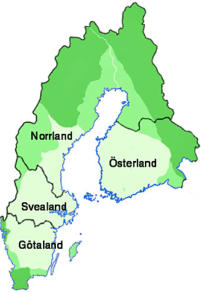
During the 12th century there was a Swedish expansion to the east. In the middle and at the end of the 13th century, we know there were Swedish crusades to Finland. Strongholds were constructed for the protection of the captured land, such as the castles at Åbo, Tavastehus, and Vyborg (east of the Gulf of Finland). A Swedish royal council was established, an administrative structure and a fiscal policy apparatus were created, and laws were codified during the 13th and 14th centuries. As a result, the “Eastern Land” (Österland) was firmly integrated into the Swedish Empire. In 1323, Sweden and Novgorod (Russia) signed a peace treaty that set the Sweden's eastern boundary. The western and southern parts of Finland became Swedish, while Russia gained the eastern parts. Finland now became a fully integrated part of Sweden and was under the same political and juridical administration as the rest of Sweden. So, Finland was never a “state” under Swedish rule but rather one of four Swedish so-called “greater regions”, or "lands" (Swedish: landsdelar), which included Svealand, Götaland, Norrland, and Finland. Swedish-speaking colonists settled down in the coastal regions of Finland. In 1362, the Finns were granted the power to send representatives to king elections, and in the 1500s, this right was expanded to include sending representatives to the Swedish parliament. Swedish was the primary language for administration, jurisdiction, the military, and higher education in Finland. Finnish was primarily a language spoken by farmers, clergy, and local courts in predominantly Finnish-speaking areas. Many regiments were established in the Finnish half of Sweden during the Swedish ”Great Power Period,” both infantry and cavalry. The soldiers in the regiments in Finland were Finnish, while the majority of the officers came from Sweden. The military command language was Swedish. There was a reason for this. When a soldier or an officer was transferred to another regiment, they had to understand the commands independent of where in Sweden the regiment was established. Gustav Vasa (reigned 1523–1560) made his second son, Johan, Duke of Finland. In 1594, the office of Governor-General of Finland was established as part of the restructuring of the administration of the Swedish Empire. Baron Clas Fleming was then appointed to the post. A governor-general was the senior military and civil authority over a region, which often included many provinces, and hence represented royal power. During the 17th century, several Swedish governorates were established both in the Baltic provinces and in Swedish border regions. After 1669, the appointment of governors- general over Finland ceased, except for 1710–1712, 1742-1743, and 1747-1752. In 1634, administrative counties (Swedish: Län) were introduced in the Swedish Realm, which naturally also included the eastern half of the kingdom. During the Swedish period, which lasted until 1809, the region of Finland consisted of six provinces (and, from 1634, counties), and “the eastern half of the realm” constituted a so-called greater region in the same way as Götaland, Svealand, and Norrland in Sweden proper. The six provinces of Finland were called in Swedish: Egentliga Finland, Tavastland, Savolax, Karelen, Nyland, and Österbotten. In fact, there was no such thing as “Finland” early on during the Swedish era; instead, it was called “Östra Rikshalvan” (the Eastern Half of the Realm) or Österland” (the Eastern Land). However, there was one province in “Eastern Land called “Egentliga Finland” (Proper Finland) or “Varsinais-Suomi” in Finnish. “Proper Finland” is located in the southwestern part of Finland (in the former county of Åbo och Björneborgs län), where Åbo (Turku) is the largest city. The map of Sweden shows the four greater regions (Swedish: Landsdel) of the Swedish kingdom until 1809. Image: Wikipedia. The stages of expansion are depicted in various shades of green, with borders at 1700. As can be seen, each of the greater region ends with the term "land," hence “landsdel” in Swedish. The name “Finland”: The origin of the name “Finland” is not really known, and it is not entirely clear when the Swedish name Finland” began to be used as a term for the entire eastern half of the kingdom. During the 12th and 13th centuries, the name Finland referred only to one of the provinces in the eastern half, namely “Proper Finland” (Egentliga Finland). During the 14th century, the name “Österland” (the Eastern Land) began to be used as a term for the entire eastern half of the kingdom. However, during the 16th century, “Finland” began to be used more and more in parallel with “Österland.” For example, from 1556, John III was Duke of Finland (not Duke of “the Eastern Land”). From the 17th century until 1809, Finland, or Eastern Half of the Kingdom,” was the established name for the region. Note, “Finland” is called “Suomi” in the Finnish language. So, Swedish and Finnish history are, of course, closely interrelated.

Loss of Finland in 1809

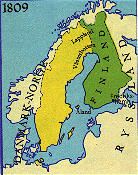
The War with Russia 1808-1809: The 19th century began with several wars for Sweden. Between 1805 and 1807, Sweden was at war with France in Swedish Pomerania in northern Germany, between 1808 and 1809 with Russia in Swedish Finland, and in 1808 with Denmark. Between 1813 and 1814, Sweden was at war with France and Denmark (the Napoleonic Wars) and in 1814 with Norway. The Finnish War was fought between Sweden and the Russian Empire from 1808 to 1809. Sweden was supported by the United Kingdom, whereas Russia was supported by the French Republic and its various allies (including Denmark-Norway). The war was fought as part of the Napoleonic Wars. The conflict broke out after Tsar Alexander I of Russia and Emperor Napoleon I of France signed a peace pact in Tilsit in July 1807. The agreement obliged Alexander I to attack Sweden if the country did not break off its relations with Great Britain and join Napoleon's trade blockade against Great Britain. Sweden had been in alliance with Great Britain since the Pomeranian War, and the Swedish monarch Gustav IV Adolf refused to agree to the French demands. In principle, Napoleon and Alexander divided Europe into different spheres of interest. Alexander was given free rein to invade Swedish Finland. On February 21, 1808, in the middle of a cold winter, Emperor Alexander's Russian troops cross the Swedish-Russian border into Finland. The Russian force numbered 24,000 men. The attack took place without an official declaration of war. The Swedish field army numbered approximately 21,000 men in Finland, of whom approximately 7,000 were stationed at the fortresses of Sveaborg and Svartholm. Since it was the middle of winter and the Gulf of Bothnia was frozen over, it was not possible to ship reinforcements from Stockholm to Finland at that time. The Swedish forces in Finland would have difficulty defending the whole of Finland against the Russians. The plan was for the Swedish army to retreat northwards in Finland while awaiting reinforcements, while the southern parts were abandoned and occupied by the Russians. The Swedish defense in the south was maintained with the support of the fortresses of Sveaborg and Svartholm. When spring arrived and the Swedish army was at full strength and reinforced, the plan was to launch a counterattack from the north and, with the help of the navy and the troops in the fortresses in the south, recapture the whole of Finland in a pincer movement. The Swedish fortress Sveaborg, located outside Helsinki (Helsingfors) in Finland, is one of the world's largest sea fortresses. It encompasses several islands at the entrance to Helsinki and is also known as the Gibraltar of the North.” When the war began, Vice Admiral Carl Olof Cronstedt was commandant at Sveaborg. But Cronstedt turned out to be a traitor. The defense of Finland depended on Sveaborg holding out against the Russian siege. However, it was unlikely that the first Russian force alone would be able to capture Sveaborg as long as there was gunpowder in the fortress, where 7,000 men and the entire Swedish archipelago fleet with over 200 ships were stationed. In total, the fortress itself also had over 2,000 cannons. Russian troops entered Helsinki across the ice on March 2, 1808. On March 23, Cronstedt met with Russian negotiators, and on April 6, Cronstedt agreed to surrender to the Russian commander in Helsinki. This was completely contrary to Cronstedt's orders to hold the fort. He did not have the authority to do this. After the surrender, Cronstedt defected to the Russians. The surrender of Sveaborg was a heavy blow to Finland's defenses, and now it became even easier for the superior Russian forces to occupy Finland. Denmark has always had a habit of attacking Sweden when Sweden has been at war with other nations, and this time was no exception. On March 14, 1808, Denmark (aligned with France) declared war on Sweden, which tied up the main army in Sweden on the western border. This meant that Sweden now faced a two-front war. Throughout the conflict with Denmark, the British navy was a help to Sweden and posed a threat to any Danish landings. The war in Finland went badly for Sweden and led to Sweden having to cede its eastern half. The peace treaty was signed in Fredrikshamn on September 17, 1809. The Russians demanded the six provinces that made up Finland at the time, plus parts of Västerbotten County and the Åland Islands. The Finland region of Sweden consisted of six provinces in the southern and central parts of the eastern half of our country. The northern part of present-day Finland was then part of the Norrland region of Sweden, or more precisely, part of Västerbotten County. The Åland Islands, east of Stockholm, were part of the Svealand region of Central Sweden. Before 1809, the old border between Finland and the rest of Sweden ran considerably further south in Finland than it does today. In practice, what is now northern Finland was then part of the Västerbotten County. The final border between Sweden and what then became Russian Finland was drawn along the Torneå and Muonio rivers. The map shows Sweden’s borders after the peace in 1809. With the peace, Sweden lost around one-third of its territory and one-quarter of its inhabitants. In accordance with the peace treaty, Finland now came under Russian rule and formed the Russian Grand Duchy of Finland. The peace treaty with Denmark was signed in Jönköping on December 10, 1809, with no alterations to boundary borders.

Gustav IV Adolf is Deposed from the Swedish

Throne

Gustav IV Adolf, Sweden's regent, had no admiration for Napoleon and the French Empire; quite the contrary. His distancing himself from Napoleon and his sometimes exaggerated and willful pride and self- image meant that his decisions were not always based on common sense and facts. As King of Sweden, Gustav IV Adolf led the military campaign. On March 13, 1809, Gustav IV Adolf was deposed from the throne in a coup d'état. Formally, pending a new heir to the throne, Duke Karl took power as Karl XIII. Karl XIII was a younger brother of Gustav III. The coup d'état of 1809 was a rebellion against Gustav IV Adolf. The background to the coup d'état was mainly the military defeats in the Finnish War and the growing dissatisfaction with how the country was being governed. Gustav IV Adolf's foreign policy was widely disliked, and his anti-French position had terrible implications for Sweden. However, the main reason was dissatisfaction with autocracy. His poor and ineffective leadership was also blamed for the unsuccessful war in Finland. The conspirators had their strongest power resources within the western army. It was agreed that as soon as word came from the conspirators' headquarters in Stockholm that the time was right, Lieutenant Colonel Georg Adlersparre would lead reliable troops in a march on the capital. Gustav IV Adolf decided to travel to Skåne in southern Sweden on March 13 to seek support from the army there, which was led by Johan Christopher Toll, who was more loyal to the king. Then a group of nobles led by Carl Johan Adlercreutz intervened and captured the king at Stockholm Palace. During the night, Gustav Adolf was taken as a prisoner of state to Drottningholm Palace, from where he was soon transferred to Gripsholm Castle. Among other things, the revolution resulted in the irreversible loss of the Swedish crown by the king, queen, and their heirs. Instead, Gustav Adolf's uncle Duke Karl became the new king. The king, queen, crown prince, and other royal children were stripped of their Swedish citizenship and expelled from Sweden for good. However, Karl XIII was in his sixties and had no children. This meant that there was no heir to the Swedish throne. New heir to the throne: On July 18, 1809, the Danish-Norwegian Prince Christian August was elected as the new heir to the Swedish throne and was to succeed the elderly and childless Karl XIII, who would wear the crown until his death. However, Crown Prince Karl August died unexpectedly on May 28, 1810, at the age of only 41. However, a few months later, something strange happened: a French military officer and nobleman was chosen as the new crown prince of Sweden instead. It was the Prince of Ponte Corvo, Jean Baptiste Bernadotte. When Karl XIII died in 1818, Bernadotte was crowned as king of Sweden with the royal name Karl XIV Johan. The image shows Sweden's Crown Prince Karl Johan wearing a Swedish general's uniform in 1811 (reigned as King Karl XIV Johan from 1818 to 1844). Painting by François Gérard. Image: Wikipedia.

1813–1814, War with France and Denmark

In accordance with the conventions of Saint Petersburg and Stockholm (April 5 and 9, 1812), Sweden committed itself to actively participating in the fight against Napoleon in exchange for Russia's promise to work toward Sweden's acquisition of Danish Norway. In the spring of 1813, Sweden transferred 30,000 men to Germany to participate in the war against Napoleon. Swedish Crown Prince Swedish Crown Prince Karl Johan was assigned leadership of the so-called Northern Army, which consisted of Swedes as well as approximately 95,000 Prussian and Russian soldiers. Under the circumstances, Karl Johan attempted to save the Swedish troops for the impending Swedish attack on Denmark (which was allied with France), when the Danes would be forced to cede Norway to Sweden. At the end of 1813, Karl Johan moved northwards to Holstein to force Denmark to capitulate. After the battle at Bornhöved on December 7, 1813, the surrender of Frederiksort on December 19, and Glückstadt's capitulation on January 4, 1814, Denmark was also forced to yield and, in the Treaty of Kiel on January 14, cede Norway to the King of Sweden.

Union Between Sweden and Norway

The Norwegian resistance to the Treaty of Kiel led to a Norwegian declaration of independence and the adoption of a Norwegian constitution, the Constitution of Eidsvoll, on May 17, 1814. From a Swedish perspective, this meant that Sweden had to subdue Norway by force unless the Swedes wanted to renounce the gains of the Treaty of Kiel. But giving up Norway was not an option for Crown Prince Karl Johan, which is why an invasion of Norway was planned. The battle-hardened Swedish main army of approximately 45,000 soldiers entered Norway at dawn on July 30 1814, with Fredriksten Fortress as their first target. On August 4, 1814, the Norwegian defenders of Fredrikstad raised a white flag on the fortress ramparts. At around eight o'clock in the evening on August 14, 1814, the Norwegian negotiators signed the Convention of Moss. Crown Prince Karl Johan, representing the Swedish king, secured an agreement with the Norwegian Parliament. In the weeks following the armistice, negotiations continued on how the Eidsvoll constitution should be adapted to the union solution, i.e., a revision of the Norwegian constitution to enable a personal union with Sweden. The Convention of Moss of August 14, 1814, meant that Danish King Kristian Fredrik abdicated the Norwegian throne and that Norway entered into a personal union with Sweden. Sweden's King Karl XIII became the joint king of both Sweden and Norway. A personal union is a union between two or more states with a common head of state, in this case, the King of Sweden. The union between Sweden and Norway was dissolved in 1905. More information about the union is available at Union Between Sweden and Norway

Conscription

One of the weaknesses of the military allotment system was the problem of obtaining sufficient reinforcements. During the war with Russia in 1808–1809, it became clear that something had to be done about the allotment system in order to obtain a sufficient number of reserve soldiers. On October 27, 1812, the Swedish Parliament passed an act that introduced a conscription system to supplement the regular army. The name of the conscription system was Beväringen. At the age of 21, young men were called up for registration and then underwent a short period of military training. Initially, the training period was only 12 days, but in the 1850s it was extended to 30 days. The military training period was subsequently extended several times, reaching 90 days in the 1890s.

Peace, the Vaccine, and Potatoes

During the 17th and 18th centuries, Sweden was at war for very long periods of time. This had a very adverse impact on population growth. Since 1814, however, Sweden has enjoyed a long period of peace. This had a positive effect on population growth. In Sweden, between 1749 and 1800, 270,000 people died from smallpox. Edward Jenner, a Brit, developed a smallpox vaccine that may be used to prevent the disease. The Swedish authorities were early to take advantage of Edward Jenner's discovery. The first smallpox vaccination in Sweden was carried out on 23 October 1801. In 1816, Sweden became the first country in the world to legislate that all children under the age of two should be vaccinated against smallpox. The result was a reduction in mortality. However, there were other epidemics that were a problem during the 19th century, including cholera. Five epidemics ravaged Sweden between 1834 and 1873. There was no vaccine against cholera. Another reason for the decline in mortality was diet. This is where potatoes come into the picture. It was nutritious and naturally provided calories, but more importantly, it supplied vitamins that built resistance to many diseases. Another important reason for the decline in mortality was the realization of the importance of hygiene, particularly in connection with childbirth, which, above all, reduced the high infant mortality rate. The chart shows Sweden's population growth since the census began in the mid-1700s. From 1750 to 1850, the population roughly doubled. Agriculture remains the foundation of our economy but is undergoing major changes. Arable land is increasing through new cultivation. Drainage and crop rotation are increasing yields. Education and campaigns are introducing new crops such as potatoes, improved cultivation methods, and more efficient tools. So, it is fair to say that peace, the vaccine, and potatoes were three important prerequisites for development.

Society is being reformed

The mid-19th century was a time of many reforms. Examples include the Elementary School Act of 1842, equal inheritance rights for men and women in 1845, majority capacity for unmarried women in 1858, and the elimination of guilds in 1846. A bicameral parliament was established in 1865 to replace the ancient Parliament of the Four Estates. The nineteenth century also saw substantial land reforms, which resulted in significant improvements in agricultural.
Land Distribution Reforms

The arable land was expanded in the 1800s through land reclamation. Ditching and crop rotation raised the yield. During the same time, there were significant social changes, not least in farming. The gradual realization of the massive redistribution of land ownership helped agriculture. The purpose of the redistribution was to gather each farmer’s fields into as few as possible—rather one large field than several small ones. The sun distribution of land (Swedish: solskiftet) has regulated the farming of land in Sweden's rural settlements since the Middle Ages. In a so-called farming village, each farmer owned a portion of each individual piece of arable land and meadows owned by the village, forming a community of shared ownership. So, each farmer in the hamlet held a strip of land in each of the village's fields. The size and number of these strips of land were proportional to the farmer's share in the farming village. All farmhouses were grouped together like a village, often with a church in the center, hence the term "farming village." The farmland surrounded these farming villages. Every single field owned by the village was divided into several small bits of parcels and each villager had his share in the respective field. It was impossible to gain access to one's parcel of farmland if the parcel next to it was not harvested simultaneously. Even if an individual farmer wanted to change his farming methods, he couldn't unless the others did as well. This was, of course, counterproductive. Therefore, various land reforms were initiated to make agriculture more efficient. These land reforms were private initiatives but were supported by the government. It was voluntary for each farming village to adopt the reforms. The aim of the reforms was to give each farmer as large a contiguous area of arable land as possible, rather than several small parcels of land. There have been three major land reforms: Storskifte, Enskifte, and Laga skifte. The Storskifte Reform: The first modern land reform implemented in Sweden was the Storskifte reform. To modernize the farming and to get a better yield of the land, there was a parliament act taken in 1749 called "Storskifte" (The Great Redistribution of Land Holdings). According to the law of 1734, a new redistribution of land could not take place unless all the landowners in the farming village agreed to it. The 1749 law made it possible for a co-owner in a farming village to request a redistribution of land, which then also included the other owners' plots, i.e., an attempt to consolidate the farmers' land into larger parcels. The Storskifte reform was carried out in large parts of the country between 1758 and 1827. However, the redistribution wasn't radical enough. There were many compromises. The farmland was still split into many parcels of land, and the individual farmer was still dependent on his neighboring farmers. The Enskifte Reform: The Enskifte reform was initiated by Baron Rutger Maclean, owner of the Svaneholm Estate in Skåne province. Between 1782 and 1785, he divided his estate's land into quadratic parts, and the tenant farmhouses in each village on his land were relocated to each square, i.e., to each farm's attached farmland. So, on the Svaneholm Estate, each tenant farm was now located on each farmer's arable land, resulting in a coherent expanse of farmland. This way of distributing the land (the Svaneholm way) became the model of the next redistribution reform, the "enskiftet," which was established for southern Sweden in 1803-1804. The "enskifte reform" was a further development of the "strorskifte reform." The basic difference in the "enskifte" was that the farmhouses were moved into each farmer’s farmland. The "enskifte reform" was best applied on the plains of southern Sweden. The Laga Skifte Reform: In 1827, a land distribution law, known as "Laga Skifte," was passed, allowing land reform to be implemented across Sweden. The "laga skifte" was accomplished by the middle of the 1800s. This reform involved the relocation of many farmhouses from the farming villages into each farmer's allocated farmland. It was sufficient for one co-owner of a farming hamlet to request a land redistribution under the 1827 redistribution statute for the village's land to be redistributed. The land redistribution, including farm relocation, meant that farmers were no longer as reliant on each other as they had been in the farming villages, and they no longer needed to cross someone else's field to reach their own. When land redistribution was to be carried out in a village, a land surveyor was sent to measure the farmers' land, distribute it, and draw up land redistribution maps (Swedish: skifteskartor.) During the land redistribution process, a land classification was carried out to ensure a fair distribution of land. The landowner who was assigned land of lower quality could be compensated by receiving a larger plot of land. The total value of the homestead before and after the redistribution would be the same. The farmers were reimbursed for the cost of tearing down the old buildings, moving them, and rebuilding them at the new place. As a result, many countryside villages disappeared from the map. In parts of Sweden, the land reform was never carried out, especially not in Dalarna province. More information about the reforms is available at Swedish Land Reforms

Sweden Industrializes

Industrialization begins in the middle of the century. The sawmill industry is the first to start. Many sawmills are established along the Norrland coast. The old farming society of Sweden undergoes fundamental changes. New communities spring up, and an industrial working class emerges. By 1900, almost one in three wage earners works in industry. Several inventions contributed to industrialization, such as the steam engine, steel production, and, not least, the propeller. The steam engine made it possible to establish works where it was most convenient. Previously, works and mill had to be built along streams to harness water power. The industry had shifted to the cities, and so had the laborers. Around the city of Sundsvall in Medelpad province, Mid-Sweden, the country's first steam sawmill was built in 1849, and it was soon followed by so many other similar facilities that the Sundsvall district became one of Sweden's most important industrial areas with connections to countries all over the world. The establishment of steam sawmills was quickly followed by the establishment of pulp mills and paper mills. The poet Elias Sehlstedt coined the famous saying "Sawmill by sawmill I saw, wherever I looked" ("Och såg vid såg jag såg, varhelst jag såg") after visiting Sundsvall and being impressed by the large number of sawmills in the area. The railroads connected Sweden in a whole new way. Construction of railroads began in the middle of the century, and in 1862 the first line, the Western Trunk Line (Swedish: Västra stambanan) between Stockholm City and Gothenburg City, was inaugurated. Two years later, in 1864, the Southern Trunk Line (Södra stambanan) to Malmö City was opened. Goods could now also be transported by land using steam locomotives. The steam engine would also revolutionize shipping. Steamboats made people less dependent on the weather. However, it took until the turn of the century before the number of steamships reached the same level as sailing ships in the transport industry. Steamships could be built in iron and became both larger and faster. The Swedish Navy underwent major changes during the 19th century. The first steam-powered warship was the steam corvette HMS Thor, which was completed in 1841 and the first propeller-driven warship, one of the first in Europe, was the steam corvette HMS Gefle. The navy's first steam-powered iron ship was the paddle steamer HMS Kare, which was launched in 1847. The Swedish export of iron to the United States increased in the beginning of the 19th century and became quite significant by that time.

The Birth of Popular Movements

Social and economic changes are the backdrop to popular movements; the Working-class movement, Free Church movement and the Temperance movement. The goal was an eight-hour working day, the abolishment of the Swedish State Church, and alcohol prohibition. The demand for universal suffrage grew. The suffrage at the time was based on income or private means, and only 20% of the men of age had the right to vote. Universal suffrage for men was introduced in 1909, but not until 1919 did women receive the right to vote. The first Swedish general election when women could vote for the first time was held in 1921. When liberal Nils Edén and social democrat Hjalmar Branting formed a coalition government in 1917, parliamentarianism (i.e. power held by the majority in parliament) was put into reality.

1842 Elementary School Act

In 1842, a bill was passed introducing universal elementary education in Sweden. According to the 1842 Elementary School Act (Swedish: Folkskolestadgan), there was to be at least one school in every rural parish and urban municipality. This school was to be permanent and have an approved teacher. The requirements were thus one school per parish and at least one teacher per school. There was no division into classes; all age groups were to attend the same class. The school was to be run locally, i.e., by the local administration. It should be noted that when the public elementary school system was formed in 1842, children were not required to attend school. This was a concession to the peasantry in parliament to allow the Elementary School Act to be passed. The farming community, for whom the school was primarily intended, was moderately interested and not convinced that it was necessary. Compulsory schooling was first introduced with the 1882 Elementary School Act. More information is available at Swedish School History

The Emigration from Sweden

During the period beginning in 1850 and ending in 1930, about 1,250,000 Swedes emigrated from Sweden to North America. Roughly 200,000 of these emigrants returned to Sweden. There was an early emigration from Sweden to North America too, beginning in the 1830s, but this was a modest one. The huge wave of emigrants from Sweden started after the American Civil War, i.e. after 1865. During the 19th century, many Swedes began to dream of America. The early settlers went there in protest against Sweden. They were liberals, free church members, or teetotalers who protested against conservative Sweden. In the mid-1800s, a new wave of travelers set off for America. This time around, landless farmhands and farmers' sons set out to cultivate their own land in the new country. Two consecutive years of poor harvests and famine in the 1860s accelerated emigration, with 40,000 people emigrating in 1869 alone. Towards the end of the 19th century, most emigrants came from southwestern Sweden, but shortly after 1900, people from northern Sweden also began to leave. A large proportion of those who emigrated from Sweden to America settled in the state of Minnesota and in the city of Chicago (IL). The early emigrants had to organize the journey to the United States by themselves. There were no passenger ships across the Atlantic at this time. Instead, these emigrants had to travel as “ballast” aboard the cargo sailing ships carrying iron. This was not a comfortable way of traveling; the conditions were very bad, and the journey could take up to 3 months, or at least 1 1/2 months. From the 1860s there were pure passenger sailing ships, and from the 1880s there were fast steamships where the comforts of the passengers were in focus. The traveling time was reduced to between 16 and 24 days. There was no direct passenger traffic between Sweden and North America during the era of the mass emigration. Instead, the Swedish emigrants had to travel by ship from Gothenburg to England and from there on passenger ships to the United States. The first direct line from Sweden to the United States opened in 1915: the Swedish American Line (SAL). Between 1820 and 1930, over 1.2 million Swedes emigrated to America. This meant that in 1910, one in five Swedes lived in the USA. More information is available at The Emigration from Sweden to North America

1862: Local governments are being

reorganized, and regional self-government

is being introduced

Since medieval times, Sweden’s rural areas have been divided into smaller entities called “socken.” There were two purposes of the “socken”: the parish church and local administration. So, inside the same body, there was the church and its congregation (church socken) and an administrative section for local administration (worldly socken). "Socken" is translated into "parish" in English. The governance of cities and the churches within them was arranged differently. Local governments: Until 1863, local administration of the parish (Swedish: socken) was handled by the parish council (Sockenstämman). “Sockenstämman” was the highest decision-making body in each “socken. The parish minister headed the local church and served as the obvious chair of the parish council (sockenstämman). So until 1863, the “socken” had two functions integrated into one and the same body, partly as a church parish (rural parish) and partly as a worldly socken (parish municipality), which was the local government. In 1862, a bill was passed in the parliament called kommunalförordningen (the municipal ordinance), which ended the concept of the socken. The parish was now broken up and divided into two separate units. The new ordinance came into force on January 1, 1863. The Municipal Ordinance of 1862 meant that the previous administrative body, “socken,” was replaced by two different types of municipalities called kommun”: 1. a civil “kommun” (municipality,) i.e., local administration called “landskommun. 2. an ecclesiastical municipality (“Församling,” i.e., church parish); Both have independent bodies and tasks. There were now different types of civil municipalities: 1. Rural municipalities in the countryside — Landskommuner 2. Cities Between 1863 and 1970, the Kommunalfullmäktige” (municipal council) was the name given to the highest elected political decision-making body in a “Landskommun” (rural municipality). However, the “Kommunalstämma” (municipal assembly) was the highest decision- making body in all small municipalities. From 1863 to 1970, the “Stadsfullmäktige” (city council) was the highest elected decision-making body in a city in Sweden. The reform of 1862 resulted in the establishment of around 2,500 municipalities in Sweden. This led to municipalities varying greatly in terms of size and population density. The 1952 municipal reform lowered the number of municipalities from 2,498 to 1,037 by mergers. The municipal ordinance of 1862 thus laid the foundation for the current municipal system in Sweden. The municipality's main tasks include schools, elderly care, social welfare service, firefighting, local infrastructure, water and sewage, sanitation, and local power distribution, among others. A Swedish “kommun” is about the same thing as a US county. The 1971 municipal reform: On January 1, 1971, a uniform municipal type was introduced, when all former rural municipalities, cities, and market towns were reorganized into municipalities only. The municipal reform of 1952 soon proved to be insufficiently radical. Consideration was now given to the central town principle. Towns and rural areas would together form unified municipalities in which the town, or another larger urban area, would serve as the central town for the surrounding area. Usually, several rural municipalities were consolidated with the adjacent town to form a single municipality called “kommun.” For example, there were several rural municipalities (Landskommun) around the city of Sundsvall, including Njurunda, Matfors, Indals-Liden, and Stöde, which were now consolidated with the city of Sundsvall to form the municipality of Sundsvall (Sundsvalls Kommun). The US term “consolidated city-county” probably best describes these new municipalities called “Kommun.” More information is available at Subdivisions of Sweden and The Concept of Socken Regional self-governance: The 1862 municipal regulations also established Landsting” (county councils) to take care of areas that were too large for a municipality to manage. County councils were a new self-governing body, controlled by an elected assembly, for regional administration within a county. So, from 1862, the new regional authority was called the Landsting (County Council). In 1634, Sweden was divided into several regional units called Län (counties). The counties were an instrument of the Crown for regional control of the country. In each county a county governor was appointed by the government, heading the “Länsstyrelse” (County Administrative Board). In 1862, when the “Landsting” (County Council) was established as an entity for regional administration, a Landsting was created in each of the already existing counties. However, county councils and county administrative boards are two completely different entities, even though they are located in the same territorial area. The names of the individual county councils include the name of the county in which they are located, for example, “Västernorrlands Läns Landsting” (Västernorrland County Council.) The Landstingsfullmäktige” is the highest decision- making body in each “Landsting.” In 2015, the responsibilities of the county councils were expanded, and they were renamed “Regions.” Thus, “Västernorrlands Läns Landsting” became “Region Västernorrland.” The major responsibilities for the County Council are public health care, including dental care, and public transportation.

The Bicameral Parliament of 1866

The medieval Riksdag of the Four Estates was abolished in 1865, and a bicameral Riksdag was established. As of 22 June 1866, a new Parliament Act entered into force—Parliament met on an annual basis. The First Chamber (Första kammaren) was mainly represented by the upper classes. The Second Chamber (Andra kammaren) was more popular in character. Members of the Second Chamber had a shorter term of office than those of the First Chamber. The preparation of parliamentary matters would take place in joint committees of the two chambers. However, the second chamber had a majority in joint votes due to its larger number of members. The First Chamber was the name given to the indirectly elected upper house. The Second Chamber was the name given to the directly elected part of the bicameral parliament (the lower house). In 1970 the bicameral Riksdag was abolished and replaced by a unicameral Riksdag (Swedish: Enkammarriksdagen). More information is available at The History of the Swedish Riksdag

Transition to the Metric System in 1878

In 1665, Sweden adopted a standard measurement system covering the whole nation. An adjustment of that system was made in 1735. A major change to the measurement system was introduced in 1855 when the decimal system was adopted. In other words, Sweden already had a decimal system when the metric system was introduced. Our present system, the metric system, originates from France. The Metric System was introduced after the French Revolution in about 1795. Sweden adopted the metric system in 1878, and over a ten-year period, Sweden changed from the old measurements to the metric system. Since January 1, 1889, the metric system has been the only legal system for measurements in Sweden. More information is available at Old Swedish Units of Measurement

The Monetary Reform of 1873

When Sweden entered the 19th century, the Swedish currency was the “Riksdaler.” In 1855 a decimal monetary system was introduced in Sweden. The new name of the unit was Riksdaler Riksmynt” and was divided into 100 öre. In 1873, the Riksdag, or Parliament, authorized a monetary reform. Sweden's currency became the krona,” which was divided into 100 öre, i.e., 1 krona = 100 öre. “Krona” (or short: Kr) is singular, while “kronor” is plural. It is today abbreviated SEK. At the same time, Denmark and Norway also switched to the new currency, “kronor.” More information is available at The History of the Swedish Monetary System

Banking

Modern commercial banks started in the early 19th century. The first was Skånska Privatbanken, founded in Ystad in 1831. This private issuance of banknotes lasted from 1830 to 1904, when the Riksbank (Central Bank of Sweden) obtained a monopoly on all banknote issuance. Stockholm Enskilda Bank, founded in 1856 by A. O. Wallenberg, started a new way of thinking by building its business on deposits. Banks soon changed their corporate form to limited companies (corporations). The first savings bank in Sweden was established on 28 October 1820. In the beginning, deposits were the most important thing for the savings banks, but after 1839, lending became as important as deposits. More information is available at The History of Swedish Banking

Religious Freedom in 1858

Sweden was, according to its constitution, a Christian country with a state church, the Church of Sweden. It was the only church to which Swedes could belong, and it was (is) an Evangelical Lutheran Church. Sweden adopted a new Church Act on January 12, 1726, the so-called “Konventikelplakatet” (The Conventicle Article), which banned all pious meetings outside the control of the Church of Sweden, such as Bible reading and prayer meetings in people’s homes headed by laymen. The article was debated at several Parliament meetings but was not abolished until 1858. A religious meeting that was not headed by a parish minister from the Church of Sweden was still not allowed during the regular hours of public worship without special permission. However, this last restriction was abolished on December 11, 1860. Then it became possible to hold religious meetings during regular hours of public worship, but not so close to a church that they disturbed the regular church service.