Copyright © Hans Högman 2025-12-29
A brief overview of Swedish
history
The following historical section is by no means
complete from a historical perspective.
The purpose of this page is to provide a
chronological historical overview of events in
Sweden that may have had a connection with or
impact on the lives and livelihoods of my and others’
Swedish ancestors.
Swedish History in
Brief (1700s)

1700s
The Great Northern War 1700 - 1721
When King Karl XI died in 1697, he had introduced
the Late Allotment System (Swedish: Det yngre
indelningsverket) and rearmed the Swedish armed
forces. The soldiers were well trained and well
equipped. At the time, the Swedish Army was
arguably Europe's best. When the 15-year-old Karl
XII became the new sovereign of Sweden in 1697, he
was in command of a perfect military machine.
In Russia, Peter the Great was the new Tsar. In
Poland, in August, the Elector of Saxony had been
elected the new king of Poland, and in Denmark,
Frederik IV had been crowned as the new king. A
curious fact was that Karl XII, Frederik IV, and August
II were first cousins.
Russia, Poland, and Denmark formed a pact of
aggression against Sweden. They were all after
Swedish territory. Russia was after the Baltic coast,
Poland wanted Swedish Livland in the Baltic, and
Denmark wanted to regain Skåne province in the
south of Sweden.
In February 1700, August of Saxony launched an
offensive on Swedish Livland in the Baltics, besieging
Riga. In March 1700, Frederik IV of Denmark
launched an attack on Holstein-Gottorp, an ally of
Sweden in Northern Germany. In September 1700,
Tsar Peter of Russia besieged the Narva Fortress in
Swedish Estonia.
Karl XII decided to deal with Denmark before he
turned on August of Saxony/Poland.
On July 25, 1700, Sweden landed a force in Denmark,
just north of Copenhagen on Zealand. The landing
area was soon under Swedish control, and the force
was increased to 10,000 soldiers. Karl XII planned to
attack Copenhagen, but King Frederik IV of Denmark
immediately initiated peace talks, and the peace
treaty was signed in Traventhal on August 18, 1700.
In the peace treaty, Denmark was forced to leave the
pact of aggression against Sweden.
In October 1700, a Russian force of 30,000-35,000
troops assaulted the city of Narva, Estonia. The
Swedish garrison at Narva still held the fortress and
the city.
With this fact in hand, Karl XII decided to deal with
Russia before August of Saxony/Poland. A Swedish
force of 8,000 soldiers was shipped to Pernau in
present-day Estonia. The force was extended to
11,000 soldiers. Instead of waiting for
reinforcements, Karl XII launched an immediate
march towards Narva. On
November 20, 1700, the Swedish
force of 11,000 soldiers attacked
the Russian army in Narva, which
consisted of more than 30,000
soldiers. Despite being
outnumbered by the Russians, the
Swedes emerged victorious.
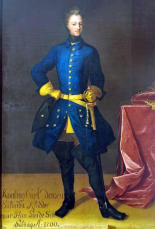
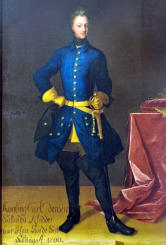
The image shows King Karl XII of
Sweden wearing his military field
uniform in 1700. Sovereign from
1697 to 1718. Painting by David von Krafft, 1706.
Image: Wikipedia.
King Karl XII now had to decide whether to march
directly to Moscow or to go south and first deal with
August II. Karl XII chose August and Poland. After
four years of war in Poland, Sweden emerges
victorious. The treaty was signed on November 17,
1705, in Warsaw. The war had a devastating impact
on Poland and the Polish people.
Meanwhile, the Russians had once again begun to
besiege the Swedish provinces in the Baltic region.
Now it was time to deal with Russia, the last of the
enemies in the pact of aggression. The Swedish
march eastwards began during the fall of 1707. One
strategy for dealing with the Russians would have
been to return to the Swedish Baltic provinces and
expel the Russians before turning to Moscow.
However, Karl XII decided to directly go for Moscow.
Karl XII marches towards Russia with a 35,000-strong
army. A very harsh winter took its toll on the Swedes.
Of the Swedish army that marched out of Poland,
25,000 men now remain.
The Swedish army encountered the main Russian
army in the Battle of Holowczyn on June 30, 1708.
Although only a part of the Swedish army had
arrived at Holowczyn, Karl XII decided to attack. The
battle ended with a Swedish victory. The Swedish
cavalry carried out a splendid battle and had a lot to
do with the victory. After this battle, the Russians
avoided any further battles and withdrew as soon as
the Swedes approached them. As the Russians
retreated, they burned down villages, farms, and
cornfields, making it impossible for the Swedes to
procure supplies, among other things—the scorched
earth tactic.
At the end of August 1708, Karl XII decided to change
the route and go south to Ukraine to get in contact
with Ivan Mazepa and his Cossacks and to get him to
join the Swedes in the war against Russia.
During the extremely harsh winter of 1708/09, the
Swedes established a winter camp in northern
Ukraine, near the town of Poltava. The supply
situation was dire for the Swedes.
At the end of June 1709, a Russian army of 40,000
soldiers was arriving at the scene. Near Petrovka, the
Russians set up camp by the river, forming a large
square with sides approximately 1 km long. They
strengthen their camp by building redoubts.
The situation was now desperate for the Swedish
army. There was a shortage of food and ammunition.
Reinforcements had not arrived. Something had to
be done. Retreating would be life-threatening with
the Russians at their backs. Karl XII now had no
choice but to win or die. In the morning, at dawn, on
June 28, 1709, the Swedes attacked the Russian
camps.
The Russians had artillery at their camp. The Swedes
had left the artillery at their camp, hoping to surprise
the Russians with a sudden attack. Attacking without
artillery support proved to be a major disadvantage.
The Swedes suffered heavy losses, and by midday it
was clear that they would not be able to capture the
Russian camp. The only option was to retreat to their
own camp in Pusjkarjovka, which was a 2-hour march
away. Left on the battlefield at the Russian camp
were 6,900 fallen Swedish soldiers and 2,760
captured, a total of 9,660 soldiers. On the Russian
side, 1,345 troops were killed and 3,290 wounded.
During the afternoon, the baggage train and soldiers
prepared for retreat from the area. The Swedish
infantry had lost a third of its soldiers, but the cavalry
remained intact. The departure took place without
incident and without any Russian pursuit.
On the afternoon of June 30, the Swedish army
began arriving in Perovolotjno, near Tashtaika, on the
Dnieper River. The Russians now followed the
Swedes but generally kept their distance. The plan
for the Swedes was to cross the river at Tashtaika.
However, the river was wide and turbulent. Advance
troops were sent across to secure the other side. The
crossing was not without problems.
It soon became clear that it would be impossible to
cross the river with the entire army. The king was
persuaded to seek safety on the other side. A unit of
about 3,000 men followed the king across the river.
Remaining in Perovolotjno was General Lewenhaupt
with the remnants of the Swedish field army,
approximately 16,000 men.
The king and his entourage were to travel to Turkey.
The plan was for the field army to follow the Dnieper
down to Crimea and then to Otjakov, where it would
join the king.
The next morning, General Lewenhaupt receives a
report that a large Russian force is heading towards
their position. In total, there were over 9,000 men led
by Prince Menshikov. Militarily, the Swedes were
stronger, with their cavalry almost intact. But morale
was disintegrating among the remaining Swedish
forces.
At eleven o'clock in the morning on July 1, 1709,
Prince Menshikov received word that General
Lewenhaupt was willing to negotiate for a
surrender.
Karl XII never forgave General Lewenhaupt for
surrendering the Carolinian army.
With the remainder of his army, Charles XII now
retreats to Bender in Turkey. They remain there until
1714.
In 1718, the king launched a new campaign, this time
against Danish Norway. Sweden was still threatened
by the coalition, and in order to defeat Denmark,
Danish Norway had to be conquered. A siege of
Fredriksten Fortress in Fredrikshald, Norway, begins.
At the same time, Swedish troops led by General
Armfelt invade Mid-Norway at Trondheim. Karl XII
dies on November 30, 1718, at Fredriksten after
being hit by an enemy bullet.
On August 30, 1721, peace is signed with Russia at
Nystad. Sweden is forced to cede the southern parts
of Kexholm County, Vyborg County, Ingria, Estonia
with Ösel and Dagö, and Livonia.
The Swedish Great Power Era is thereby over.
More information about the war is available at The
Great Northern War
Age of Liberty
After Karl II's death, his sister Ulrika Eleonora takes
over the throne and becomes Queen of Sweden.
However, after Sweden had had several successive
autocratic monarchs, the Council of the Realm now
demanded that the royal power be reduced in order
to approve Elrika Eleonora as Sweden's new
monarch. Ulrika Eleonora declared her intention to
“completely abolish the so-called sovereignty” (the
Carolingian autocracy) and “restore the government of
the kingdom to its former state and essence.”
She was elected Queen of Sweden on January 23,
1719, on the condition that she sign the form of
government that the estates intended to establish,
which she did. She was crowned in Uppsala
Cathedral on March 17, 1719.
After a few years, she abdicates in favor of her
husband, Fredrik av Hessen, who in 1720 becomes
King Fredrik I of Sweden.
Under the new constitutional settlement, Sweden
became the most liberal power on the European
continent, second only to Great Britain in the
assertion of parliamentary sovereignty.
In Swedish history, the Age of Liberty (Swedish:
Frihetstiden) was a period that saw parliamentary
governance and increasing civil rights that began
with the adoption of the Instrument of Government
in 1719. This shift of power from the monarch to
parliament was a direct effect of the Great Northern
War. The Age of Liberty ended with Gustav III's coup
d'état in 1772.
The Riksdag of the Four Estates
All power was vested in the people as represented by
the Riksdag (Swedish Parliament), consisting, as
before, of four distinct estates: nobles, clergy,
burgesses, and peasants.
In the Riksdag of the Four Estates (Swedish:
Ståndsriksdagen), each estate, or “House,” held their
deliberations in separate chambers, had their own
speakers, and kept minutes of their meetings but
conferred with each other from time to time. A
resolution required the assent of three estates in
order to pass (the majority principle).
The eighteenth century was a period of enormous
change. During this time, there was significant
advancement in science and culture.
After the death of Karl XII, royal power weakened.
The power of the nobility increased, as did that of the
Riksdag, where two parties, the Hats and the Caps,
fought for power.
Significant efforts were also made in the area of
legislation, primarily in the form of the 1734 Act
(which still forms the basis of Swedish legislation)
and the 1766 Freedom of the Press Act.
The forms of parliamentary activity, particularly the
committee system, evolved through constitutional
legislation (the 1723 Parliamentary Order) and
practice.
Utility and Common Sense
The Swedish Parliament invests in business, science,
and new inventions. “Utility” is the buzzword.
Everything must be manufactured within the
country. Jonas Alströmer, noted for his intense
interest in agriculture, popularized the production of
potatoes as food, created novel ways for doing so,
and attempted to encourage Swedes to eat them.
Schooling: The School Reform of 1724
strengthened the standing of writing and arithmetic.
This was accomplished by establishing a parallel
grade called Apologistklass (arithmetic classes).
Geography and cartography were two more topics
established during this reform. The work of
Professor Carl von Linné made natural science more
popular to study. This reform also emphasized
education in the Swedish language. The school
reform also had a section emphasizing the parental
obligation to give their children a proper education.
The Real School (Swedish: Realskola), a type of
secondary school, was introduced in Sweden in 1767.
Professor Carl von Linné (1707-1778) was a Swedish
biologist and physician who formalized binomial
nomenclature, the modern system of naming
organisms. He is known as the "father of modern
taxonomy."
Healthcare: Physicians existed early on in Sweden,
but they lived in the cities and were for the wealthy.
Rural areas were largely lacking competent medical
staff. Only in exceptional cases could a town surgeon
or field surgeon be persuaded to make an arduous
and costly journey to see someone sick in a village.
Instead, in rural areas, peasants had to rely on old
household remedies, which were frequently
combined with a hefty dose of superstition.
The first provincial physicians (Swedish:
provinsialläkare) began their activities at the end of
the 17th century. In 1774, these activities were
nationalized. There were then 32 provincial
physicians, all based in the towns. A provincial
physician was a position for medical officers who
acted as district physicians. An instruction for
provincial physicians was provided in 1744, but the
services were not formally organized until the 1773
Medical Act.
The Akademiska sjukhuset (Uppsala University
Hospital), the first hospital in Scandinavia, opened in
Uppsala in 1708. In 1752, the Seraphim Hospital was
inaugurated in Stockholm. It was also the first
teaching hospital in the country.
In Stockholm, Allmänna Barnbördshuset (the General
Maternity Hospital) opened in 1775.
In 1763, regulations were introduced stipulating that
each parish should take care of its poor, i.e., poor
relief.
Law & Order: The 1734 Legislation Act introduced
provisions regarding estate inventories. There was
no modern police force until well into the 18th
century. Cities, on the other hand, maintained a City
Watch whose mission it was to keep the city in
order, man the city gates, check that customs fees
were paid, and open and close the gates on time in
the morning and evening.
It was problematic that the same tasks and
responsibilities for law and order were assigned to
multiple agencies. There was a great need for central
management of all law enforcement agencies in
Stockholm.
In the Police Act of 1776, a position as Chief of
Police (Swedish: Polismästare) was created in
Stockholm. At the same time, a new office was
established: the Royal Police Chamber. The police
chief was the highest authority in the police
chamber.
Banking: The National Debt Office was established
as a government agency in 1789. The Swedish
National Debt Office's primary task is to manage the
government's borrowing and administer the national
debt.
The 1734 innkeeping ordinance established and
clarified the obligation to provide lodging, and inns
that did not yet have dining rooms and overnight
accommodations for travelers were now required to
build them.
Coup d'état and the murder of Gustav III
As mentioned above, after Karl XII:s death, his sister
Ulrika Eleonora takes over the throne and becomes
Queen of Sweden in 1719. However, after Sweden
had had several successive autocratic monarchs, the
Council of the Realm now demanded that the royal
power be reduced to approve Elrika Eleonora as
Sweden's new monarch. Ulrika Eleonora accepted
the terms, even if it was with reluctance.
In 1771, Gustav III was crowned as King of Sweden.
He was the eldest son of King Adolf Fredrik and
Queen Louisa Ulrika of Sweden. In 1772, the youthful
Gustav III reclaimed part of the royal power that had
been lost in 1719.
In 1772, he carried out a coup d'état (or, as he
himself put it, a revolution) in which the Council of
the Realm was imprisoned. The coup was carried out
with the help of military troops, and Sweden's first
political parties, the Hats and the
Caps, were dissolved.
Under the new constitution of
1772, political power was once
again divided between the king
and the Riksdag.
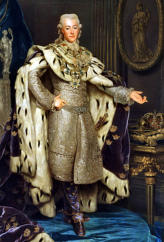
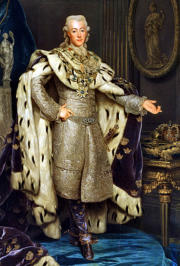
The image shows King Gustav III
of Sweden wearing his
coronation robes. Painting by
Alexander Roslin, 1777. Sovereign
between 1771 and 1792.
Gustav was a vocal opponent of what he saw as the
abuse of political privileges seized by the nobility
since the death of King Karl XII. Seizing power from
the government in a coup d'état ended the Age of
Liberty. He initiated a campaign to restore a measure
of royal autocracy. This was completed by the Union
and Security Act of 1789, which swept away most of
the powers exercised by the Swedish Riksdag of the
Estates during the Age of Liberty. At the same time, it
opened up the government for all citizens, thereby
breaking the privileges of the nobility.
This was not accepted by the nobility, who were
furious about their lost privileges. Groups within the
nobility began planning how they could get rid of the
king. On 16 March 1792, Gustav III was mortally
wounded by a gunshot in the lower back during a
masquerade ball as part of an aristocratic-
parliamentary coup attempt, but he managed to
assume command and quell the uprising before
succumbing to sepsis 13 days later. Jacob Johan
Anckarström, a nobleman and army captain of the
Life Guards, committed the crime. Anckarström was
arrested the following day for the murder and
executed by beheading on April 27, 1792, in
Stockholm.
Although the list of those guilty could have been
long, it was decided to select a limited number of
culprits. The punishment varied for those involved,
with some being imprisoned for life and others being
exiled. Anckarström was made the scapegoat before
the people and was executed.
The Swedish Colony Saint Barthélemy:
In 1784, France ceded the Caribbean island of
Saint-Barthélemy to Sweden in exchange for
trading rights in Gothenburg. As the island was
unsuitable for agriculture, it was converted into a
free port in 1785. Sweden was the first country
beside Britain and the countries involved with the
war to recognize the new American Republic. The
USA now saw a possibility to replace the closed
British ports in the Caribbean with the new Swedish
colony.
After being a very good source of income, Saint-
Barthélemy became a burden to the Swedish state
finances in the 1800s. In 1878, the island was sold
back to France. The State of France redeemed all real
property and guaranteed the Swedish civil servant’s
pensions and journey back to Sweden. The purchase
sum for the island was 320,000 francs.
More information about the Swedish colony is
available at Saint Barthélemy
Second coup d'état:
In 1789, the same year that the French Revolution
broke out, Gustav III consolidated his power in a new
coup d'état. A constitutional amendment passed by
the Riksdag in 1789 expanded the king's power. This
fueled the enmity for Gustav III that had persisted in
many circles of the nobility since the coup d'état in
1772.
However, it also resulted in a leveling of social
distinctions in Sweden, with most offices in the
kingdom now open to commoners. Before that, all
higher government offices were reserved for the
nobility. Farmers can now purchase noble land and
hunt on their own property, which was previously
reserved for royalty and nobles.
Gustav III is more interested in theater, literature,
and art than science, and he establishes the Swedish
Academy.
War with Russia 1788-1790:
In 1788, Gustav III started a war with Russia in the
hope of regaining lost territories and preventing
further Russian interference in Sweden's internal
affairs. At the end of the war, Gustav III won
Sweden's greatest naval victory ever when he
crushed the Russian archipelago fleet in the Battle of
Svensksund on July 9–10, 1790. The Russians lost 52
ships and 9,000 men, while the Swedes lost only 6
ships and 300 men. The war ended in August 1790
with the Peace of Värälä without any border
adjustments, but Russia lost its right from the Peace
of Nystad in 1721 to interfere in Swedish politics.
More information about the war is available at The
War with Russia 1788-1790
Gustav III died in 1792, and his son, Gustav IV Adolf,
succeeded to the throne.
Change of Calendars
The Julian Calendar was introduced by Emperor
Julius Caesar in 46 BC. The Julian calendar year was
too lengthy, resulting in an inaccuracy of 11 minutes
and 14 seconds per year. This inaccuracy amounted
to about one and a half days in 200 years and seven
days in 1000 years, causing the calendar to be out of
phase with the seasons.
In 1582 Pope Gregory XIII saw a great need to correct
the calendar. The vernal equinox, which was used to
determine Easter, had slipped 10 days from its
correct date. To amend the calendar, the date was
moved to October 15 on October 5, 1582. This
revision was adopted by the majority of Catholic
countries that year. This new calendar was called the
Gregorian Calendar (or the New Style, N.S.) after
Pope Gregory.
Denmark/Norway, the Netherlands, and the
Protestant states of Germany adopted the Gregorian
Calendar on March 1, 1700. In 1752, Great Britain
and the British Empire adopted the New Style.
In November 1699, Sweden decided to adopt the
new calendar the following year, 1700. However, the
Great Northern War broke out in 1700, so the
introduction of the Gregorian calendar was
postponed.
In 1753 Sweden (including Finland) was again ready
to adopt the Gregorian Calendar. That year, Sweden
made an 11-day correction by allowing February
17 to be followed by March 1.
More information is available at Change of Calendars
- Sweden