The following historical section is by no means complete from a historical perspective. The purpose of this page is to provide a chronological historical overview of events in Sweden that may have had a connection with or impact on the lives and livelihoods of my and others’ Swedish ancestors.
1500s
Swedish Monarch Gustav Eriksson Vasa
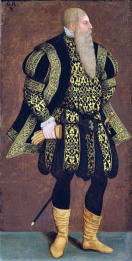
With Gustav Vasa, Sweden changed from a country in a forced Nordic union with Denmark to an independent kingdom. With help from Lübeck and an armed peasantry, Gustav Vasa succeeded in driving the Danes out of Sweden. This war is known as the War of Liberation. He was appointed Protector of the Realm in 1521 in Vadstena and crowned King of Sweden on June 6, 1523, in Strängnäs. Sweden was now liberated, which is one of the reasons why we celebrate June 6 as our National Day.King Gustav I of the Vasa dynasty was the Swedish monarch between 1523 and 1560. The Vasa dynasty was the first monarchical dynasty to rule a united Swedish realm as hereditary monarchy. His royal name was King Gustav, or Gustav I, but he is better known as King Gustav Vasa.The Reformation broke the power of the church and transferred it to the king. Silver and church bells were confiscated from monasteries and churches, melted down, and used, among other things, to build up the country's administration. The king thus became not only head of state but also head of the Church of Sweden. More information about the Reformation is available at The Reformation and King Gustav IGustav Vasa had large war debts to Lübeck. The War of Liberation (against the Danes) had cost huge sums of money. The debt to Lübeck amounted to 114,500 marks, an enormous sum at that time. The confiscation of the Church's wealth was a way of obtaining money to pay the debt and rebuild Sweden. Sweden, which had previously been a Catholic country, became Protestant under Gustav Vasa. The image shows King Gustav I of Sweden. Portrait from around 1558, unknown artist. The portrait collection at Gripsholm Castle. Image: Wikipedia.The Kalmar Union was a Scandinavian personal union, agreed upon at a meeting at Kalmar Castle, Kalmar City, Sweden, between the kingdoms of Denmark, Norway, and Sweden, joined under a single monarch, that was formed in 1397. The Kalmar Union was ruled from Copenhagen, Denmark. The union was a political and economic necessity to limit German expansion to the north during the 14th century, which was constituted by the Hanseatic League, the Teutonic Order, and North German principalities. For Sweden, the union lasted until June 6, 1523, when Gustav Eriksson Vasa was crowned King of Sweden and restored Sweden's independence. Sweden unilaterally left the Kalmar Union, which was never accepted by the Danes. The dissolution of the union for Sweden was preceded by the so-called Stockholm Bloodbath in November 1520, directly after the Danish king Kristian II:s coronation as Swedish king, and the following War of Independence. During the Stockholm Bloodbath, between November 7 and 9, approximately 50 to 60 leaders of the Swedish nobility were executed by the Danish King Kristian II. After the bloodbath, the Danish King Kristian was referred to as Kristian the Tyrant in Sweden.In 1536, Norway was reduced from a sovereign country to crown land under the Danish king. King Gustav rules his people in matters large and small. A population register is established. In order to efficiently collect taxes from the Swedish people, a reliable population register was needed. As early as 1524, the land register, the property register of the time, was established.The Bible is translated into Swedish, but the king also gives advice on how to build fences and salt herring.Rebellions in Småland and Dalarna are harshly suppressed. He makes Sweden a hereditary kingdom, thereby securing his family's political power.All estimates of Sweden's population prior to the mid-18th century are highly uncertain, but it is believed that the Swedish Empire had approximately half a million inhabitants in the western half of the country and 200,000 in Finland (Finland was a part of Sweden), based on the land register of farms and estates that Gustav I had established.
The Sons of Gustav Vasa
Three of Gustav Vasa's sons became kings: Erik, Johan, and Karl. They were all raised to be able to measure themselves against the Renaissance princes of Europe. When the eldest son, Erik, became king in 1560, a power struggle arose between the brothers. Erik XIV imprisoned Johan and his Polish-born wife, Katharina Jagellonica. Erik was ousted and imprisoned in 1568 by Johan and Karl, who had formed an alliance with the nobles. Johan became king. When Johan died in 1592, his son Sigismund inherited the crown. However, he was Catholic and had already been elected king of Poland. This caused problems, as Sweden was now a Protestant country. In 1598, Sigismund was defeated by his uncle Duke Karl in a battle at Stångebro in Östergötland. Karl IX becomes king and five of the councilors who swore allegiance and obedience to Sigismund are executed in the Linköping Bloodbath. Karl IX dies in 1611.
Älvsborg Ransom
The Älvsborg ransom refers collectively to the sums of money that Sweden was required to pay to Denmark in two separate peace treaties—Stettin (1570) and Knäred (1613)—in order to regain the (old) Älvsborg fortress in Gothenburg's harbor entrance. At that time, Sweden's only port to the west with access to the Skagerrak, Kattegat, and North Sea is Älvsborg, near present-day Gothenburg. Under the sons of Gustav Vasa, Sweden fought wars with varying degrees of success against Denmark, Poland, and Russia. The Älvsborg fortification was seized by the Danes twice, in 1571 and 1611, and had to be bought back at great expense, known as the Älvsborg ransom. The first was for 150,000 Riksdaler SM, while the second was for one million. The figures reflect not just the value of the fortress but also serve as general war reparations. The first Älvsborg ransom in 1570: In order to raise this large sum, a tax based on individual assets was levied for the first time in Swedish history. According to a decision made by the Parliament (Riksdag) in 1571, each farmer had to pay a tenth of their property (real estate) and a tenth of their silver, copper, oxen, steers, and other livestock.The second Älvsborg ransom in 1613: The second Älvsborg ransom was paid through loans, extra taxes, and income from the copper trade. The Älvsborg ransom was an additional burden for farmers, on top of several other significant taxes. For historians and genealogists, the Älvsborg ransom has become an important document. The tax collectors kept fairly detailed records.
1600s
Peaceful Reform Work
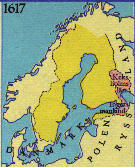
The 17th century was a time of construction and modernization. At the beginning of the 17th century, Sweden had a poor economy and a small population. But it also had vast natural resources. Copper plate, bar iron, and tar were exported, creating the conditions for Sweden's expansive and violent foreign policy.The image shows Sweden’s borders at the beginning of the 17th century. The Swedish territory is in the color dark yellow and pink.
The Thirty Years' War 1618 - 1648
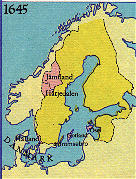
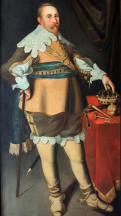
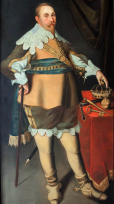
The Thirty Years' War was fought primarily in Central Europe between 1618 and 1648. Its causes derived from religious conflict within the Holy Roman Empire, sparked by the 16th-century Reformation. In addition, the acquisition of territories within the Empire by rulers like Gustav II Adolf of Sweden gave them and other foreign powers an ongoing motive to intervene. Between 1600 to 1629, Sweden was at war with Poland. Sweden was able to join the Thirty Years' War following the ceasefire in Altmark in 1629, which required Poland to give up numerous important ports and accept Swedish possession of Livland.On June 26, 1630, Gustav II Adolf intervenes with Swedish troops in the Thirty Years' War. Sweden sided with the Protestant German states against the superior Catholic armies under the Holy Roman Emperor Ferdinand II. Gustav II Adolf led a successful campaign in the Holy Roman Empire, becoming a prominent unifying figure for Protestants and gaining his most significant military victory against the imperial army at the Battle of Breitenfeld in September 1631. The image shows King Gustav II Adolf of Sweden, a painting by Jacob Heinrich Elbfas. Gustav II Adolf was sovereign between 1611 and 1632. Image: Wikipedia.Gustav II Adolf falls in battle at Lützen on November 6, 1632, but the Swedish army continues the war under the leadership of its generals. In 1648, the Peace ofWestphalia is concluded. Sweden gains new possessions in Northern Germany on the Baltic Sea and is now considered one of Europe's leading nations.War with Denmark: Sweden launched an unexpected invasion on Denmark in 1643. The attack originated from Germany. Sweden had an ambition to gain more territory on the west coast. Previous wars with Denmark had shown how difficult it was for Sweden to defend the Älvsborg fortress, the only Swedish gateway on the west coast at this time, as long as the Danes possessed land south and north of Älvsborg (where today's Gothenburg is located). Since the Kalmar Union, Sweden has been immune from duty in Öresund, the sound between Sweden and Denmark. However, Denmark was continuously making new exceptions to the exemption, which irked the Swedes. The war began in 1643 and was fought between Sweden and Denmark-Norway. The war ended with the Peace Treaty of Brömsebro in 1645. After its successes in the war, Sweden made far-reaching demands. Denmark-Norway ceded the Norwegian provinces of Jämtland and Härjedalen and the Danish islands of Gotland and Ösel in the Baltic Sea to Sweden. Sweden also received the province of Halland for 30 years. The image shows Sweden’s new borders according to the Peace of Brömsebro. The new provinces Sweden gained are in the color pink.
The Wars - a Heavy Burdens for the Population
Although the conflicts are fought outside of Sweden, they impose a significant economic and human cost on the Swedish people. Many farmers are drafted into military service. Few of them return alive. Disease claims more victims than the fighting.During Sweden's first three years in the Thirty Years' War alone, 15,000 Swedish and Finnish soldiers died.
War with Denmark - The Peace Treaty of Roskilde in 1658
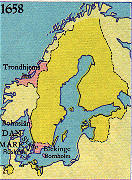
On June 20 1657, when King Karl X Gustav and the Swedish Army was involved in a war in Poland, the King got information on Danish hostilities. On June 16, 1657 Denmark had made an attack on Swedish Bremen in Northern Germany. On June 23, the Swedish King left Poland with a force of 6,000 soldiers. The destination was Denmark. The force was small, but this was probably the best and most experienced soldiers at the time. The Danish army mostly consisted of fresh recruits and they were now about to meet the most efficient army at the time. Soon, the Swedes had occupied Jutland. On February 5 1658 the Swedes moved out from Fyn on the ice over the sound Stora Bält via the islands Langeland and Lolland to Zealand. The Swedish army was now close to Copenhagen, which they reached on February 15. The Danes were now ready for peace talks.In the Peace Treaty of Roskilde in 1658 Sweden received the Danish provinces; Skåne, Blekinge, Halland, Bohuslän, the island Bornholm and Trondheim county in today’s Norway. Halland became Swedish for a period of 30 years in the peace treaty of Brömsebro in 1645. Now it permanently became a Swedish province. In the peace treaty Denmark lost about 1/3 of its area.Sweden now had natural borders in the south and on the west coast. The image shows Sweden’s new borders according to the Peace of Roskilde. The new provinces Sweden gained are in the color pink.
The Great Power Period of Sweden
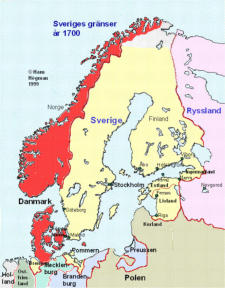
During Queen Christina's reign, the Swedish nobility's wealth and power grew. Expensive palaces were built in Stockholm and castles in the countryside. New territories are conquered. In 1645, Gotland, Halland, Jämtland, and Härjedalen become Swedish provinces. At the Peace of Roskilde in 1658, the provinces of Skåne, Blekinge, and Bohuslän also became Swedish.Karl X Gustav was with the Swedish army in Poland when Denmark, in June 1657, declared war on Sweden. Karl X Gustav then marched through Jutland to attack Copenhagen. The winter of 1657-58 was extremely cold. The ice over the Great and Little Belts had frozen over. The Danes were caught off guard when the Swedes marched across the ice on January 30, 1658, and promptly surrendered. The image shows Sweden’s territorial borders in 1700. Click on the map to enlarge it. Sweden's territory is colored yellow.
New Sweden - a Colony in North America
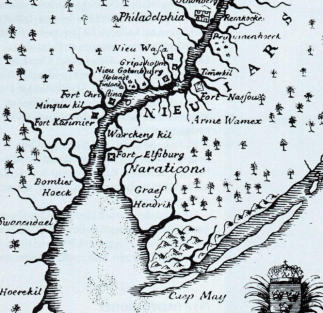
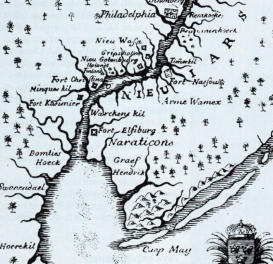
The 17th century was a time when Sweden expanded its borders in Europe by force. It was undoubtedly an achievement to establish a colony in North America under these circumstances. The many Swedish ongoing wars did cost a fortune and many soldiers were needed in the army. At the end of November in 1637 the Swedish pinnaces Kalmare Nyckel and Fågel Grip embarked from the port of Göteborg (Gothenburg) with Delaware Bay, North America as their destination. Aboard were also fully 20 Swedish soldiers under the command of Army Lieutenant Måns Nilsson Kling. The plan was to establish a Swedish colony by the Delaware Bay between the existing English and Dutch colonies. The ships then entered Delaware Bay and proceeded cautiously up the Delaware River and finally ported on March 23, 1638 at a rocky point known as “The Rocks” on the Minquas Kill near the Christina River. A few days later representatives for the river area’s two Indian tribes, the Lenapes and the Minquas boarded the Kalmare Nyckel and an agreement was signed. The right to colonize of the land on the western side of the Delaware was officially and legally transferred to the New Sweden Companyand its settlers. Fort Christina in today’s Wilmington was built on a hill near the landing rock as protection for the trading station. The palisaded bastions were surrounded with an earthwork and armed with guns. The fort stood ready before fall and was named after the Swedish monarch, Queen Christina. The main function of this and other forts became to protect the Swedes from other Europeans, not from the Indians who were friendly trading partners and agricultural advisers. Land was broken for farming and the houses built were constructed with the Swedish X-joint log house technique, a new building technique in North America. The craft was quickly adopted by other colonists and settlers.Swedish law was practiced in the colony. Churches were built, run by clergy from Sweden. The settlers broke new land and the colony grew in size and new agreements were made with the Indians. The population was rising and the colony now counted about 400 people. The map shows the New Sweden Colony by the Delaware River.Among the Swedish settlers were also many ethnic Finns, about 22%. These Finns were so-called Forest Finns from central west Sweden, primarily from the provinces Västmanland and Värmland. Finland was a part of Sweden until 1809. However, Finland was never a “nation” under Swedish rule but one of four Swedish regions or "lands" (landsdelar); Svealand, Götaland, Norrland and Finland. However, the success of New Sweden was a source of conflicts with the other colonial powers, the English and the Dutch. The Dutch colony, New Netherlands was located just north of New Sweden while the English colony, Colony of Virginia (today's Virginia) was southwest of New Sweden. A thorn in the eye for the Dutch was the Swedes better relationship with the Indians. On August 31, 1655 the Dutch fleet was discovered in the Delaware Bay approaching Fort Trinity. Captain Sven Skute, commander of the fort, could not hold the fort against the five times larger Dutch force and surrendered negotiating for free withdrawal. New Sweden surrendered on September 14, 1655 and the fort was handed over to the Dutch the following day. Thereby all of New Sweden fell into the hands of the Dutch. It was no coincidence that the Dutch attacked New Sweden in the summer of 1655. Sweden was at war in Europe. So, Sweden was fully occupied with the wars in Europe and had no opportunity to send reinforcements to New Sweden. In 1664 a war broke out between the Netherlands and England. The British conquest of the New Netherlands was commenced on August 29, 1664. The conquest continued, and was completed in October 1664, when the British captured Fort Casimir. The Swedish colony now officially becomes the Delaware Colony under an English rule.The Swedish colonization of North America didn’t end with New Sweden. The Swedish settlers were still there. It has been estimated that there were about 400 Swedes in the area in 1655 and 110 Swedish homesteads along the western bank of the Delaware River. The Swedish culture and traditions remained for another century and a half.More information is available at New Sweden.
Milestones, schoolbooks, household examinations, church records, the postal service, the land survey agency, etc. are some of the building blocks as society is now being organized.Subdivision into “Län”: In the 1634 Constitution, Sweden was divided into larger regions called “Län”, or counties in English. The sole purpose of the counties is regional administration. The county lines have changed many times since 1634; the Crown often chose to make slight changes to suit its purposes. So, counties have been divided and consolidated over time. In some cases, the administrative counties correspond almost exactly to the provinces; in other cases, they do not. So, Sweden's counties are an administrative division of Sweden introduced in 1634. In each county (Län) there is a County Administrative Board (Länstyrelse) headed by a County Governor (Landshövding) appointed by the national government. The purpose of the Länstyrelse is to supervise local state administration and to coordinate national political goals with the central government. Sweden is today (2019) divided into 21 counties. However, in 1634, the realm was divided into 12 counties (Län) in Sweden and 5 in Finland, with an additional 6 counties in the Swedish foreign provinces in the Baltics and Northern Germany, for a total of 23 counties. When the subdivision into Län was introduced, the former subdivision of Provinces lost its importance as administrative units.A new church law was introduced in 1686. It required the church to keep records of household examinations, births, marriages, deaths, and moves. Household examinations were used to regularly check residents' knowledge of Christianity. Attendance at church services was also compulsory. At the time, the church was the only legitimate news medium available to those in authority to reach the general public. Religion was not the only thing preached in churches, but also the crown's decrees.When the Swedish postal service (Swedish: Postverket) was established in 1636, mail could be delivered on a regular basis. A letter from Stockholm in Central Sweden to Ystad in Southern Sweden took a maximum of five days. Letters were distributed by postal couriers. They were subject to a strict requirement to maintain a speed of two hours per mile; otherwise, they would be punished.A standing army (“Indelningsverket,” the allotment system) was organized in 1682.With Karl XI's reduction in 1680, the state reclaimed large parts of the tracts that had previously been distributed to the nobles. This was essential for the establishment of the allotment system.Education: As early as the High Middle Ages (1000 to 1200), every cathedral had a cathedral school (or cathedral college, as it was also called), whose primary task was to educate priests. The school's primary task was to prepare students for university studies. In 1626, secondary education (Swedish: Gymnasium) was introduced, and the cathedral school was converted into a trivial school. The trivial school was a lower secondary school teaching the trivium (grammar, rhetoric, and dialectic), followed by a four-year secondary school (Swedish: Gymnasium). The primary responsibilities of upper secondary schools were outlined in the 1649 school ordinance. These statutes split the educational system into three stages: elementary schools (trivial schools), upper secondary schools (Gymnasium), and academies (universities). The first two stages comprised four one-year classes. However, there was no compulsory schooling at this time. The 1649 gymnasium was, of course, deeply rooted in theology. A new school system was introduced in 1693. It stipulated that those who wanted to go on to university had to pass a knowledge test. This was an early form of the student exam. The universities soon acquired a fixed structure and consisted of four faculties: philosophy, theology, law, and medicine. Uppsala University, founded in 1477, is the oldest university in Sweden.Several universities were established in the Swedish provinces during the Great Power Age. This was part of the Swedishization of these territories. The Swedish universities at the end of the 1600s:1.Uppsala University, founded in 1477 in the city of Uppsala, 50 km north of Stockholm.2.Dorpat University, founded in 1632 in today’s Estonia.3.Åbo University, founded in 1640 in the city of Åbo in today’s Finland.4.Lund University, founded in 1668 in Skåne province, southern Sweden.5.Greifswald University, founded in 1456 in Northern Germany. It was a Swedish university from 1648 to 1815.More information is available at Swedish School SystemBanking system: In 1657, Sweden's very first commercial bank, Stockholm Banco, was founded. They began issuing banknotes in 1661. These banknotes were for fixed amounts and were designed as proof of credit. In 1668, the Rikets Ständers Bank (now the Riksbank) was established. This was the world's first central bank, and it is still in operation today. More information is available at Swedish Banking and the Swedish Monetary System
Witch Trials
The second half of the 1600s was a period of many witch trials in Sweden. A series of witch trials and executions began in 1668 and lasted 8 years, ending in 1676. They were very intensive in a zone stretching from the province of Bohuslän on the west coast, over the provinces of Värmland and Dalarna, to Hälsingland and Ångermanland on the east coast. These witch-hunts were triggered off by an event that took place in Älvdalen, Dalarna province, in 1667. An 11-year old girl, Gertrud Svensdotter, and a younger boy, Mats Nilsson, were herding some goats in 1667 by the East Dal River in Älvdalen. For some reason, the two fell out, and the younger boy took a beating from the older girl. The boy later told his father that Gertrud was walking on the water when she crossed the river, and he in turn told the local parish minister, Lars Elvius. The parish minister interrogated Gertrud several times until she confessed to witchcraft. Gertrud also pointed out seven others, and the witch trial started in September 1668. The executions in Älvdalen were carried out on 19 May 1669; six women and one man were beheaded and burned on a bonfire of witchcraft. The 1668 trial unleashed the great witch hysteria in Sweden called Stora oväsendet (The Great Noise), involving a series of witch trials in many parts of the nation and lasting until 1676. The witch trials in Sweden were unique because they largely relied on children as witnesses. In total there were 400 persons executed for witchcraft in Sweden, of witch 300 were in the period 1668-1676. Another couple of hundred were also convicted. However, they were not executed. The doomed were beheaded first, and their bodies were then burned on a bonfire.In 1674 a horrible witch trial took place in Torsåker, province of Ångermanland. The witch hunts here began a few years after Laurentius Hornaeus had been appointed assistant parish minister in Ytterlännäs parish when parish minister Johannes Wattrangius, head of the Torsåker pastorate, commissioned Hornaeus to track down the witches. They were convinced that there was a giant struggle between the good and the evil and that the witches were the tools of the devil. To save the souls of the witches and to spare them the eternal fire of hell, it was necessary to get the witches to confess. Both Wattrangius and Hornaeus believed that torture was necessary to accomplish that goal. The water test was one method the authorities used to determine if a woman was a witch. The accused woman was tied up and thrown into a lake, river, or some other body of water. If she sank and drowned, then she was innocent. However, if she floated on the water, she was condemned as a witch and was to be executed. The Church was responsible for conducting the witch-hunt and for converting them back to Christianity; The worldly authorities were responsible for delivering a conviction in a court of law. A special Witchcraft Commission was established for this purpose. It was the responsibility of the Commission to make sure that the witches and ogresses were caught and sentenced to death. The district court in Torsåker began the trial on 15 October 1674. The witch-hunting in Torsåker reached its climax in 1674– 675 when a very large number of women in Ytterlännes were sentenced to “Yxa och bål” (ax and be burnt) or, in plain English, “to be beheaded and be burned at the stake” for witchcraft. A total of 71 persons, consisting of 65 women, 2 men, and 4 boys, were beheaded and burned at the stake on 1 June 1675. If half of the inhabitants in the three parishes were women, there would have been 336 women in the pastorate. Of these, 65 women were executed, or 19% (every fifth woman). The youngest woman executed was 18 years of age and the oldest 70.The mountain in Torsåker, where the executions took place, is still today called Häxberget or Bålberget (the “Witch Mountain” or the “Bonfire Mountain”).More information is available at Swedish Witch Trials
War with Denmark 1675 - 1679
When King Karl X Gustav of Sweden died in February 1660, the crown prince Karl was merely 5 years old. So, between 1660 and 1672, (when the crown prince formally became the Swedish regent), Sweden had a regency. During this period of regency, the Swedish armed forces were badly neglected and in 1672 the financial situation was a mess. Ever since the Peace of Roskilde in 1658, Denmark has had plans to regain their lost territory to Sweden. Now, Denmark saw a chance and opportunity and launched an attack on Sweden. At the end of June 1676 Denmark landed troops in province of Skåne and in August the province was in Danish hands. King Karl XI acted immediately on the Danish attacks of Sweden and through a series of battles the Danish attack was stopped and the Danish dream of getting Skåne back remained a dream. In one of bloodiest battles in Swedish history, the Danes were defeated in the Battle of Lund in December 4,1676. More than 9.000 soldiers were killed, about 4.000 Swedes and 5.000 Danes. Sweden defeated the Danes and this was an important turn point of the war.The Military Allotment System: Karl XI realized after the war that the Swedish Armed Forces needed to be reformed so that they could respond to threats more quickly. It takes too long to draft an army each time, as in the Early Allotment System. His goal was to build a standing army that could be quickly mobilized and respond to threats. In 1682 the so-called Late Allotment System (Swedish: Yngre Indelningsverket) was introduced. The Allotment System meant that a standing army was to be established in Sweden and Finland, and it was a system of organizing and financing the Swedish armed forces. With the Allotment System, Sweden got a well-drilled and a well-equipped army.The allotment system meant that 2 - 4 farms were grouped together in a so-called “rote” (district or ward), and each “rote” was obliged to provide one soldier with a croft (cottage), a parcel of arable land, and an annual salary for the province’s infantry regiment. More information is available at The Allotment System
The following historical section is by no means complete from a historical perspective. The purpose of this page is to provide a chronological historical overview of events in Sweden that may have had a connection with or impact on the lives and livelihoods of my and others’ Swedish ancestors.
1500s
Swedish Monarch Gustav Eriksson Vasa
With Gustav Vasa, Sweden changed from a country in a forced Nordic union with Denmark to an independent kingdom. With help from Lübeck and an armed peasantry, Gustav Vasa succeeded in driving the Danes out of Sweden. This war is known as the War of Liberation. He was appointed Protector of the Realm in 1521 in Vadstena and crowned King of Sweden on June 6, 1523, in Strängnäs. Sweden was now liberated, which is one of the reasons why we celebrate June 6 as our National Day.King Gustav I of the Vasa dynasty was the Swedish monarch between 1523 and 1560. The Vasa dynasty was the first monarchical dynasty to rule a united Swedish realm as hereditary monarchy. His royal name was King Gustav, or Gustav I, but he is better known as King Gustav Vasa.The Reformation broke the power of the church and transferred it to the king. Silver and church bells were confiscated from monasteries and churches, melted down, and used, among other things, to build up the country's administration. The king thus became not only head of state but also head of the Church of Sweden. More information about the Reformation is available at The Reformation and King Gustav IGustav Vasa had large war debts to Lübeck. The War of Liberation (against the Danes) had cost huge sums of money. The debt to Lübeck amounted to 114,500 marks, an enormous sum at that time. The confiscation of the Church's wealth was a way of obtaining money to pay the debt and rebuild Sweden. Sweden, which had previously been a Catholic country, became Protestant under Gustav Vasa. The image shows King Gustav I of Sweden. Portrait from around 1558, unknown artist. The portrait collection at Gripsholm Castle. Image: Wikipedia.The Kalmar Union was a Scandinavian personal union, agreed upon at a meeting at Kalmar Castle, Kalmar City, Sweden, between the kingdoms of Denmark, Norway, and Sweden, joined under a single monarch, that was formed in 1397. The Kalmar Union was ruled from Copenhagen, Denmark. The union was a political and economic necessity to limit German expansion to the north during the 14th century, which was constituted by the Hanseatic League, the Teutonic Order, and North German principalities. For Sweden, the union lasted until June 6, 1523, when Gustav Eriksson Vasa was crowned King of Sweden and restored Sweden's independence. Sweden unilaterally left the Kalmar Union, which was never accepted by the Danes. The dissolution of the union for Sweden was preceded by the so-called Stockholm Bloodbath in November 1520, directly after the Danish king Kristian II:s coronation as Swedish king, and the following War of Independence. During the Stockholm Bloodbath, between November 7 and 9, approximately 50 to 60 leaders of the Swedish nobility were executed by the Danish King Kristian II. After the bloodbath, the Danish King Kristian was referred to as Kristian the Tyrant in Sweden.In 1536, Norway was reduced from a sovereign country to crown land under the Danish king. King Gustav rules his people in matters large and small. A population register is established. In order to efficiently collect taxes from the Swedish people, a reliable population register was needed. As early as 1524, the land register, the property register of the time, was established.The Bible is translated into Swedish, but the king also gives advice on how to build fences and salt herring.Rebellions in Småland and Dalarna are harshly suppressed. He makes Sweden a hereditary kingdom, thereby securing his family's political power.All estimates of Sweden's population prior to the mid-18th century are highly uncertain, but it is believed that the Swedish Empire had approximately half a million inhabitants in the western half of the country and 200,000 in Finland (Finland was a part of Sweden), based on the land register of farms and estates that Gustav I had established.
The Sons of Gustav Vasa
Three of Gustav Vasa's sons became kings: Erik, Johan, and Karl. They were all raised to be able to measure themselves against the Renaissance princes of Europe. When the eldest son, Erik, became king in 1560, a power struggle arose between the brothers. Erik XIV imprisoned Johan and his Polish-born wife, Katharina Jagellonica. Erik was ousted and imprisoned in 1568 by Johan and Karl, who had formed an alliance with the nobles. Johan became king. When Johan died in 1592, his son Sigismund inherited the crown. However, he was Catholic and had already been elected king of Poland. This caused problems, as Sweden was now a Protestant country. In 1598, Sigismund was defeated by his uncle Duke Karl in a battle at Stångebro in Östergötland. Karl IX becomes king and five of the councilors who swore allegiance and obedience to Sigismund are executed in the Linköping Bloodbath. Karl IX dies in 1611.
Älvsborg Ransom
The Älvsborg ransom refers collectively to the sums of money that Sweden was required to pay to Denmark in two separate peace treaties—Stettin (1570) and Knäred (1613)—in order to regain the (old) Älvsborg fortress in Gothenburg's harbor entrance. At that time, Sweden's only port to the west with access to the Skagerrak, Kattegat, and North Sea is Älvsborg, near present-day Gothenburg. Under the sons of Gustav Vasa, Sweden fought wars with varying degrees of success against Denmark, Poland, and Russia. The Älvsborg fortification was seized by the Danes twice, in 1571 and 1611, and had to be bought back at great expense, known as the Älvsborg ransom. The first was for 150,000 Riksdaler SM, while the second was for one million. The figures reflect not just the value of the fortress but also serve as general war reparations. The first Älvsborg ransom in 1570: In order to raise this large sum, a tax based on individual assets was levied for the first time in Swedish history. According to a decision made by the Parliament (Riksdag) in 1571, each farmer had to pay a tenth of their property (real estate) and a tenth of their silver, copper, oxen, steers, and other livestock.The second Älvsborg ransom in 1613: The second Älvsborg ransom was paid through loans, extra taxes, and income from the copper trade. The Älvsborg ransom was an additional burden for farmers, on top of several other significant taxes. For historians and genealogists, the Älvsborg ransom has become an important document. The tax collectors kept fairly detailed records.
1600s
Peaceful Reform Work
The 17th century was a time of construction and modernization. At the beginning of the 17th century, Sweden had a poor economy and a small population. But it also had vast natural resources. Copper plate, bar iron, and tar were exported, creating the conditions for Sweden's expansive and violent foreign policy.The image shows Sweden’s borders at the beginning of the 17th century. The Swedish territory is in the color dark yellow and pink.
The Thirty Years' War 1618 - 1648
The Thirty Years' War was fought primarily in Central Europe between 1618 and 1648. Its causes derived from religious conflict within the Holy Roman Empire, sparked by the 16th-century Reformation. In addition, the acquisition of territories within the Empire by rulers like Gustav II Adolf of Sweden gave them and other foreign powers an ongoing motive to intervene. Between 1600 to 1629, Sweden was at war with Poland. Sweden was able to join the Thirty Years' War following the ceasefire in Altmark in 1629, which required Poland to give up numerous important ports and accept Swedish possession of Livland.On June 26, 1630, Gustav II Adolf intervenes with Swedish troops in the Thirty Years' War. Sweden sided with the Protestant German states against the superior Catholic armies under the Holy Roman Emperor Ferdinand II. Gustav II Adolf led a successful campaign in the Holy Roman Empire, becoming a prominent unifying figure for Protestants and gaining his most significant military victory against the imperial army at the Battle of Breitenfeld in September 1631. The image shows King Gustav II Adolf of Sweden, a painting by Jacob Heinrich Elbfas. Gustav II Adolf was sovereign between 1611 and 1632. Image: Wikipedia.Gustav II Adolf falls in battle at Lützen on November 6, 1632, but the Swedish army continues the war under the leadership of its generals. In 1648, the Peace ofWestphalia is concluded. Sweden gains new possessions in Northern Germany on the Baltic Sea and is now considered one of Europe's leading nations.War with Denmark: Sweden launched an unexpected invasion on Denmark in 1643. The attack originated from Germany. Sweden had an ambition to gain more territory on the west coast. Previous wars with Denmark had shown how difficult it was for Sweden to defend the Älvsborg fortress, the only Swedish gateway on the west coast at this time, as long as the Danes possessed land south and north of Älvsborg (where today's Gothenburg is located). Since the Kalmar Union, Sweden has been immune from duty in Öresund, the sound between Sweden and Denmark. However, Denmark was continuously making new exceptions to the exemption, which irked the Swedes. The war began in 1643 and was fought between Sweden and Denmark-Norway. The war ended with the Peace Treaty of Brömsebro in 1645. After its successes in the war, Sweden made far-reaching demands. Denmark-Norway ceded the Norwegian provinces of Jämtland and Härjedalen and the Danish islands of Gotland and Ösel in the Baltic Sea to Sweden. Sweden also received the province of Halland for 30 years. The image shows Sweden’s new borders according to the Peace of Brömsebro. The new provinces Sweden gained are in the color pink.
The Wars - a Heavy Burdens for the
Population
Although the conflicts are fought outside of Sweden, they impose a significant economic and human cost on the Swedish people. Many farmers are drafted into military service. Few of them return alive. Disease claims more victims than the fighting.During Sweden's first three years in the Thirty Years' War alone, 15,000 Swedish and Finnish soldiers died.
War with Denmark - The Peace Treaty of
Roskilde in 1658
On June 20 1657, when King Karl X Gustav and the Swedish Army was involved in a war in Poland, the King got information on Danish hostilities. On June 16, 1657 Denmark had made an attack on Swedish Bremen in Northern Germany. On June 23, the Swedish King left Poland with a force of 6,000 soldiers. The destination was Denmark. The force was small, but this was probably the best and most experienced soldiers at the time. The Danish army mostly consisted of fresh recruits and they were now about to meet the most efficient army at the time. Soon, the Swedes had occupied Jutland. On February 5 1658 the Swedes moved out from Fyn on the ice over the sound Stora Bält via the islands Langeland and Lolland to Zealand. The Swedish army was now close to Copenhagen, which they reached on February 15. The Danes were now ready for peace talks.In the Peace Treaty of Roskilde in 1658 Sweden received the Danish provinces; Skåne, Blekinge, Halland, Bohuslän, the island Bornholm and Trondheim county in today’s Norway. Halland became Swedish for a period of 30 years in the peace treaty of Brömsebro in 1645. Now it permanently became a Swedish province. In the peace treaty Denmark lost about 1/3 of its area.Sweden now had natural borders in the south and on the west coast. The image shows Sweden’s new borders according to the Peace of Roskilde. The new provinces Sweden gained are in the color pink.
The Great Power Period of Sweden
During Queen Christina's reign, the Swedish nobility's wealth and power grew. Expensive palaces were built in Stockholm and castles in the countryside. New territories are conquered. In 1645, Gotland, Halland, Jämtland, and Härjedalen become Swedish provinces. At the Peace of Roskilde in 1658, the provinces of Skåne, Blekinge, and Bohuslän also became Swedish.Karl X Gustav was with the Swedish army in Poland when Denmark, in June 1657, declared war on Sweden. Karl X Gustav then marched through Jutland to attack Copenhagen. The winter of 1657-58 was extremely cold. The ice over the Great and Little Belts had frozen over. The Danes were caught off guard when the Swedes marched across the ice on January 30, 1658, and promptly surrendered. The image shows Sweden’s territorial borders in 1700. Click on the map to enlarge it. Sweden's territory is colored yellow.
New Sweden - a Colony in North America
The 17th century was a time when Sweden expanded its borders in Europe by force. It was undoubtedly an achievement to establish a colony in North America under these circumstances. The many Swedish ongoing wars did cost a fortune and many soldiers were needed in the army. At the end of November in 1637 the Swedish pinnaces Kalmare Nyckel and Fågel Grip embarked from the port of Göteborg (Gothenburg) with Delaware Bay, North America as their destination. Aboard were also fully 20 Swedish soldiers under the command of Army Lieutenant Måns Nilsson Kling. The plan was to establish a Swedish colony by the Delaware Bay between the existing English and Dutch colonies. The ships then entered Delaware Bay and proceeded cautiously up the Delaware River and finally ported on March 23, 1638 at a rocky point known as “The Rocks” on the Minquas Kill near the Christina River. A few days later representatives for the river area’s two Indian tribes, the Lenapes and the Minquas boarded the Kalmare Nyckel and an agreement was signed. The right to colonize of the land on the western side of the Delaware was officially and legally transferred to the New Sweden Companyand its settlers. Fort Christina in today’s Wilmington was built on a hill near the landing rock as protection for the trading station. The palisaded bastions were surrounded with an earthwork and armed with guns. The fort stood ready before fall and was named after the Swedish monarch, Queen Christina. The main function of this and other forts became to protect the Swedes from other Europeans, not from the Indians who were friendly trading partners and agricultural advisers. Land was broken for farming and the houses built were constructed with the Swedish X-joint log house technique, a new building technique in North America. The craft was quickly adopted by other colonists and settlers.Swedish law was practiced in the colony. Churches were built, run by clergy from Sweden. The settlers broke new land and the colony grew in size and new agreements were made with the Indians. The population was rising and the colony now counted about 400 people. The map shows the New Sweden Colony by the Delaware River.Among the Swedish settlers were also many ethnic Finns, about 22%. These Finns were so-called Forest Finns from central west Sweden, primarily from the provinces Västmanland and Värmland. Finland was a part of Sweden until 1809. However, Finland was never a “nation” under Swedish rule but one of four Swedish regions or "lands" (landsdelar); Svealand, Götaland, Norrland and Finland. However, the success of New Sweden was a source of conflicts with the other colonial powers, the English and the Dutch. The Dutch colony, New Netherlands was located just north of New Sweden while the English colony, Colony of Virginia (today's Virginia) was southwest of New Sweden. A thorn in the eye for the Dutch was the Swedes better relationship with the Indians. On August 31, 1655 the Dutch fleet was discovered in the Delaware Bay approaching Fort Trinity. Captain Sven Skute, commander of the fort, could not hold the fort against the five times larger Dutch force and surrendered negotiating for free withdrawal. New Sweden surrendered on September 14, 1655 and the fort was handed over to the Dutch the following day. Thereby all of New Sweden fell into the hands of the Dutch. It was no coincidence that the Dutch attacked New Sweden in the summer of 1655. Sweden was at war in Europe. So, Sweden was fully occupied with the wars in Europe and had no opportunity to send reinforcements to New Sweden. In 1664 a war broke out between the Netherlands and England. The British conquest of the New Netherlands was commenced on August 29, 1664. The conquest continued, and was completed in October 1664, when the British captured Fort Casimir. The Swedish colony now officially becomes the Delaware Colony under an English rule.The Swedish colonization of North America didn’t end with New Sweden. The Swedish settlers were still there. It has been estimated that there were about 400 Swedes in the area in 1655 and 110 Swedish homesteads along the western bank of the Delaware River. The Swedish culture and traditions remained for another century and a half.More information is available at New Sweden.
Milestones, schoolbooks, household examinations, church records, the postal service, the land survey agency, etc. are some of the building blocks as society is now being organized.Subdivision into “Län”: In the 1634 Constitution, Sweden was divided into larger regions called “Län”, or counties in English. The sole purpose of the counties is regional administration. The county lines have changed many times since 1634; the Crown often chose to make slight changes to suit its purposes. So, counties have been divided and consolidated over time. In some cases, the administrative counties correspond almost exactly to the provinces; in other cases, they do not. So, Sweden's counties are an administrative division of Sweden introduced in 1634. In each county (Län) there is a County Administrative Board (Länstyrelse) headed by a County Governor(Landshövding) appointed by the national government. The purpose of the Länstyrelse is to supervise local state administration and to coordinate national political goals with the central government. Sweden is today (2019) divided into 21 counties. However, in 1634, the realm was divided into 12 counties (Län) in Sweden and 5 in Finland, with an additional 6 counties in the Swedish foreign provinces in the Baltics and Northern Germany, for a total of 23 counties. When the subdivision into Län was introduced, the former subdivision of Provinces lost its importance as administrative units.A new church law was introduced in 1686. It required the church to keep records of household examinations, births, marriages, deaths, and moves. Household examinations were used to regularly check residents' knowledge of Christianity. Attendance at church services was also compulsory. At the time, the church was the only legitimate news medium available to those in authority to reach the general public. Religion was not the only thing preached in churches, but also the crown's decrees.When the Swedish postal service (Swedish: Postverket) was established in 1636, mail could be delivered on a regular basis. A letter from Stockholm in Central Sweden to Ystad in Southern Sweden took a maximum of five days. Letters were distributed by postal couriers. They were subject to a strict requirement to maintain a speed of two hours per mile; otherwise, they would be punished.A standing army (“Indelningsverket,” the allotment system) was organized in 1682.With Karl XI's reduction in 1680, the state reclaimed large parts of the tracts that had previously been distributed to the nobles. This was essential for the establishment of the allotment system.Education: As early as the High Middle Ages (1000 to 1200), every cathedral had a cathedral school (or cathedral college, as it was also called), whose primary task was to educate priests. The school's primary task was to prepare students for university studies. In 1626, secondary education (Swedish: Gymnasium) was introduced, and the cathedral school was converted into a trivial school. The trivial school was a lower secondary school teaching the trivium (grammar, rhetoric, and dialectic), followed by a four-year secondary school (Swedish: Gymnasium). The primary responsibilities of upper secondary schools were outlined in the 1649 school ordinance. These statutes split the educational system into three stages: elementary schools (trivial schools), upper secondary schools (Gymnasium), and academies (universities). The first two stages comprised four one-year classes. However, there was no compulsory schooling at this time. The 1649 gymnasium was, of course, deeply rooted in theology. A new school system was introduced in 1693. It stipulated that those who wanted to go on to university had to pass a knowledge test. This was an early form of the student exam. The universities soon acquired a fixed structure and consisted of four faculties: philosophy, theology, law, and medicine. Uppsala University, founded in 1477, is the oldest university in Sweden.Several universities were established in the Swedish provinces during the Great Power Age. This was part of the Swedishization of these territories. The Swedish universities at the end of the 1600s:1.Uppsala University, founded in 1477 in the city of Uppsala, 50 km north of Stockholm.2.Dorpat University, founded in 1632 in today’s Estonia.3.Åbo University, founded in 1640 in the city of Åbo in today’s Finland.4.Lund University, founded in 1668 in Skåne province, southern Sweden.5.Greifswald University, founded in 1456 in Northern Germany. It was a Swedish university from 1648 to 1815.More information is available at Swedish School SystemBanking system: In 1657, Sweden's very first commercial bank, Stockholm Banco, was founded. They began issuing banknotes in 1661. These banknotes were for fixed amounts and were designed as proof of credit. In 1668, the Rikets Ständers Bank (now the Riksbank) was established. This was the world's first central bank, and it is still in operation today. More information is available at Swedish Bankingand the Swedish Monetary System
Witch Trials
The second half of the 1600s was a period of many witch trials in Sweden. A series of witch trials and executions began in 1668 and lasted 8 years, ending in 1676. They were very intensive in a zone stretching from the province of Bohuslän on the west coast, over the provinces of Värmland and Dalarna, to Hälsingland and Ångermanland on the east coast. These witch-hunts were triggered off by an event that took place in Älvdalen, Dalarna province, in 1667. An 11-year old girl, Gertrud Svensdotter, and a younger boy, Mats Nilsson, were herding some goats in 1667 by the East Dal River in Älvdalen. For some reason, the two fell out, and the younger boy took a beating from the older girl. The boy later told his father that Gertrud was walking on the water when she crossed the river, and he in turn told the local parish minister, Lars Elvius. The parish minister interrogated Gertrud several times until she confessed to witchcraft. Gertrud also pointed out seven others, and the witch trial started in September 1668. The executions in Älvdalen were carried out on 19 May 1669; six women and one man were beheaded and burned on a bonfire of witchcraft. The 1668 trial unleashed the great witch hysteria in Sweden called Stora oväsendet (The Great Noise), involving a series of witch trials in many parts of the nation and lasting until 1676. The witch trials in Sweden were unique because they largely relied on children as witnesses. In total there were 400 persons executed for witchcraft in Sweden, of witch 300 were in the period 1668-1676. Another couple of hundred were also convicted. However, they were not executed. The doomed were beheaded first, and their bodies were then burned on a bonfire.In 1674 a horrible witch trial took place in Torsåker, province of Ångermanland. The witch hunts here began a few years after Laurentius Hornaeus had been appointed assistant parish minister in Ytterlännäs parish when parish minister Johannes Wattrangius, head of the Torsåker pastorate, commissioned Hornaeus to track down the witches. They were convinced that there was a giant struggle between the good and the evil and that the witches were the tools of the devil. To save the souls of the witches and to spare them the eternal fire of hell, it was necessary to get the witches to confess. Both Wattrangius and Hornaeus believed that torture was necessary to accomplish that goal. The water test was one method the authorities used to determine if a woman was a witch. The accused woman was tied up and thrown into a lake, river, or some other body of water. If she sank and drowned, then she was innocent. However, if she floated on the water, she was condemned as a witch and was to be executed. The Church was responsible for conducting the witch-hunt and for converting them back to Christianity; The worldly authorities were responsible for delivering a conviction in a court of law. A special Witchcraft Commission was established for this purpose. It was the responsibility of the Commission to make sure that the witches and ogresses were caught and sentenced to death. The district court in Torsåker began the trial on 15 October 1674. The witch-hunting in Torsåker reached its climax in 1674– 675 when a very large number of women in Ytterlännes were sentenced to “Yxa och bål” (ax and be burnt) or, in plain English, “to be beheaded and be burned at the stake” for witchcraft. A total of 71 persons, consisting of 65 women, 2 men, and 4 boys, were beheaded and burned at the stake on 1 June 1675. If half of the inhabitants in the three parishes were women, there would have been 336 women in the pastorate. Of these, 65 women were executed, or 19% (every fifth woman). The youngest woman executed was 18 years of age and the oldest 70.The mountain in Torsåker, where the executions took place, is still today called Häxberget or Bålberget (the “Witch Mountain” or the “Bonfire Mountain”).More information is available at Swedish Witch Trials
War with Denmark 1675 - 1679
When King Karl X Gustav of Sweden died in February 1660, the crown prince Karl was merely 5 years old. So, between 1660 and 1672, (when the crown prince formally became the Swedish regent), Sweden had a regency. During this period of regency, the Swedish armed forces were badly neglected and in 1672 the financial situation was a mess. Ever since the Peace of Roskilde in 1658, Denmark has had plans to regain their lost territory to Sweden. Now, Denmark saw a chance and opportunity and launched an attack on Sweden. At the end of June 1676 Denmark landed troops in province of Skåne and in August the province was in Danish hands. King Karl XI acted immediately on the Danish attacks of Sweden and through a series of battles the Danish attack was stopped and the Danish dream of getting Skåne back remained a dream. In one of bloodiest battles in Swedish history, the Danes were defeated in the Battle of Lund in December 4,1676. More than 9.000 soldiers were killed, about 4.000 Swedes and 5.000 Danes. Sweden defeated the Danes and this was an important turn point of the war.The Military Allotment System: Karl XI realized after the war that the Swedish Armed Forces needed to be reformed so that they could respond to threats more quickly. It takes too long to draft an army each time, as in the Early Allotment System. His goal was to build a standing army that could be quickly mobilized and respond to threats. In 1682 the so-called Late Allotment System (Swedish: Yngre Indelningsverket) was introduced. The Allotment System meant that a standing army was to be established in Sweden and Finland, and it was a system of organizing and financing the Swedish armed forces. With the Allotment System, Sweden got a well-drilled and a well-equipped army.The allotment system meant that 2 - 4 farms were grouped together in a so-called “rote” (district or ward), and each “rote” was obliged to provide one soldier with a croft (cottage), a parcel of arable land, and an annual salary for the province’s infantry regiment. More information is available at The Allotment System