Copyright © Hans Högman 2025-09-08


Personlastterrängbil 903 “Valpen” (Off-road
personnel carrier 903)
The 903 off-road personnel carrier (Pltgb 903)
(Swedish: Personlastterrängbil 903 (Pltgb 903),
“Valpen”), is an off-road utility vehicle used by the
Swedish Armed Forces and was one of several
models in Volvo's L3314 series.
The vehicle is a light truck or bus with high ground
clearance. Volvo's name for this vehicle series was
“Laplander.” However, the vehicle began to be
nicknamed “Valpen—the Puppy.”
Full scale deliveries began in 1963.
The vehicles in the series without a letter after the
number “903” mean that the model is in its basic
configuration and equipped with a roof and sides
made of tarpaulin stretched over steel arches,
i.e., a soft top. The doors to the driver's
compartment are two-part. The model does not
normally have a winch.
The 903B, 9033, and 9034 variants were equipped
with full steel cabs (hard top) and full front
doors. Many of these vehicles are equipped with a
mechanical winch connected to the transfer case.
A variant with an open flatbed, a hard-top cab for
two persons, and a winch was provided to the Air
Force and Navy, among others, under the
designation 902B.
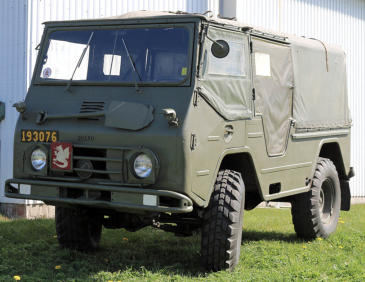
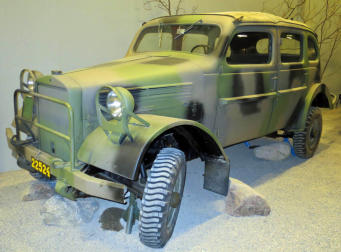
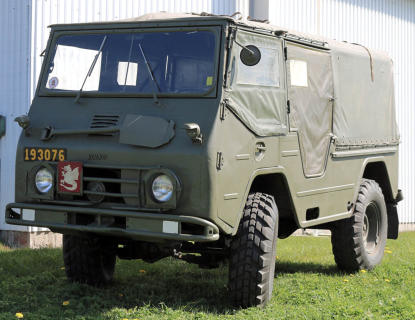
The image shows the off-road personnel
carrier/utility vehicle 903 (Personlastterrängbil 903
"Valpen" (Pltgb 903)) with a roof and sides made of
tarpaulin. Artillery Museum. Image: Wikipedia.
Over 8,000 vehicles in the “903” vehicle family were
delivered to the Swedish Armed Forces. They were
put into service between 1963 and 1964. In 1974,
the vehicle was removed from the military
organization when it was replaced by the
Terrängbil 11 (Off-road vehicle 11).
Due to the large number of vehicles and spare
parts delivered, the 903 utility vehicle remained in
the Armed Forces until the end of the 1990s. Many
were sold off and used as civilian vehicles when
they were taken out of service in the Armed Forces.
Variants:
•
Personlastterrängbil 903: Open body (soft
top) with steel arches and fabric canopy.
•
Personlastterrängbil 903B: Covered steel
body (hard top).
•
Pansarvärnspjästerrängbil 9031 (Pvpjtgb
9031): Anti-tank gun vehicle 9031.
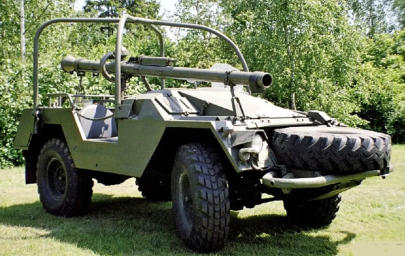
The frame/chassis is basically the same as the
903, but with an open body and a very
different appearance from the basic model. It
was equipped with a 9 cm recoilless anti-tank
gun 1110. The 9031 was developed to create a
mobile anti-tank weapon for the 59th Infantry
Brigade.
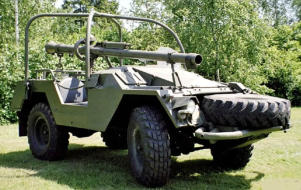
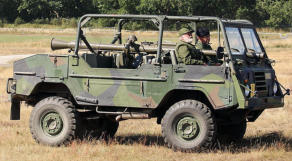
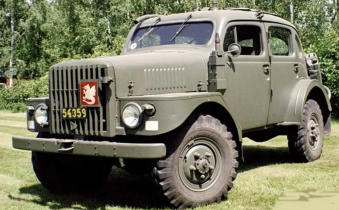
The image shows the anti-tank gun vehicle
9031 (Pansarvärnspjästerrängbil 9031 (Pvpjtgb
9031)). Image: Artillery Museum, ID:
ART.200017.
•
Pansarvärnsrobotterrängbil 9032: Anti-tank
missile carrier 9032. It has launchers for the
missile system RBS 52. Basically the same
appearance as the basic model 903 but with a
different type of canopy.
•
Radiopersonterrängbil 9033: Off-road radio
personnel carrier 9033.
This is a variant for radio communication
based on Volvo's upgraded L3315. Differences
from the base vehicle include a 24-volt
electrical system with dual batteries and an
extra-large AC generator. The radio
communication equipment consisted of one of
the models Ra 120/121/122, Ra145, Ra200, or
Ra422.
•
C202: In the 1970s, Volvo relaunched the
Valpen/Laplander as a cheaper alternative to
the C303 (Tgb11). The main differences
compared to the L3314/15 are that the C202
has the larger B20 engine, higher gear ratios
on the front and rear axles, different seats for
improved comfort, and different
instrumentation.
Specifications:
•
Crew
1
•
Passengers
6
•
Mass
1,600 kg (service weight), 2,250 kg
(maximum weight) 650 kg (load)
•
Length
4.05 m
•
Width
1.65 m
•
Height
2.10 m
•
Engine
Straight 4-cylinder liquid-
cooled Volvo B18A engine 48 kW (64 hp)
•
Transmission
Manual 4-speed + transfer
case. 4 x 4 drive.
•
Max. speed
70 km/h (maximum 33 km/h,
low gear, off-road)
•
Electrical system
12V
•
Manufacturer
AB Volvo
•
Manufactured
1959–1967. C202: 1977–1981
•
In Swedish service
1961-1974
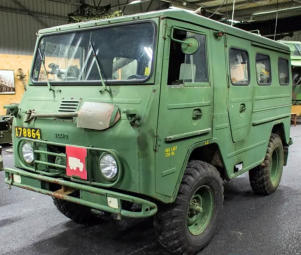
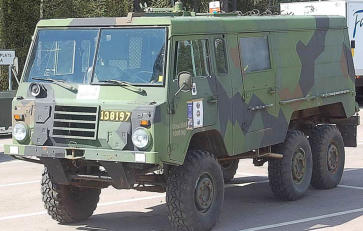
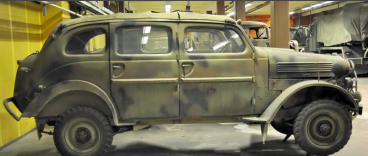
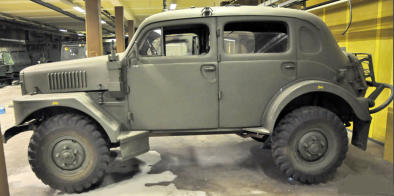
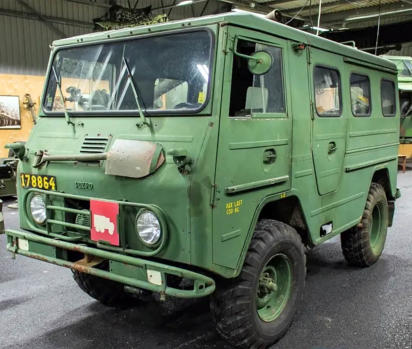
The image shows the off-road personnel
carrier/utility vehicle 903B (Personlastterrängbil
903B (full steel cabs (hard top)) “Valpen”. Image:
Museum of Mobile Coast Artillery, ID:
MRKA.000003.
Terrängbil 11 and 13 (Off-road vehicles 11
and 13)
Off-road vehicle 11 (Swedish: Terrängbil 11, abr.
Tgb 11, Volvo C303) and off-road vehicle 13
(Swedish: Terrängbil 13, abr. Tgb 13, Volvo C304)
are two types of off-road vehicles/utility vehicles
used by the Swedish Armed Forces. They are
usually referred to simply as the 11 or 13 vehicles.
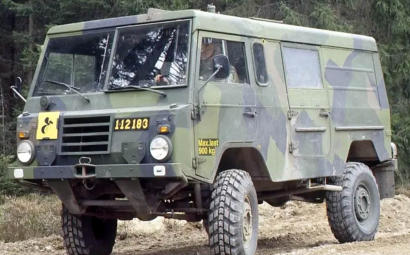
The off-road vehicle 11 (Terrängbil 11) in all its
variants is a further development of Volvo's
previous off-road vehicle 903 (Personlastterrängbil
903 (Pltgb 903 - Valpen)).
The Tgb 11 has two axles, while the Tgb 13 and Tgb
20 have three. The vehicles are normally propelled
on the rear wheels only, but the front wheels can
be engaged to provide all-wheel drive. Portal axles
are used to achieve the highest possible ground
clearance.
In the late 1960s, the Swedish Armed Forces
planned to replace the previous off-road vehicle,
the 903 (Pltgb 903). The work began in 1967. The
new generation of off-road vehicles included
several variants with both two and three axles. A
four-axle variant was also planned, but it was never
realized. What remained were the two-axle four-
wheel drive and three-axle six-wheel drive variants.
Variants:
•
Terrängbil 11 (C303/4141): The Tgb 11 is the
basic variant (two axles) and has been the most
common military vehicle in the Swedish Armed
Forces.
•
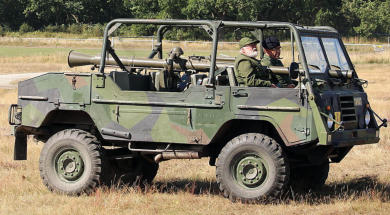
Pansarvärnspjästerrängbil 1111 (C303/4151):
Anti-tank gun vehicle 1111.
It has two axles and an open body with a folding
roll bar. The vehicle is designed for anti-tank
warfare and is armed with a 9 cm anti-tank gun,
the 1110.
The image shows the anti-tank gun vehicle 1111
(Pansarvärnspjästerrängbil 1111 (PvPjTgb 1111)).
Image: Wikipedia.
•
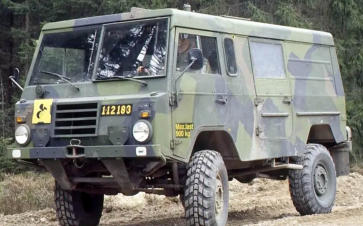
Terrängbil 1112/1113 (C303/4141): The Tgb
1112/1113 is a radio communication off-road
vehicle with two axles and five radio connections.
Otherwise, it is identical to the basic model Tgb
11.
•
Terrängbil 13 (C304/4143): The Tgb 13 is very
similar to the Tgb 11, the difference being that
the Tgb 13 has two rear axles and is one meter
longer at the rear.
•
Other variants:
Terrängbil 1312, This is a three-axle microwave
radio relay off-road vehicle. It has a separate
communications cabin.
Terrängbil 1313 is a three-axle off-road staff
vehicle with a separate communications cabin
for combat command.
Terrängbil 1314A/B is a three-axle medical
transport vehicle with a separate, extra-spacious
medical compartment with room for four
stretchers and emergency equipment.
Terrängbil 1315A/B is an ambulance equipped
with a stretcher for one injured person and the
capacity to carry four civil defense stretchers. Full
medical equipment (according to military
standards), blue lights, and a siren.
Terrängbil 1321A/B is a three-axle artillery
battery vehicle with space behind the driver's
compartment for a battery group belonging to an
artillery or mortar unit.
Specifications Tgb 11:
•
Crew
1
•
Troops
6
•
Mass
2.4 tons (empty), 3.3 tons (fully
loaded), 900 kg load
•
Length
4.35 m
•
Width
1.9 m
•
Height
2.17 m
•
Engine
Straight 6-cylinder liquid-
cooled Volvo B30A engine, 117 hp
•
Max. speed
125 km/h (max. speed in
peacetime: 70 km/h)
•
Sec. armament
Machine gun Ksp 58 in a
mount on the roof
•
Manufacturer
AB Volvo
•
Manufactured
1974 - 1984
The image shows the off-road vehicle Tgb 11
(Terrängbil 11 (Tgb 11)). Image: Miliseum, ID:
MILIF.030527.
Specifications Tgb 13:
•
Crew
1
•
Troops
6
•
Mass
2.82 tons (empty), 4.4 tons (fully
loaded), 1.5 ton load
•
Length
5.35 m
•
Width
1.9 m
•
Height
2.17 m
•
Engine
Straight 6-cylinder liquid-
cooled Volvo B30 A engine, 117 hp
•
Max. speed
110 km/h (max. speed in
peacetime: 70 km/h)
•
Sec. armament
Machine gun Ksp 58 in a
mount on the roof
•
Manufacturer
AB Volvo
•
Manufactured
1974 - 1984
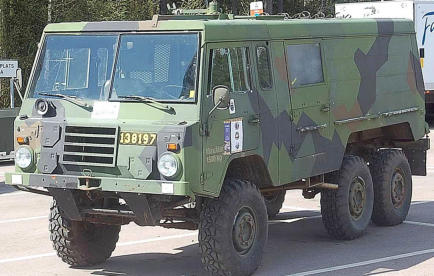
The image shows the off-road vehicle Tgb 13
(Terrängbil 13 (Tgb 13) - three axles). Image:
Wikipedia.
Terrängbil 20 (Off-road Vehicle 20)
The off-road vehicle Tgb 20 (Swedish: Terrängbil
20 (Tgb 20)) began series production in 1974 and
is one of many troop transport vehicles used by the
Swedish Armed Forces. It is commonly referred to
simply as the 20 vehicle.
With the defense decisions of 2000 and 2004, the
vehicle came to serve as a transport vehicle in the
Home Guard's combat companies in southern
Sweden. From 2013, the vehicle began to be
replaced when the Home Guard was supplied with
troop transport vehicle Pb 8.
The off-road vehicle Tgb 20 (C306/4163) is a vehicle
with three axles and a five-speed gearbox.
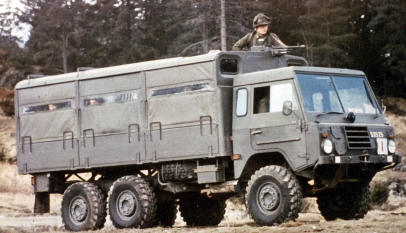
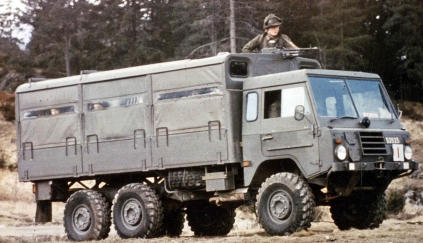
The image shows the off-road vehicle Tgb 20
(Terrängbil 20 (Tgb 20)). Image: Kulturparken
Småland/Smålands museum, ID: REMU0352.
The designation Tgb 20 is a collective name for the
two sub-models, Tgb 21 and Tgb 22.
Variants:
•
Terrängbil 21, Tgb 21, (off-road vehicle Tgb 21) is
the most common variant and is mainly used by
rifle companies in infantry brigades. The entire
rear compartment of the vehicle is equipped with
seats for 16 combat-equipped soldiers. The
compartment can also be converted to
accommodate eight stretchers.
•
Terrängbil 22, Tgb 22, (off-road vehicle Tgb 22) is a
variant adapted for air defense units. Part of the
vehicle's flatbed has been converted to
accommodate air defense missile systems, such
as the Missile System RBS 70 or Missile System
RBS 90.
Specifications:
•
Crew
1
•
Troops
18 soldiers or 8 stretchers
•
Mass
3.39 tons, 5.7 tons (fully loaded),
2.31 tons load, trailer weight: 350 kg
•
Length
6.05 m
•
Width
2.14 m
•
Height
2.8 m
•
Engine
Straight 6-cylinder liquid-
cooled Volvo B30A engine, 117 hp
•
Max. speed
70 km/h
•
Main armament
1 machine gun Ksp 58 on a
roof mount
•
Manufacturer
Volvo
•
Manufactured
1974 -
Personbil 8 (Troop Transport Vehicle 8)
The troop transport vehicle Pb 8 (Swedish:
Personbil 8 (Pb 8) or Grupptransportfordon-Hv) is a
group transport vehicle used by the Swedish Armed
Forces, based on the Mercedes Sprinter 316 but
modified to meet the special requirements for
military vehicles. The vehicle has been developed as
a group transport vehicle for the Home Guard with
the aim of replacing the off-road vehicle Tgb 20,
which has been used by combat companies in
Home Guard battalions in southern Sweden.
A total of 400 vehicles were delivered to the
Home Guard between 2013 and 2016, including a
version with expanded space for liaison and
command.
The vehicle does not have the same off-road
capabilities as, for example, the Tgb 20, but it is
four-wheel drive, has high ground clearance, and is
equipped with skid plates. It has seating for the
driver and eight troops and a cargo area adapted
for combat equipment and personal weapons.
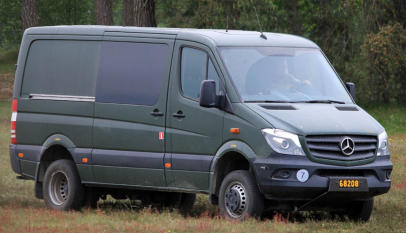
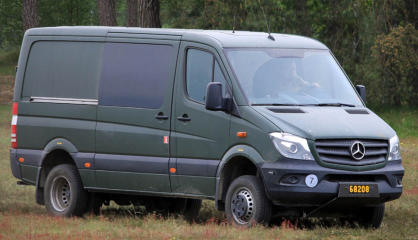
The image shows the troop transport vehicle Pb 8,
mainly used by the Home Guard. Image: Wikipedia.
Specifications:
•
Crew
1
•
Troops
8
•
Mass
3,280 kg
•
Height
2.54 m
•
Motor
4-cylinder eco-friendly diesel
engine, 164 hp
•
Transmission
5-speed automatic with high and
low gear and four-wheel drive
•
Manufacturer
Mercedes
•
Design Engineer
Swedish Defense Materiel
Administration (FMV)
•
Numbers
400
•
In Swedish service
2013 –
Wheeled Off-road Vehicles,
Sweden - 1
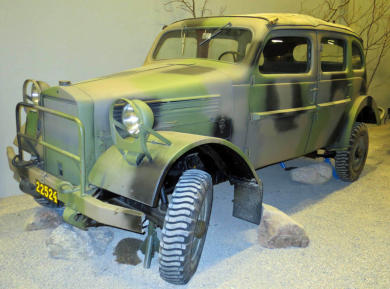
Terrängpersonbil m/1943 (Off-road
Passenger Car m/1943)—the Volvo TPV
Off-road passenger car m/1943—the Volvo TPV
(Swedish: Terrängpersonbil m/1943—Volvo TPV)
was a military off-road passenger car manufactured
by Volvo for the Swedish Armed Forces. It was
designed by Måns Hartelius.
In the Army, the vehicle was designated
Terrängpersonbil m/1943 (abr. Tgpbil m/43).
During World War II, there was a great need for
vehicles within the Armed Forces. Initially, they had to
rely on civilian cars and trucks, which were painted in
camouflage colors. However, these vehicles were not
suitable for off-road use and did not have enough
space for radio equipment. The Armed Forces
needed a staff and radio vehicle with excellent off-road
capabilities, preferably with four-wheel drive.
To shorten the development time for the vehicle,
existing parts were used as much as possible. By
taking an existing passenger car body and placing it
on a modified light truck frame, adding larger
wheels and four-wheel drive, an off-road vehicle
was constructed.
The body, also modified, and the engine came from
the Volvo PV800 series, i.e., the PV 801 and 802,
which were well-known taxis nicknamed “Droskan.”
The axles and a four-speed unsynchronized gearbox
were taken from the Volvo LV101 light truck series
(“spetsnosen”). By equipping the truck axle (rear axle)
with a steering joint, a front axle was created that was
driven via a transfer case. The transfer case was a
new design.
Between 1944 and 1946, 210 units of this vehicle
were manufactured. From the 1950s onwards, the
vehicle was designated Radioterrängpersonbil 911
25W (Ratgpbil 911 25W).
The
image shows the off-road passenger car m/1943
(Terrängpersonbil m/1943 (Tgpb m/43)) – Volvo TPV.
Photo Hans Högman, 2016, Arsenalens
fordonsmuseum.
Specifications:
•
Besättning
1 + 1 radio operator
•
Length
4.80 m
•
Width
1.80 m
•
Heigth
1.95 m
•
Mass
2,340 kg
•
Engine
straight 6-cylinder in-line
engine (3670 cm3), 84 hp
•
Transmission
type E9, 4-speed manual, un-
synchronized, and transfer case 2/4 wheel drive
•
Manufacturer
AB Volvo
•
Volvo designation
TPV
•
Manufactured
1944–1946
•
Numbers
210
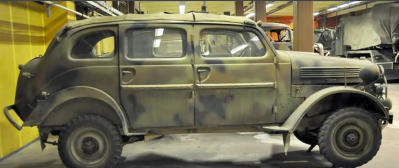
The
image shows the off-road passenger car m/1943
(Terrängpersonbil m/1943 (Tgpb m/43))—the Volvo
TPV. This variant is the Radioterrängpersonbil 911.
Image: Armémuseum, ID: AM.004597.
Radiopersonterrängbil 915 (Off-road Radio
Personnel Carrier 915)
During the 1950s, Volvo manufactured a four-wheel
driven successor to the Tgpb m/1943 (TPV) for the
armed forces, called the TP21 (Terrängpersonvagn
21) or Radiopersonterrängbil 915 (Raptgb
915)—Off-road radio personnel carrier 915, as it
was called by the Swedish Armed Forces. The TP21
(Raptgb 915) off-road vehicle was manufactured
between 1953 and 1958, with 720 units produced.
It was originally nicknamed “Terrängsuggan” (the off-
road sow), based on the nickname “Suggan” (the sow)
for Volvo's PV800 taxi model, on which the militarized
version Volvo TP 21 was based.
The TP 21 was developed by Måns Hartelius at Volvo
as a replacement for the older Volvo TPV (Tgpb m/43)
and was used as a staff and liaison vehicle, primarily
with radio models Ra 121/122 and Ra 422 as
communication means.
The last vehicles remained in service with the Army
until the 1980s, to teach new drivers of the battle
tank 101/102 Centurion how to drive with an un-
synchronized gearbox.
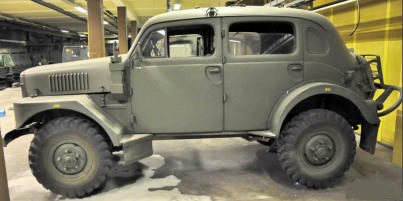
The
image shows the off-road radio personnel carrier
(Radiopersonterrängbil 915 (Raptgb 915))—the Volvo
TP21. Model year 1956. Image: Armémuseum, ID:
AM.006317.
Specifications:
•
Crew
1
•
Passengers
4
•
Mass
2.85 tons
•
Length
4.70 m
•
Width
1,90 m
•
Height
2.15 m
•
Engine
Volvo ED Straight 6-cylinder
(gasoline), cylinder capacity 3.67 liters, 90 hp
•
Load capacity
500 kg
•
Transmission
4×4
•
Ground clearance
0.25 m
•
Max. speed
90 km/h
•
Manufacturer
AB Volvo
•
Volvo designation
TP21
•
Manufactured
1953–1958
•
Numbers
720
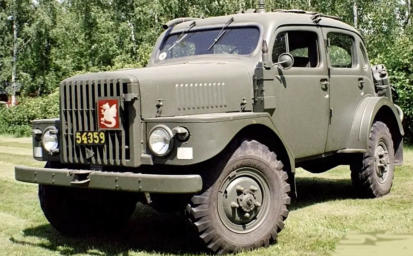
The images shows the off-road radio personnel
carrier (Radiopersonterrängbil 915 (Raptgb 915))—the
Volvo TP21. Modell year 1957. Image: Artillerimuseet,
ID: ART.200010.