Military Hans Högman
Copyright © Hans Högman 2025-09-08

Infantry Fighting Vehicles, Sweden - 1

Introduction

Armored infantry fighting vehicles (AIFVs) [Swedish: Pansarskyttefordon (pskf)], also known as mechanized infantry combat vehicles (MICV), are armed armored vehicles on wheels or tracks designed to carry infantry soldiers (known as armored infantry) to, during, and from combat and to actively participate in combat in cooperation with the armored infantry. Armored infantry must be able to fight both from inside the vehicle through openings (mounted combat) and outside the vehicle in its immediate vicinity (dismounted combat). Armored infantry fighting vehicles should not be confused with similar troop transport vehicles, such as splinter-protected troop transport vehicles, which only transport troops to combat without actively participating in combat themselves. In Sweden, armored infantry fighting vehicles began to be developed in the mid-1930s to meet the need for protected transport for armored infantry in combat. Armored troops were formed as an independent branch of the armed forces in Sweden in 1942. This led to the creation of the armored wheeled off-road vehicle known as Terrängbil Tgb m/42 KP, Sweden's first true armored infantry fighting vehicle.

Infantry Fighting Vehicles, Sweden

Listed below are the infantry fighting vehicles used in the Swedish Armed Forces during the 20th century and up to the present day.

List of Infantry Fighting Vehicles

Armored Car fm/1925 and fm/1926 Armored Car fm/1929 Armored Car m/1931 Armored Car m/1939 and m/1940 Armored Personnel Carrier m/1942 KP Armored Personnel Carrier 203 Armored Personnel Carrier 300 Armored Modular Vehicle 360 Tracked Armored Personnel Carrier 301 Tracked Armored Personnel Carrier 302 Tracked Armored Personnel Carrier 401 Tracked Armored Personnel Carrier 501

Armored Personnel Carrier (Pansarterrängbil)

Pansarterrängbil 203 (Armored Personnel Carrier (APC))

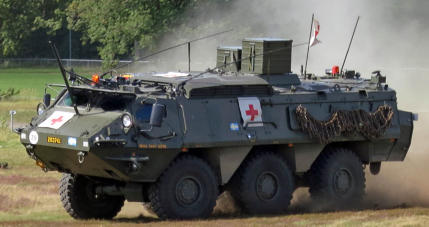
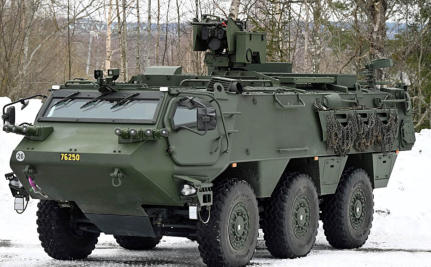
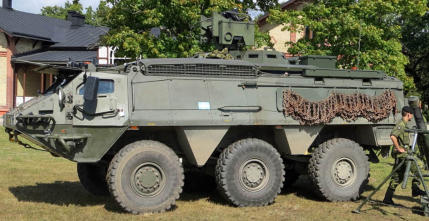
The armored personnel carrier 203 (Pansarterrängbil 203 (Patgb 203)) is a six-wheeled, armored personnel carrier (APC) used by the Swedish Armed Forces. The vehicle is manufactured by Patria, Finland. Today, there are around 165 vehicles in the Swedish Army. The armored personnel carrier 203A is a modification of the Sisu XA-180, which was constructed by the same company in 1983. The vehicle has six smoke launchers mounted on the chassis, three on each side at the front. All variants of the Swedish vehicles, except for the ambulance version, are equipped with a 20 mm automatic cannon m/47D. The cannon with gun turret has been taken from the tracked armored vehicle 302 (Pansarbandvagn 302), which has been decommissioned. When the APC 203 was upgraded to the APC 203B, the weapon cover was replaced with a remote-controlled weapon station of the Kongsberg Protector Nordic (VS01) type. It lacks amphibious capabilities but can wade through water that is up to 1.5 m deep. The image shows the armored personnel carrier 203B (pansarterrängbil 203B (Patgb 203B)). Image: Wikipedia. Variants of the APC 203 A: Troop transport Command & communications Anti-tank missile Field repairs Ambulance CBRN defense Variants of the 203 B: Troop transport Command & communications Field repairs The image shows the armored personnel carrier 203A (pansarterrängbil 203A (Patgb 203A)), the ambulance variant. Image: Wikipedia. Specifications: Crew 2 + 1 in the gun turret (depending on variant) Troops 7 (depending on variant) Mass 20.5 tons Length 7.68 m Width 2.96 m Height 3.25 m Engine Valmet 612 DWBAC 202 kW (274 hp) at 2100 rpm, 1080 Nm at 1600 rpm Max. speed 95 km/h (65 km/h low gear) Armor Ballistic protection against 14.5 mm small-arms fire Main armament 20 mm automatic cannon m/47 Sec. armament 7.62 mm machine gun 58 In Swedish service 2000 - Numbers, Sweden 165

Pansarterrängbil 300 (Armored Personnel Carrier 300 (APC))

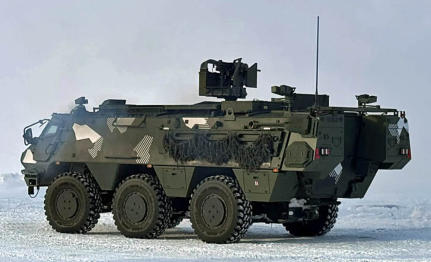
The Patria 6×6 (Patria XA-300) is an all-terrain, six-wheeled armored personnel carrier (APC) manufactured by the Finnish company Patria. The Patria 6×6 is primarily designed for troop transport but can also be configured for other roles. In March 2024, the Swedish Defense Materiel Administration (FMV) signed an agreement with Patria Land Oy for the order of 321 new armored all-terrain vehicles with associated weapon stations. The vehicle is designated Pansarterrängbil 300 (Patgb 300) in Sweden. The order is a result of the Common Armored Vehicle System (CAVS), a research and development agreement, which is a collaboration between Sweden, Finland, Latvia, and Germany, as well as the Finnish industrial company Patria. Sweden joined the collaboration in 2022. Deliveries to Sweden began in the first quarter of 2025. Deliveries of the various vehicle variants will continue until 2030. However, in April 2023, Sweden ordered a pre-series of 20 vehicles on behalf of the Life Guard, which were delivered in the fall of 2023. The image shows the armored personnel carrier 300 (Patgb 300) with weapon station and smoke grenade launcher system. Photo: Patria Land Oy. In December 2025, FMV was commissioned by the Swedish Armed Forces to order an additional 94 Pansarterrängbil 300 vehicles from Patria Land Oy. The order includes troop transport, command, and medical transport variants of the vehicle. A total of 415 vehicles will now be delivered to the Swedish Armed Forces between 2025 and 2030. In December 2025, 14 Troop Transport variant Patgb 300 vehicles were delivered to the Swedish Armed Forces, adding to the previous pre-series of 20 vehicles. The Patria 6×6 (Patgb 300) personnel carrier is a 24-ton, all- wheel-drive armored vehicle with landmine and ballistic protection. It has a crew of two and a gunner, as well as space for nine soldiers in the troop compartment. The vehicle is equipped with air conditioning, hydrostatic shock absorbers, automatic fire extinguishing systems in the engine and crew and troop compartments, camera systems for day and night driving, and a winch. The weapon station can be equipped with heavy machine guns, grenade launchers, and anti-tank weapons, among other things. The image shows the armored personnel carrier 300B (Patgb 300B) with weapon station 02. Photo: Anders Mattsson, FMV. The driver and vehicle commander are positioned in front of the engine compartment, while troop and role-specific equipment is located in the rear compartment. On the right-hand side, there is a passageway that allows movement between the front and rear compartments. The vehicles will be used in motorized units, air defense units, and artillery units, among others. The Patgb 300 is technically simple, easier to train on, and also provides better visibility for the driver and vehicle commander compared to today's Pansarterrängbil 360 (see below). Variants Troop transport vehicles Command and control vehicles Medical transport vehicles Specifications Crew 1 + 1 (driver + vehicle commander + optional gunner) Troops 10 Mass 24 tons Length 7.5 m Width 2.9 m Height 2.5 m Engine DC 09 Scania AB 5-cylinder diesel, 294 kW (394 hp) Load capacity 8,500 kg Max. speed over 100 km/h (land), 8 km/h (water) Transmission 6 x 6 (All-wheel-drive) Armor STANAG 4569 level K2, Manufacturer Patria In Swedish service 2024 - Numbers, Sweden 415 (when all have been delivered)

Pansarterrängbil 360 (Armored Modular Vehicle 360)

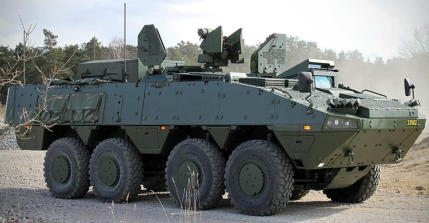
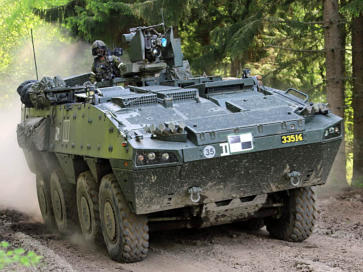
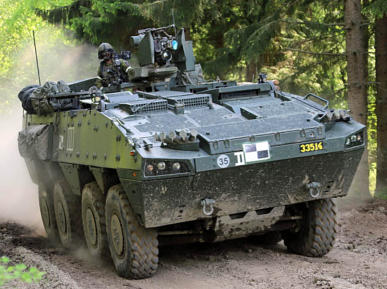
The armored personnel carrier 360 (Pansarterrängbil 360 (Patgb 360)) is the Swedish Armed Forces' new addition to the combat vehicle family and forms the backbone of the motorized battalions. The vehicle is manufactured by the Finnish defense company Patria Land Systems Oy, and the first one was delivered to the Swedish Armed Forces in 2013. The vehicle is a military armored off-road wheeled vehicle with a modular multi-functional transport space (AMV Armored Modular Vehicle) and all-wheel drive (8×8). The vehicle has very good protection against mines and can withstand explosions of up to 10 kg (22 lb) of TNT. The 360 AMV has armor up to 30 mm thick at the front. On August 13, 2010, the Swedish Defense Materiel Administration (FMV) announced that Patria AMV had won the new contract. Among other things, Scania supplied the engines, SSAB supplied the armored steel, and Åkers Krutbruk Protection AB provided the protection. A total of 113 vehicles were delivered. They were delivered in 2012 and were operational in the Army from 2014. The AMV 360 has four axles and a cruising speed of 90 km/h. The vehicle is fitted with a hydraulic ramp that riflemen use to mount and disembark. The crew has its own hatches on top of the vehicle to mount and disembark. Vehicle combat hatches are positioned in the rear of the vehicle. The vehicle includes weapon station 01, which allows for the placement of a variety of weapon options. Usually, a heavy machine gun model 88 (KSP 88) is used. The KSP 88 has a caliber of 12.7 mm. The station's sensors are high-tech and have both day and night vision. The image shows armored modular vehicle 360 (pansarterrängbil 360). Photo: Bodil Böös. Image: Swedish Armed Forces. Variants: Armored personnel carrier Armored command vehicle Armored field repairs vehicle Armored ambulance Specifications: Crew 2–3 (commander, driver, optional gunner) Troops 8–12 (depending on configuration) Mass 14–26 ton (depending on configuration) Length 7.3 m Width 2.9 m Height 2.3 m Engine Scania DI 12 360 kW (483 hp) Max. speed 120 km/h Armor Not specified Main armament 7.62 mm machine gun up to 105 mm canon or twin 120 mm mortars in the turret Sec. armament Protector RWS In Swedish service 2014 - Numbers, Sweden 113 The image shows armored modular vehicle 360 (Pansarterrängbil 360). Photo: Mats Carlsson. Image: Swedish Armed Forces.
xxxxx Swegen xxxxxxxxxxx

xxxxxxxxxxxxxxxxxxxxxxxx
Military Hans Högman
Copyright © Hans Högman 2025-09-08

Infantry Fighting Vehicles,

Sweden - 1

Introduction

Armored infantry fighting vehicles (AIFVs) [Swedish: Pansarskyttefordon (pskf)], also known as mechanized infantry combat vehicles (MICV), are armed armored vehicles on wheels or tracks designed to carry infantry soldiers (known as armored infantry) to, during, and from combat and to actively participate in combat in cooperation with the armored infantry. Armored infantry must be able to fight both from inside the vehicle through openings (mounted combat) and outside the vehicle in its immediate vicinity (dismounted combat). Armored infantry fighting vehicles should not be confused with similar troop transport vehicles, such as splinter-protected troop transport vehicles, which only transport troops to combat without actively participating in combat themselves. In Sweden, armored infantry fighting vehicles began to be developed in the mid-1930s to meet the need for protected transport for armored infantry in combat. Armored troops were formed as an independent branch of the armed forces in Sweden in 1942. This led to the creation of the armored wheeled off-road vehicle known as Terrängbil Tgb m/42 KP, Sweden's first true armored infantry fighting vehicle.

Infantry Fighting Vehicles,

Sweden

Listed below are the infantry fighting vehicles used in the Swedish Armed Forces during the 20th century and up to the present day.

List of Infantry Fighting Vehicles

Armored Car fm/1925 and fm/1926 Armored Car fm/1929 Armored Car m/1931 Armored Car m/1939 and m/1940 Armored Personnel Carrier m/1942 KP Armored Personnel Carrier 203 Armored Personnel Carrier 300 Armored Modular Vehicle 360 Tracked Armored Personnel Carrier 301 Tracked Armored Personnel Carrier 302 Tracked Armored Personnel Carrier 401 Tracked Armored Personnel Carrier 501

Armored Personnel Carrier

(Pansarterrängbil)

Pansarterrängbil 203 (Armored Personnel

Carrier (APC))

The armored personnel carrier 203 (Pansarterrängbil 203 (Patgb 203)) is a six-wheeled, armored personnel carrier (APC) used by the Swedish Armed Forces. The vehicle is manufactured by Patria, Finland. Today, there are around 165 vehicles in the Swedish Army. The armored personnel carrier 203A is a modification of the Sisu XA-180, which was constructed by the same company in 1983. The vehicle has six smoke launchers mounted on the chassis, three on each side at the front. All variants of the Swedish vehicles, except for the ambulance version, are equipped with a 20 mm automatic cannon m/47D. The cannon with gun turret has been taken from the tracked armored vehicle 302 (Pansarbandvagn 302), which has been decommissioned. When the APC 203 was upgraded to the APC 203B, the weapon cover was replaced with a remote-controlled weapon station of the Kongsberg Protector Nordic (VS01) type. It lacks amphibious capabilities but can wade through water that is up to 1.5 m deep. The image shows the armored personnel carrier 203B (pansarterrängbil 203B (Patgb 203B)). Image: Wikipedia. Variants of the APC 203 A: Troop transport Command & communications Anti-tank missile Field repairs Ambulance CBRN defense Variants of the 203 B: Troop transport Command & communications Field repairs The image shows the armored personnel carrier 203A (pansarterrängbil 203A (Patgb 203A)), the ambulance variant. Image: Wikipedia. Specifications: Crew 2 + 1 in the gun turret (depending on variant) Troops 7 (depending on variant) Mass 20.5 tons Length 7.68 m Width 2.96 m Height 3.25 m Engine Valmet 612 DWBAC 202 kW (274 hp) at 2100 rpm, 1080 Nm at 1600 rpm Max. speed 95 km/h (65 km/h low gear) Armor Ballistic protection against 14.5 mm small-arms fire Main armament 20 mm automatic cannon m/47 Sec. armament 7.62 mm machine gun 58 In Swedish service 2000 - Numbers, Sweden 165

Pansarterrängbil 300 (Armored Personnel

Carrier 300 (APC))

The Patria 6×6 (Patria XA-300) is an all-terrain, six- wheeled armored personnel carrier (APC) manufactured by the Finnish company Patria. The Patria 6×6 is primarily designed for troop transport but can also be configured for other roles. In March 2024, the Swedish Defense Materiel Administration (FMV) signed an agreement with Patria Land Oy for the order of 321 new armored all-terrain vehicles with associated weapon stations. The vehicle is designated Pansarterrängbil 300 (Patgb 300) in Sweden. The order is a result of the Common Armored Vehicle System (CAVS), a research and development agreement, which is a collaboration between Sweden, Finland, Latvia, and Germany, as well as the Finnish industrial company Patria. Sweden joined the collaboration in 2022. Deliveries to Sweden began in the first quarter of 2025. Deliveries of the various vehicle variants will continue until 2030. However, in April 2023, Sweden ordered a pre- series of 20 vehicles on behalf of the Life Guard, which were delivered in the fall of 2023. The image shows the armored personnel carrier 300 (Patgb 300) with weapon station and smoke grenade launcher system. Photo: Patria Land Oy. In December 2025, FMV was commissioned by the Swedish Armed Forces to order an additional 94 Pansarterrängbil 300 vehicles from Patria Land Oy. The order includes troop transport, command, and medical transport variants of the vehicle. A total of 415 vehicles will now be delivered to the Swedish Armed Forces between 2025 and 2030. In December 2025, 14 Troop Transport variant Patgb 300 vehicles were delivered to the Swedish Armed Forces, adding to the previous pre-series of 20 vehicles. The Patria 6×6 (Patgb 300) personnel carrier is a 24- ton, all-wheel-drive armored vehicle with landmine and ballistic protection. It has a crew of two and a gunner, as well as space for nine soldiers in the troop compartment. The vehicle is equipped with air conditioning, hydrostatic shock absorbers, automatic fire extinguishing systems in the engine and crew and troop compartments, camera systems for day and night driving, and a winch. The weapon station can be equipped with heavy machine guns, grenade launchers, and anti-tank weapons, among other things. The image shows the armored personnel carrier 300B (Patgb 300B) with weapon station 02. Photo: Anders Mattsson, FMV. The driver and vehicle commander are positioned in front of the engine compartment, while troop and role-specific equipment is located in the rear compartment. On the right-hand side, there is a passageway that allows movement between the front and rear compartments. The vehicles will be used in motorized units, air defense units, and artillery units, among others. The Patgb 300 is technically simple, easier to train on, and also provides better visibility for the driver and vehicle commander compared to today's Pansarterrängbil 360 (see below). Variants Troop transport vehicles Command and control vehicles Medical transport vehicles Specifications Crew 1 + 1 (driver + vehicle commander + optional gunner) Troops 10 Mass 24 tons Length 7.5 m Width 2.9 m Height 2.5 m Engine DC 09 Scania AB 5-cylinder diesel, 294 kW (394 hp) Load capacity 8,500 kg Max. speed over 100 km/h (land), 8 km/h (water) Transmission 6 x 6 (All-wheel-drive) Armor STANAG 4569 level K2, Manufacturer Patria In Swedish service 2024 - Numbers, Sweden 415 (when all have been delivered)

Pansarterrängbil 360 (Armored Modular

Vehicle 360)

The armored personnel carrier 360 (Pansarterrängbil 360 (Patgb 360)) is the Swedish Armed Forces' new addition to the combat vehicle family and forms the backbone of the motorized battalions. The vehicle is manufactured by the Finnish defense company Patria Land Systems Oy, and the first one was delivered to the Swedish Armed Forces in 2013. The vehicle is a military armored off-road wheeled vehicle with a modular multi-functional transport space (AMV Armored Modular Vehicle) and all-wheel drive (8×8). The vehicle has very good protection against mines and can withstand explosions of up to 10 kg (22 lb) of TNT. The 360 AMV has armor up to 30 mm thick at the front. On August 13, 2010, the Swedish Defense Materiel Administration (FMV) announced that Patria AMV had won the new contract. Among other things, Scania supplied the engines, SSAB supplied the armored steel, and Åkers Krutbruk Protection AB provided the protection. A total of 113 vehicles were delivered. They were delivered in 2012 and were operational in the Army from 2014. The AMV 360 has four axles and a cruising speed of 90 km/h. The vehicle is fitted with a hydraulic ramp that riflemen use to mount and disembark. The crew has its own hatches on top of the vehicle to mount and disembark. Vehicle combat hatches are positioned in the rear of the vehicle. The vehicle includes weapon station 01, which allows for the placement of a variety of weapon options. Usually, a heavy machine gun model 88 (KSP 88) is used. The KSP 88 has a caliber of 12.7 mm. The station's sensors are high-tech and have both day and night vision. The image shows armored modular vehicle 360 (pansarterrängbil 360). Photo: Bodil Böös. Image: Swedish Armed Forces. Variants: Armored personnel carrier Armored command vehicle Armored field repairs vehicle Armored ambulance Specifications: Crew 2–3 (commander, driver, optional gunner) Troops 8–12 (depending on configuration) Mass 14–26 ton (depending on configuration) Length 7.3 m Width 2.9 m Height 2.3 m Engine Scania DI 12 360 kW (483 hp) Max. speed 120 km/h Armor Not specified Main armament 7.62 mm machine gun up to 105 mm canon or twin 120 mm mortars in the turret Sec. armament Protector RWS In Swedish service 2014 - Numbers, Sweden 113 The image shows armored modular vehicle 360 (Pansarterrängbil 360). Photo: Mats Carlsson. Image: Swedish Armed Forces.