Copyright © Hans Högman 2025-09-08


Bandvagn m/1948 (Tracked Vehicle m/1948)
The M29 Weasel, also known in Sweden as
Bandvagn m/1948 (Bv m/48), is an American
tracked off-road vehicle with excellent mobility in
difficult terrain, particularly snowy landscapes.
The tracked vehicle was developed by the American
company Studebaker during World War II. After the
war, Sweden purchased surplus equipment from the
Allied forces in Europe, including the M29 Weasel.
In Sweden, the vehicle was designated Bv m/1948,
although it was assigned type number 201 in the
Swedish Armed Forces' M numbering system.
The Bv m/1948 was used by all branches of the
Swedish Armed Forces, and the last vehicles were
taken out of
service in May
1970. The
vehicle was then
replaced by the
tracked vehicles
202 and 203.
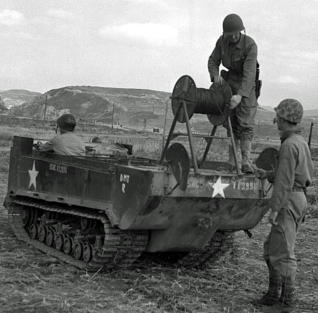
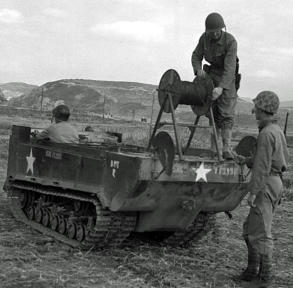
The image
shows the
American M29
Weasel tracked
vehicle, known
in Sweden as the
Bandvagn m/1948 (Bv/48). The photo is from the
Korean War. Image: Wikipedia.
Variants:
•
M29 (without float tanks)
•
M29C (equipped with float tanks, i.e.,
amphibious)
Specifications:
•
Crew
4
•
Mass
1,700 kg
•
Length
3.2 m
•
Width
1.5 m
•
Height
1.3 m
•
Engine
Studebaker Model 6-170
Champion 6-cylinder 70 hp
•
Max. speed
58 km/h
•
Suspension
Tracks
•
Manufacturer
Studebaker,
USA
•
Manufactured
1943 - 1945
•
Numbers
4,476 M29,
10,647 M29C
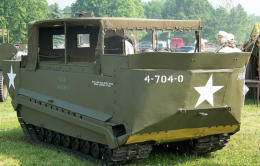
The image shows the American M29C tracked
vehicle (the amphibious variant), known in Sweden
as the Bandvagn m/1948 (Bv/48). Image: Wikipedia.
Bandvagn 202 and 203 (Tracked Vehicles
202 and 203)
The tracked vehicles 202 & 203 (Swedish:
Bandvagn 202/203 (Bv 202/203)) are off-road
articulated tracked vehicles (ATVs) with excellent
mobility in rough terrain. The vehicle consists of
two permanently connected carriages, with the
engine and gearbox located in the front carriage
and a drive shaft to the rear carriage so that all four
tracks are powered. The driver and vehicle
commander are in the front car. In the rear
carriage, up to 8 troops can be transported.
At the end of the 1950s, the articulated tracked
vehicle Bv 202 was developed by the Swedish
company Bolinder-Munktell, a subsidiary of Volvo,
as a replacement for the tracked vehicle m/1948
(M29 Weasel). The Bv 202 was a two-part vehicle
with an actuated linkage in between. The
background to the tracked vehicle was to be able to
easily provide support and maintenance in rough
terrain to army units, especially in northern regions
(Norrland) with their large marshes and deep snow
in winter.
Initial testing of the vehicle took place in 1959.
Series production then took place between 1964
and 1981 at Volvo BM, Arvikaverken. A total of
approximately 1,700 tracked vehicles were
manufactured by Volvo BM.
The tracked vehicle has very low ground pressure,
which means it can be driven on marshes and
wetlands. The Bv 202 is a so-called oversnow
vehicle, which means that it does not sink into the
snow and can therefore be driven in virtually any
depth of snow.
The tracked vehicle has been exported to several
countries, including Norway, Finland, the UK,
Canada, and others.
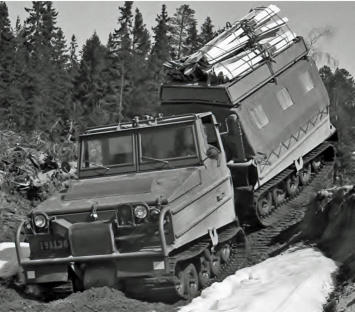
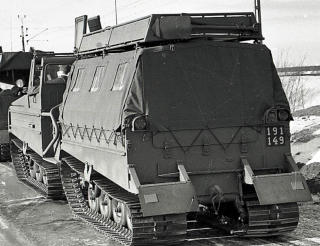
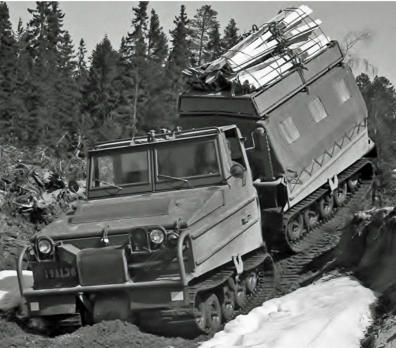
The image shows the articulated tracked vehicle Bv
202A (Bandvagn 202A), at an exercise in Graninge in
1966, belonging to the Västernorrland Regiment, I
21. Photo: Claes-Göran Hedström. Image:
Armémuseum, ID: AMA.0008961.
Variants:
•
Bv 202A – basic model with a canopy roof on the
rear carriage
•
Bv 202B – 12-pin socket for trailers
•
Bv 202C – water radiator heated rear carriage.
•
Bv 202D – extra insulated and heated rear
carriage.
•
Bv 2022 – fire control vehicle 2022, fire control
variant
•
Bv 203B – a radio communications tracked
vehicle with a fixed, heat-insulated
superstructure on the rear carriage equipped for
communications service.
Specifications:
•
Crew
1
•
Troops
9
•
Mass
2,900 kg
•
Length
6.175 m
•
Width
1.8 m
•
Height
2.2 m
•
Engine
82.5 hp/97 hp
•
Load capacity
800 kg (off-road)
•
Max. speed
39 km/h
•
Sec. armament
Machine gun 58
•
Manufacturer
Volvo BM Arvika
•
Manufactured
1964 - 1981
•
Numbers
1,700
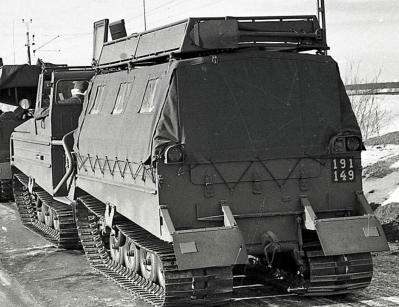
The image shows the articulated tracked vehicle Bv
202A (Bandvagn 202A) during a winter exercise in
Jämtland in March 1966 belonging to the
Västernorrland Regiment, I 21. Photo: Claes-Göran
Hedström. Image: Armémuseum, ID:
AMA.0008948..
Bandvagn 206 and 208 (Tracked Vehicles
206 and 208)
The tracked vehicle 206 (Swedish: Bandvagn 206
(Bv 206)) and tracked vehicle 208 (Bandvagn 208
(Bv 208)) are military tracked off-road vehicles with
articulated steering that can carry up to 17 combat-
equipped soldiers.
The Bv 206 is the basic model in Hägglunds' family of
articulated tracked vehicles (ATVs) with plastic
bodies, but around fifty variants of the Bv 206 have
been manufactured, including both military and
civilian variants.
In the early 1970s, the Swedish Army began
looking for a replacement for the tracked vehicle
202 (Bv 202). The requirements for a new
articulated tracked vehicle included higher load
capacity, better road handling, greater reliability,
and lower maintenance costs. In 1974, Hägglunds
won the contract for what became the tracked
vehicle 206 (Bv 206).
Three test series were built by Hägglunds, and in
June 1979, the Swedish Army ordered 3,500 Bv 206s
but has since placed additional orders for another
1,000 vehicles.
Over 11,000 tracked vehicles of the 206 and 208
were constructed, with the Swedish Armed Forces
receiving a maximum of 4,500.
The Bv 206 and Bv 208 have been exported to a
large number of countries.
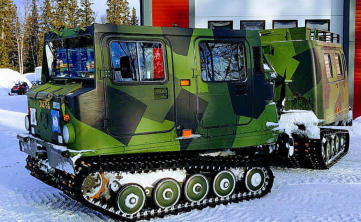
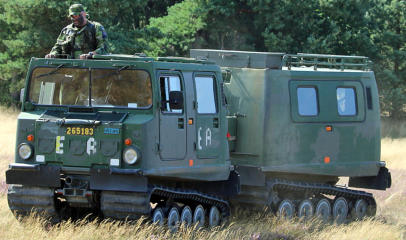
The image shows the articulated tracked vehicle Bv
206 (Bandvagn 206) in 2015. Image: Wikipedia.
In 1990, Hägglunds, in collaboration with the
Swedish Defense Materiel Administration (FMV),
presented an armored variant of the Bv 206,
designated Bv 206S, or, as it is known within the
Swedish Armed Forces, the Bv 308 & 309.
Variants:
The Swedish Armed Forces have had two main
variants of the tracked vehicle, the Bv 206 and the
Bv 208. These two main variants are available in a
large number of sub-variants.
•
The Bv 206 is the standard variant with a Ford
V6 gasoline engine. The Bv 206A is the troop
transport version.
•
The Bv 208, also known as the Bv 206D, has a
Mercedes 5-cylinder diesel engine. The Bv 208 is
a troop transport version similar to the Bv 206A.
Specifications:
•
Crew
1 (driver)
•
Troops
16
•
Mass
2,740 kg (front carriage), 1,760 kg
(rear carriage)
•
Length
6.90 m
•
Width
1.87 m
•
Height
2.30 m (front carriage), 2.45
m (rear carriage)
•
Engine Bv 206
Ford 2658E V6 water-cooled
gasoline engine, 135 hp
•
Engine Bv 208
Mercedes-Benz OM 603.950
Turbo Diesel 3.0 l 136 hp
•
Max. speed
55 km/h (road), 4 km/h
(water)
•
Main armament
Machine gun Ksp 58 or
heavy machine gun Tksp 12.7 in a mount on the
roof
•
Manufacturer
BAE Systems Hägglunds
•
Manufactured
1979 -
•
Numbers
11,000, of which 4,500 are in
Swedish service
•
In Swedish service
1979 -
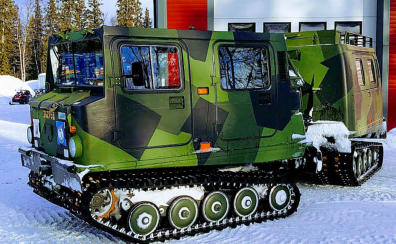
The image shows the articulated tracked vehicle Bv
206A (Bandvagn 206A). Image: Wikipedia.
Bandvagn 308 and 309 (Tracked Vehicles
308 and 309)
The tracked vehicle 308 and 309 (Swedish:
Bandvagn 308/309 (Bv 308/309)), also known as
tracked vehicle 206S (Bv 206S), is a tracked,
articulated, armored personnel carrier with off-
road capability. The tracked vehicle is a two-part
articulated vehicle with two interconnected
carriages, all four of whose tracks are driven.
The tracked vehicle 308/206S (Bv 308/206S) is a
variant of Bv 206 with an armored cabin and diesel
engine, popularly known as Skalman in Swedish.
Initially, this version was called Bv 208, but was
renamed Bv 308 to distinguish it from the
composite plastic tracked vehicles.
The tracked vehicle is, in other words, a further
development of the unarmored basic version Bv
206/208 and was developed in collaboration
between Alvis plc Hägglunds (now BAE Systems
Hägglunds) and the Swedish Defense Materiel
Administration (FMV). In Hägglunds' range, it is
called the Bv 206S.
A total of 479 tracked vehicles of this armored-
protected variant have been ordered.
The Bv 308/309 also has amphibious capabilities.
The reason for the reinforcements to the Bv 309 is
to enable it to participate in operations outside
Sweden's borders. It is equipped with CBRN
protection and air conditioning and can operate in
temperatures ranging from -32 to +46 degrees
Celsius.
Initially, it was intended for use solely by the
Swedish Armed Forces, but has since been adopted
by the armed forces of several other countries.
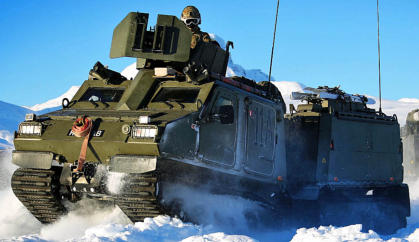
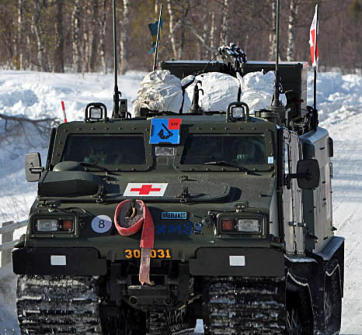
The image shows the tracked vehicle Bv 309
(Bandvagn 309). Photo: Mats Carlsson, 2012. Image:
Swedish Armed Forces.
Variants:
•
The Bv 308 is an armored tracked vehicle. The
vehicle is powered by a Mercedes-Benz diesel
engine and has a top speed of approximately 52
km/h. The Bv 308 has been in service since 1993.
•
The Bv 309 is an amphibious variant. The vehicle
is powered by a six-cylinder diesel engine from
Steyr and has a top speed of approximately 52
km/h. It is equipped with CBRN protection and
air conditioning and can operate in temperatures
from -32 to +46 degrees Celsius. Bv 309 has been
in service since 2003.
Specifications Bv 308:
•
Crew
4+8
•
Mass
Front carriage: 3,140 kg, Rear
carriage: 2,190 kg
•
Length
6.86 m
•
Width
2.00 m
•
Height
1.97 m
•
Engine
Mercedes-Benz OM 603.950,
136 hp
•
Max. speed
52 km/h
•
Main armament
Machine gun Ksp 58 or
heavy machine gun Tksp 12.7 in a mount on the
roof
•
Manufacturer
BAE System Hägglunds
•
Numbers
20
•
In Swedish service
1993 -
Specifications Bv 309:
•
Crew
3+8
•
Mass
Front carriage: 3,860 kg, Rear
carriage: 2,450 kg
•
Length
6.92 m
•
Width
2.00 m
•
Height
2.0-2.1 m
•
Engine
STEYR M16 Turbo Diesel 176
hp
•
Max. speed
52 km/h (road), 4,7 km/h
(water)
•
Main armament
Machine gun Ksp 58 or
heavy machine gun Tksp 12.7 in a mount on the
roof
•
Armor
Withstands direct fire from 7.62 *
51 caliber weapons
•
Manufacturer
BAE System Hägglunds
•
Numbers
93
•
In Swedish service
2003 -
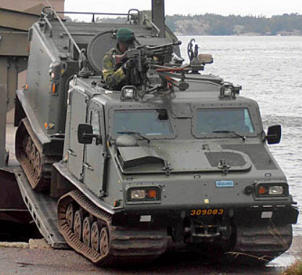
The image shows the tracked vehicle Bv 309
(Bandvagn 309). Image: Wikipedia.
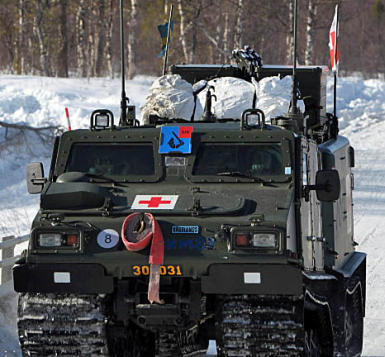
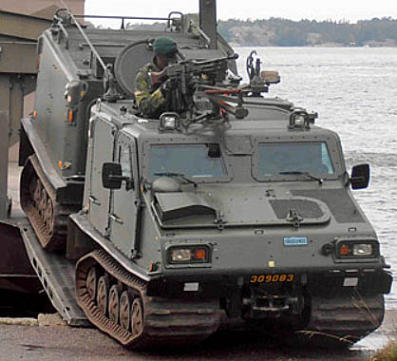
Tracked Vehicles, Sweden - 1
Introduction
A tracked vehicle is a tracked transport vehicle for
driving off-road. They were developed on a large
scale by German and American military equipment
companies during World War II for use in desert
environments and for transport on snow or other
soft surfaces.
An articulated tracked vehicle (ATV) is a type of
continuous track vehicle made up of two cars, each
with their own tracks and, most typically, an actuated
linkage in between. This configuration allows an
articulated tracked vehicle to turn by articulating the
swivel joint in between the two vehicles.
Emergency services, power companies, and other
organizations employ articulated tracked vehicles as
well.
A major manufacturer of articulated tracked vehicles
is the Swedish company BAE Systems Hägglunds AB in
Örnsköldsvik.
Tracked Vehicles, Sweden
Listed below are the tracked vehicles used in the
Swedish Armed Forces during the 20th century and
up to the present day.
List of tracked vehicles
•
Tracked Vehicle m/1948
•
Tracked Vehicles 202 and 203
•
Tracked Vehicles 206 and 208
•
Tracked Vehicles 308 and 309
•
Tracked Vehicle 410
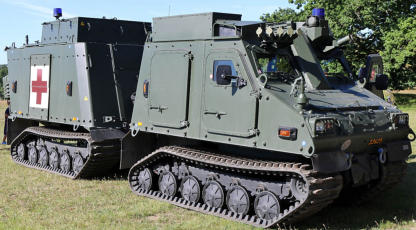
Bandvagn 410 (Tracked Vehicle 410)
The tracked vehicle 410 (Swedish: Bandvagn 410
(Bv 410)), also known as BvS10 (Bandvagn Skyddad
10), is an amphibious armored off-road tracked
vehicle manufactured by BAE Systems Hägglunds.
The Bv 410 was originally developed in collaboration
with the UK Ministry of Defense. Initially, the Swedish
Armed Forces had 150 vehicles at their disposal,
which were ordered in two batches in 2012 and 2013,
respectively.
The Bv 410 has significantly enhanced protection
against landmines and a higher load capacity. Its
armament consists of either a machine gun (7.62
mm Ksp 58b or 12.7 mm Ksp 88) mounted in a turret
on the front carriage or a remote-controlled VS01
weapon station, as well as a Ksp 58 mounted on a
gun mount on the rear carriage (troop transport
only). The vehicle is primarily used within engineer,
air defense, and artillery battalions, as well as an
ambulance within mechanized battalions.
The Bv 410 is designed to handle most situations in
the field and can reach speeds of up to 65 kilometers
per hour.
In May 2021, the Swedish Defense Materiel
Administration (FMV) signed a contract with BAE
Systems to produce and deliver 127 Bv 410 tracked
vehicles. Delivery of the tracked vehicles began in
2022 and was completed in 2024. These vehicles are
crucial for the introduction of the army's command
and control system, among other things.
At the same time, it was announced that Sweden,
through FMV, would lead a joint procurement of the
Bv 410 tracked vehicle together with Germany, the
United Kingdom, and the Netherlands. An initial
order comprises a total of 436 tracked vehicles in
various variants distributed among three nations,
Sweden, Germany, and the United Kingdom, of
which 236 Bv 410 will go to Sweden. Delivery of
the first tracked vehicles began in early 2024.
In addition to the 236 vehicles ordered, Sweden
ordered another 40 vehicles outside of the
collaboration with Germany and the United Kingdom,
bringing the total number of tracked vehicles
ordered to 553.
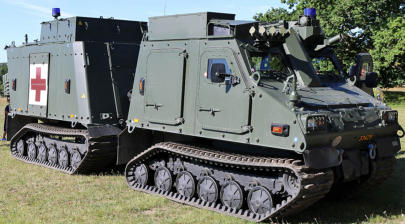
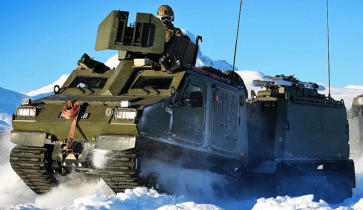
The image shows the tracked vehicle Bv 410
(Bandvagn 410) in 2016. Image: Wikipedia.
In January 2024, FMV announced an order for mobile
air defense systems for installation on Bv 410. The air
defense systems, Saab's RBS70 NG and Giraffe 1X,
were delivered starting in January 2025.
Variants:
The Swedish Armed Forces use the following four
variants:
•
Troop transport vehicles – 33 vehicles, each with
space for six troops with equipment and three
crew members.
•
Ambulance vehicles – 45 vehicles, with space for
up to two stretchers with injured soldiers, two crew
members, and two paramedics.
•
Logistics vehicles – 58 vehicles, crew of 3 people.
Load exchange system on the rear carriage. Can
load a 10-foot container or flatbed. This variant
can also be used to carry the Arthur artillery
locating radar or a radio link.
•
Command vehicles – 14 vehicles, with space for
four staff members, command systems, and three
crew members.
The distribution of the number of tracked vehicles
per variant above corresponds to the 150 vehicles
ordered in 2012 and 2013.
Specifications:
•
Crew
2 to 3
•
Troops
6
•
Mass
Both carriages: 15 tons
•
Length
8.3 m
•
Width
2.2 m
•
Height
2.3 m
•
Load capacity
3 tons
•
Max. speed
65 km/h (road), 4 km/h (water)
•
Sec. armament
1 × turret or Weapon Station
01 with 5.56 mm machine gun 90, 7.62 mm
machine gun 58, 12.7 mm machine gun 88, 40 mm
automatic grenade launcher 92
•
Manufactured
2013 –
•
Manufacturer
BAE Systems Hägglunds
The image shows the tracked vehicle Bv 410
(Bandvagn 410) in British service. Image: Wikipedia.