Military Hans Högman
Copyright © Hans Högman 2025-09-08

Stormartillerivagn m/1943 (Infantry Assault Gun m/1943)

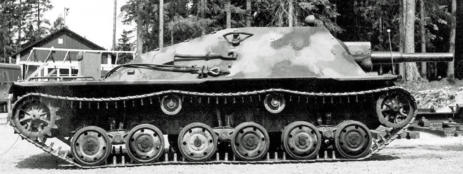
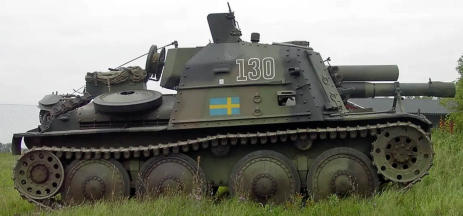
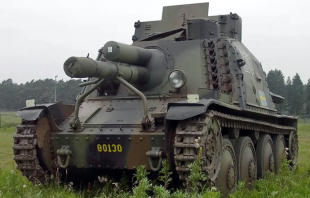
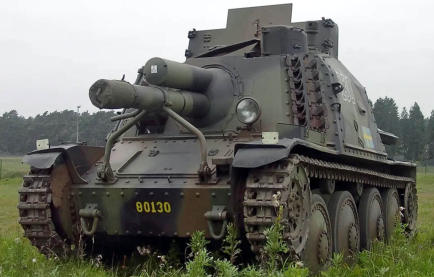
The infantry assault gun m/1943 (Swedish: Stormartillerivagn m/1943 (SAV m/43)) was a Swedish-designed assault gun for indirect and direct fire support for infantry, based on the chassis of the m/1941 tank. Its original designation was “Pansarartillerivagn m/1943 (armored artillery vehicle m/1943), but this was changed to “Stormartillerivagn” (assault gun) before the vehicle entered service. The Swedish term“Stormartillerivagn” literally means “storm artillery vehicle”. The army ordered 36 assault guns. The first 18 assault guns were initially armed with a substandard 7.5 cm m/1902 cannon. When the other 18 vehicles were completed in 1946, they were armed with the new 10.5 cm L/21 m/1944 SAV howitzer. The first 18 vehicles were then rearmed with this gun. The SAV m/1943 remained in service until 1973, when the last ones were replaced by the battle tank 74. The images show the infantry assault gun m/1943 (Stormartillerivagn m/1943). Image: Artillerimuseet, ID: ART.200020. Specifications: Crew 4 Mass 12 tons Length 5.5 m including the fire tube, 4.61 m chassi Width 2.14 m Height 2.29 m Engine Scania-Vabis type 603/2, 160 hp Max. speed 45 km/h Armor 8–50 mm Main armament One 10.5 cm cannon m/1944 SAV L/21 Manufacturer Scania-Vabis Numbers 36 In Swedish service 1944-1973

Infanterikanonvagn 72/102/1030 (Infantry Assault Guns 72/102/103)

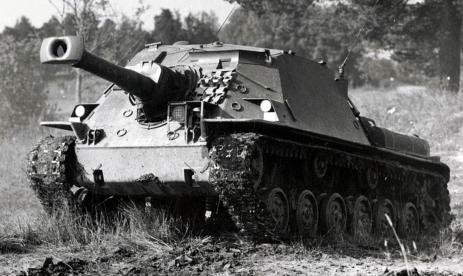
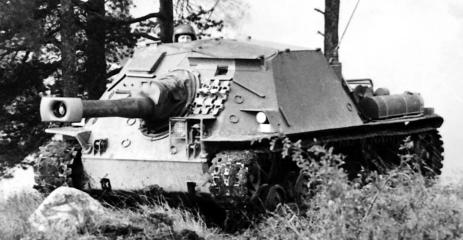
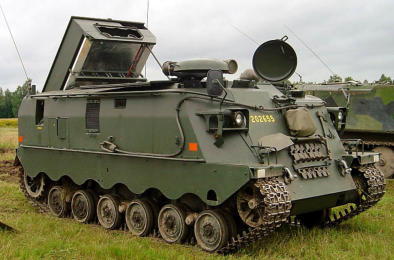
The infantry assault guns 72, 102, and 103 (Infanterikanonvagn 72, 102, and 103 (IKV 72, 102, and 103)) were a series of Swedish assault guns developed by AB Landsverk for the army, begun in the early 1950s and remaining in service until the mid-1970s. Assault Gun 72 (Infanterikanonvagn 72 (IKV 72)) Assault guns began to be supplied to infantry brigades in southern Sweden during the 1950s. Landsverk, together with Bofors, was tasked with developing and producing a new vehicle, the Infantry Assault Gun 72 (IKV 72). Between 1952 and 1954, 36 IKV 72s were delivered to the army, 26 of which were the IKV 72B versions. The IKV 72 had a combat compartment with an open roof in the front part of the vehicle, while the engine and gearbox were located in the rear. The vehicle was rear-wheel drive, which is unusual for Swedish armored vehicles. The gun was mounted directly in the front armor. The gun was the same as the one used in the m/1942 battle tank, i.e., the m/1941 tank gun with a 7.5 cm caliber. At the end of the 1950s, the IKV 72 was rearmed with a new gun. The image shows the assault gun IKV 72 (infanterikanonvagn 72 (IKV 72)). Image: Garnisonsmuseet Skaraborg, ID: GMSF.038391. Specifications: Crew 4 Mass 8 tons Length Chassis: 4.95 m (incl. fire tube: 5.79 m) Width 2.23 m Height 1.67 m Engine Ford sidevalve engine, 5.5 L V-8, petrol, 145 hp Max. speed 45–57 km/h Main armament 7.5 cm battle tank gun m/1941 Manufacturer Landsverk Numbers 36 Assault Gun 102 (Infanterikanonvagn 102 (IKV 102)) Between 1956 and 1958, the IKV 72 was modified into the Assault Gun IKV 102. Armored hatches were installed to cover the open fighting compartment. Furthermore, the gun was replaced with a newly developed 10.5 cm gun from Bofors. The barrel was actually considered a howitzer rather than a cannon. In the early 1980s, the IKV 102 was converted into the Pansarvärnsrobotbandvagn 551 (anti-tank missile vehicle 551). The image shows the assault gun IKV 102 (infanterikanonvagn 102 (IKV 102)). Image: Armémuseum, ID: AMA.0023761. Fakta: Crew 4 Mass 8.8 tons Length Chassi:s 4.95 m (incl. fire tube: 5.79 m) Width 2.23 m Height 1.67 m Engine Ford sidevalve engine, 5,5 L V-8, petrol, 145 hp Max. speed 45–57 km/h Main armament 10.5 cm gun Manufacturer Landsverk Numbers 36 Assault Gun 103 (Infanterikanonvagn 103 (IKV 103)) The assault gun IKV 103 (Infanterikanonvagn 103 (IKV 103)) was a somewhat improved variant of the IKV 102. It was equipped with a four-cylinder boxer engine from Svenska Flygmotor in Trollhättan. In total, 81 vehicles were delivered between 1956 and 1957, and the IKV 103 was in service from 1956 until 1976. In the early 1980s, the IKV 103 was converted into the Pansarvärnsrobotvagn 551 (anti-tank missile vehicle) and the Luftvärnsrobotvagn 701 (air defense missile vehicle). The image shows the assault gun IKV 103 (infanterikanonvagn 103 (IKV 103)) during a training exercise in the 1960s. Photo: Arméns bilddetalj. Image: Wikipedia. Specifications: Crew 4 Mass 8.8 tons Length Chassis: 4,95 m (incl. the fire tube: 5.79 m) Width 2.23 m Height 1.67 m Motor SFA 5.1 L 4-cylinder, petrol, 150 hp Max. speed 45–57 km/h Main armament 10.5 cm gun Manufacturer Landsverk Numbers 81 In service 1956 - 1976

Infanterikanonvagn 91 (Infantry Assault Gun 91)

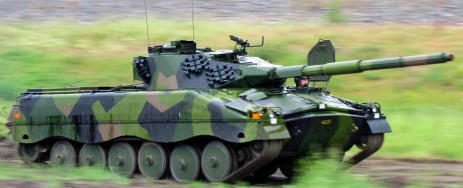
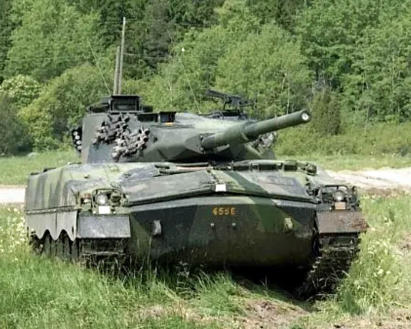
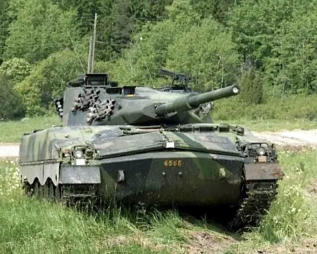
The infantry assault gun 91, IKV 91 (Infanterikanonvagn 91), was a high mobility assault gun, i.e., a support vehicle for the infantry, developed by Hägglund & Söner and manufactured between 1975 and 1978. A total of 212 vehicles were produced. The vehicle was built to provide infantry brigades with a mobile anti-tank and support weapon. The IKV 91 was amphibious. The armament was a 90 mm low-pressure gun developed by Bofors. The vehicle was equipped with a laser rangefinder and ballistic computer. Additional armament included two 7.62 mm Browning machine guns. The crew consisted of a vehicle commander, gunner, driver, and loader. IKV 91 was part of the Norrland and Infantry Brigades' tracked armored anti-tank companies. When work on the Combat Vehicle 90 (CV90) began at Hägglunds, the Swedish Armed Forces decided to abandon the assault gun (IKV) concept. The image shows the assault gun 91, IKV 91 (Infanterikanonvagn 91). Image: Wikipedia. Specifications: Crew 4 Mass 16,300 kg Length Chassis: 6.41 m, Incl. fire tube: 8.85 m Width 3.00 m Height 2.32 m Engine Volvo-Penta model TD 120 A, turbocharged inline 6- cylinder diesel; cylinder capacity 11.97 l, 330 hp at 2200 rpm Max. speed 65 km/h (road), 6,5 km/h (water) Armor Secret (protects against 20 mm armor-piercing shells) Main armament 90 mm low pressure cannon Sec. armament Two 7.62 mm machine gun m/39 Numbers 212 Manufactured 1975–1978 The image shows the assault gun 91, IKV 91 (Infanterikanonvagn 91). Image: Miliseum, ID: MILIF.032144.

Infantry Assault Guns, Sweden - 1

Related Links

Swedish Military Aircraft Helicopters in the Swedish Armed Forces Tanks of Sweden Ships of the Swedish Navy Arms in the Swedish Armed Forces Sweden’s Military Preparedness 1939 - 1945

Source References

Swedish Armed Forces (“Försvarsmakten”) Wikipedia Digitaltmuseum Top of page

Introduction

An infantry assault gun (Swedish: Infanterikanonvagn—IKV), formerly also known as a heavy artillery vehicle (Swe: stormartillerivagn—SAV) or heavy gun vehicle (Swe: stormkanonvagn—SKV), is a type of combat vehicle whose basic task is to provide a mobile, protected, self-propelled artillery piece for direct infantry support. To put it another way, this kind of armored infantry support vehicle and self-propelled artillery is designed to give soldiers substantial direct fire support during combat, particularly against other infantry or fortified positions. It mounts an infantry support gun on a protected self-propelled chassis. To engage traditional infantry targets, such as unprotected soldiers, machine gun positions, combat fortifications, artillery batteries, and other vehicles, infantry assault guns typically have a large-caliber cannon as their main armament. They are primarily intended for use as protected self-propelled field guns that can advance with infantry both in and out of combat, but also as independent units that can be used in conjunction with armored troops. Infantry assault guns were mainly used during World War II and were often (but not always) based on tank chassis where the turret had been replaced by an armored casemate or open armored body on which a heavier field gun with limited lateral range had been mounted.

Infantry Assault Guns, Sweden

Listed below are the infantry assault guns used in the Swedish Armed Forces during the 20th century and up to the present day.

List of infantry assault guns

Infantry Assault Gun m/1943 Infantry Assault Guns 72/102/103 Infantry Assault Gun 91 Combat Vehicle 90 (CV90) Anti-tank Missile Carrier 551 Anti-aircraft Missile Carrier 701
xxxxx Swegen xxxxxxxxxxx

xxxxxxxxxxxxxxxxxxxxxxxx

Anti-tank Carrier

“Anti-tank carrier” is a collective term for combat vehicles that are equipped and designed to combat enemy armored vehicles, i.e., to act as anti-tank defenses. Other terms are “tank destroyer”, “tank hunter” or “tank killer”. They are mainly divided into two categories depending on their armament: Anti-tank gun carriers (Swedish: Pansarvärnskanonvagnar (Pvkv)), armed with anti-tank guns Anti-tank missile carrierss (Swedish: Pansarvärnsrobotvagnar (Pvrbv)), armed with anti-tank missile systems Essentially, these vehicles are self-propelled anti-tank guns or missile launchers. These anti-tank carriers are usually armored and can be tracked or wheeled. Some are equipped with turrets like tanks but differ from tanks in other respects. Other anti-tank carriers have casemates or open fighting compartments. Anti-tank vehicles can be part of armored forces as a separate unit or as fire support for mechanized infantry.

Anti-tank Missile Carrier

Pansarvärnsrobotvagn 551 (Anti-tank Missile Carrier 551)

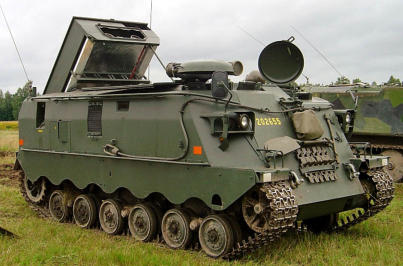
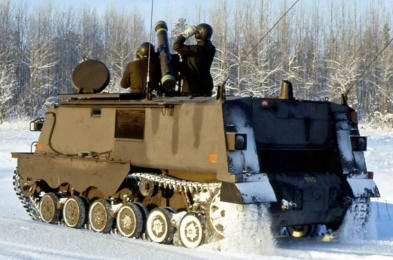
The anti-tank missile carrier 551 (Pansarvärnsrobotvagn 551 (Pvrbv 551)) is a Swedish anti-tank missile carrier built on the chassis of the 102 and 103 infantry assault guns. It is equipped with the RBS 55 anti-tank missile system, hence the designation “Pvrbv 551”. The carrier was developed in the late 1970s and entered service in 1984. They remained in service until the turn of the millennium in 2000. The vehicle has an almost identical sister carrier, the anti-aircraft missile carrier Lvrbv 701, which is instead armed with the RBS 70 anti-aircraft missile system. When infantry assault guns IKV 102 and 103 were replaced between 1975 and 1978 with infantry assault gun IKV 91, the chassis of IKV 102 and 103 were used as the basis for the design of the missile carriers that were to be added to the armored brigades. The chassis was fitted with an entirely new superstructure. The carriers were also given a new engine and gearbox of the same type as those used in the tracked personnel carrier 206 (Bandvagn 206). The conversion was carried out between 1984 and 1986 at Hägglund & Söner in Örnsköldsvik. A total of 57 carriers of the anti-tank version, Pvrbv 551, and 48 carriers of the anti-aircraft version, Lvrbv 701, were built. These were in service with the Swedish Armed Forces between 1984 and 2000. The vehicle was operated by a crew of four: driver, gunner, loader, and commander. The driver and commander are seated at the front of the vehicle. The gunner and loader are housed under two large roof hatches in the center of the vehicle while it is moving. When the vehicle enters the firing position, the hatches open and the missile launcher is elevated above the vehicle's roof. In this position, both the gunner and loader are unprotected by armor. The image shows the anti-tank missile carrier 551 (Pansarvärnsrobotvagn 551 (Pvrbv 551)). Photo: Jörgen Eriksson in 2007. Image: Wikipedia. Specifications: Crew 4 Mass 9,700 kg Length 4.81 m Width 2.54 m Engine Ford model 2658E V-6 petrol engine, 136 hp Max. speed 45 km/h Main armament Missile System RBS 55 (TOW-2) Sec. armament Machine gun KSP 58, 6 smoke launchers Manufacturer Landsverk / Hägglunds Manufactured 1984–1986 Numbers 57 In Swedish service 1984–2000

Anti-aircraft Carrier

Anti-aircraft carriers are combat vehicles equipped and armed with air defense weapons, such as anti-aircraft guns or anti-aircraft missiles. Their task is to provide mobile protection for ground units against air attacks. Air defense vehicles can move with the troops they are protecting, but there are also self-propelled air defense systems that operate independently in batteries with fire control centers, similar to stationary air defense systems. Anti-aircraft carriers are often based on splinter-protected or armored chassis equipped with air defense weapons in open mounts or turrets.

Anti-aircraft Missile Carrier

Luftvärnsrobotvagn 701 (Anti-aircraft Missile Carrier 701)

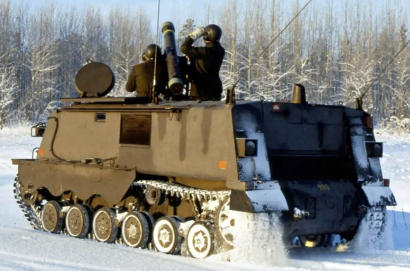
The anti-aircraft missile carrier (Luftvärnsrobotvagn 701 (Lvrbv 701)) is a Swedish anti-aircraft missile carrier built on the chassis of the 102 and 103 infantry assault guns. It is equipped with the RBS 70 anti-aircraft missile system (designed for anti-aircraft warfare), hence the designation “Lvrbv 701”. The carrier was developed in the late 1970s and entered service in 1984. They remained in service until the turn of the millennium in 2000. The vehicle has an almost identical sister carrier, the anti-tank missile carrier Pvrbv 551, which is instead armed with the RBS 55 anti-tank missile system. When infantry assault guns IKV 102 and 103 were replaced between 1975 and 1978 with infantry assault gun IKV 91, the chassis of IKV 102 and 103 were used as the basis for the design of the missile carriers that were to be added to the armored brigades. The chassis was fitted with an entirely new superstructure. The carriers were also given a new engine and gearbox of the same type as those used in the tracked personnel carrier 206 (Bandvagn 206). The conversion was carried out between 1984 and 1986 at Hägglund & Söner in Örnsköldsvik. A total of 48 carriers of the anti-aircraft version, Lvrbv 701 and 57 carriers of the anti-tank version, Pvrbv 551, were built. These were in service with the Swedish Armed Forces between 1984 and 2000. The vehicle was operated by a crew of four: driver, gunner, loader, and commander. The driver and commander are seated at the front of the vehicle. The gunner and loader are housed under two large roof hatches in the center of the vehicle while it is moving. When the vehicle enters the firing position, the hatches open and the missile launcher is elevated above the vehicle's roof. In this position, both the gunner and loader are unprotected by armor. The image shows the anti-aircraft carrier (Luftvärnsrobotvagn 701 (Lvrbv 701)). Image: Garnisonsmuseet Skaraborg, ID: GMSF.038387. Specifications: Crew 4 Mass 9,700 kg Length 4.81 m Width 2.54 m Engine Ford model 2658E V-6 petrol engine, 136 hp Max. speed 45 km/h Main armament Missile System RBS 70 (RBS-70 SAM) Sec. armament Machine gun KSP 58, 6 smoke launchers Manufacturer Landsverk / Hägglunds Manufactured 1984–1986 Numbers 48 In Swedish service 1984–2000
Military Hans Högman
Copyright © Hans Högman 2025-09-08

Stormartillerivagn m/1943 (Infantry

Assault Gun m/1943)

The infantry assault gun m/1943 (Swedish: Stormartillerivagn m/1943 (SAV m/43)) was a Swedish-designed assault gun for indirect and direct fire support for infantry, based on the chassis of the m/1941 tank. Its original designation was Pansarartillerivagn m/1943 (armored artillery vehicle m/1943), but this was changed to Stormartillerivagn” (assault gun) before the vehicle entered service. The Swedish term“Stormartillerivagn” literally means “storm artillery vehicle”. The army ordered 36 assault guns. The first 18 assault guns were initially armed with a substandard 7.5 cm m/1902 cannon. When the other 18 vehicles were completed in 1946, they were armed with the new 10.5 cm L/21 m/1944 SAV howitzer. The first 18 vehicles were then rearmed with this gun. The SAV m/1943 remained in service until 1973, when the last ones were replaced by the battle tank 74. The images show the infantry assault gun m/1943 (Stormartillerivagn m/1943). Image: Artillerimuseet, ID: ART.200020. Specifications: Crew 4 Mass 12 tons Length 5.5 m including the fire tube, 4.61 m chassi Width 2.14 m Height 2.29 m Engine Scania-Vabis type 603/2, 160 hp Max. speed 45 km/h Armor 8–50 mm Main armament One 10.5 cm cannon m/1944 SAV L/21 Manufacturer Scania-Vabis Numbers 36 In Swedish service 1944-1973

Infanterikanonvagn 72/102/1030 (Infantry

Assault Guns 72/102/103)

The infantry assault guns 72, 102, and 103 (Infanterikanonvagn 72, 102, and 103 (IKV 72, 102, and 103)) were a series of Swedish assault guns developed by AB Landsverk for the army, begun in the early 1950s and remaining in service until the mid-1970s. Assault Gun 72 (Infanterikanonvagn 72 (IKV 72)) Assault guns began to be supplied to infantry brigades in southern Sweden during the 1950s. Landsverk, together with Bofors, was tasked with developing and producing a new vehicle, the Infantry Assault Gun 72 (IKV 72). Between 1952 and 1954, 36 IKV 72s were delivered to the army, 26 of which were the IKV 72B versions. The IKV 72 had a combat compartment with an open roof in the front part of the vehicle, while the engine and gearbox were located in the rear. The vehicle was rear-wheel drive, which is unusual for Swedish armored vehicles. The gun was mounted directly in the front armor. The gun was the same as the one used in the m/1942 battle tank, i.e., the m/1941 tank gun with a 7.5 cm caliber. At the end of the 1950s, the IKV 72 was rearmed with a new gun. The image shows the assault gun IKV 72 (infanterikanonvagn 72 (IKV 72)). Image: Garnisonsmuseet Skaraborg, ID: GMSF.038391. Specifications: Crew 4 Mass 8 tons Length Chassis: 4.95 m (incl. fire tube: 5.79 m) Width 2.23 m Height 1.67 m Engine Ford sidevalve engine, 5.5 L V-8, petrol, 145 hp Max. speed 45–57 km/h Main armament 7.5 cm battle tank gun m/1941 Manufacturer Landsverk Numbers 36 Assault Gun 102 (Infanterikanonvagn 102 (IKV 102)) Between 1956 and 1958, the IKV 72 was modified into the Assault Gun IKV 102. Armored hatches were installed to cover the open fighting compartment. Furthermore, the gun was replaced with a newly developed 10.5 cm gun from Bofors. The barrel was actually considered a howitzer rather than a cannon. In the early 1980s, the IKV 102 was converted into the Pansarvärnsrobotbandvagn 551 (anti-tank missile vehicle 551). The image shows the assault gun IKV 102 (infanterikanonvagn 102 (IKV 102)). Image: Armémuseum, ID: AMA.0023761. Fakta: Crew 4 Mass 8.8 tons Length Chassi:s 4.95 m (incl. fire tube: 5.79 m) Width 2.23 m Height 1.67 m Engine Ford sidevalve engine, 5,5 L V-8, petrol, 145 hp Max. speed 45–57 km/h Main armament 10.5 cm gun Manufacturer Landsverk Numbers 36 Assault Gun 103 (Infanterikanonvagn 103 (IKV 103)) The assault gun IKV 103 (Infanterikanonvagn 103 (IKV 103)) was a somewhat improved variant of the IKV 102. It was equipped with a four-cylinder boxer engine from Svenska Flygmotor in Trollhättan. In total, 81 vehicles were delivered between 1956 and 1957, and the IKV 103 was in service from 1956 until 1976. In the early 1980s, the IKV 103 was converted into the Pansarvärnsrobotvagn 551 (anti-tank missile vehicle) and the Luftvärnsrobotvagn 701 (air defense missile vehicle). The image shows the assault gun IKV 103 (infanterikanonvagn 103 (IKV 103)) during a training exercise in the 1960s. Photo: Arméns bilddetalj. Image: Wikipedia. Specifications: Crew 4 Mass 8.8 tons Length Chassis: 4,95 m (incl. the fire tube: 5.79 m) Width 2.23 m Height 1.67 m Motor SFA 5.1 L 4-cylinder, petrol, 150 hp Max. speed 45–57 km/h Main armament 10.5 cm gun Manufacturer Landsverk Numbers 81 In service 1956 - 1976

Infanterikanonvagn 91 (Infantry Assault

Gun 91)

The infantry assault gun 91, IKV 91 (Infanterikanonvagn 91), was a high mobility assault gun, i.e., a support vehicle for the infantry, developed by Hägglund & Söner and manufactured between 1975 and 1978. A total of 212 vehicles were produced. The vehicle was built to provide infantry brigades with a mobile anti-tank and support weapon. The IKV 91 was amphibious. The armament was a 90 mm low-pressure gun developed by Bofors. The vehicle was equipped with a laser rangefinder and ballistic computer. Additional armament included two 7.62 mm Browning machine guns. The crew consisted of a vehicle commander, gunner, driver, and loader. IKV 91 was part of the Norrland and Infantry Brigades' tracked armored anti-tank companies. When work on the Combat Vehicle 90 (CV90) began at Hägglunds, the Swedish Armed Forces decided to abandon the assault gun (IKV) concept. The image shows the assault gun 91, IKV 91 (Infanterikanonvagn 91). Image: Wikipedia. Specifications: Crew 4 Mass 16,300 kg Length Chassis: 6.41 m, Incl. fire tube: 8.85 m Width 3.00 m Height 2.32 m Engine Volvo-Penta model TD 120 A, turbocharged inline 6-cylinder diesel; cylinder capacity 11.97 l, 330 hp at 2200 rpm Max. speed 65 km/h (road), 6,5 km/h (water) Armor Secret (protects against 20 mm armor-piercing shells) Main armament 90 mm low pressure cannon Sec. armament Two 7.62 mm machine gun m/39 Numbers 212 Manufactured 1975–1978 The image shows the assault gun 91, IKV 91 (Infanterikanonvagn 91). Image: Miliseum, ID: MILIF.032144.
Infantry Assualt Guns, Sweden - 1

Related Links

Swedish Military Aircraft Helicopters in the Swedish Armed Forces Tanks of Sweden Ships of the Swedish Navy Arms in the Swedish Armed Forces Sweden’s Military Preparedness 1939 - 1945

Source References

Swedish Armed Forces (“Försvarsmakten”) Wikipedia Digitaltmuseum Top of page

Introduction

An infantry assault gun (Swedish: Infanterikanonvagn—IKV), formerly also known as a heavy artillery vehicle (Swe: stormartillerivagn—SAV) or heavy gun vehicle (Swe: stormkanonvagn—SKV), is a type of combat vehicle whose basic task is to provide a mobile, protected, self-propelled artillery piece for direct infantry support. To put it another way, this kind of armored infantry support vehicle and self-propelled artillery is designed to give soldiers substantial direct fire support during combat, particularly against other infantry or fortified positions. It mounts an infantry support gun on a protected self-propelled chassis. To engage traditional infantry targets, such as unprotected soldiers, machine gun positions, combat fortifications, artillery batteries, and other vehicles, infantry assault guns typically have a large- caliber cannon as their main armament. They are primarily intended for use as protected self-propelled field guns that can advance with infantry both in and out of combat, but also as independent units that can be used in conjunction with armored troops. Infantry assault guns were mainly used during World War II and were often (but not always) based on tank chassis where the turret had been replaced by an armored casemate or open armored body on which a heavier field gun with limited lateral range had been mounted.

Infantry Assault Guns, Sweden

Listed below are the infantry assault guns used in the Swedish Armed Forces during the 20th century and up to the present day.

List of infantry assault guns

Infantry Assault Gun m/1943 Infantry Assault Guns 72/102/103 Infantry Assault Gun 91 Combat Vehicle 90 (CV90) Anti-tank Missile Carrier 551 Anti-aircraft Missile Carrier 701

Anti-tank Carrier

“Anti-tank carrier” is a collective term for combat vehicles that are equipped and designed to combat enemy armored vehicles, i.e., to act as anti-tank defenses. Other terms are “tank destroyer”, “tank hunter” or “tank killer”. They are mainly divided into two categories depending on their armament: Anti-tank gun carriers (Swedish: Pansarvärnskanonvagnar (Pvkv)), armed with anti- tank guns Anti-tank missile carrierss (Swedish: Pansarvärnsrobotvagnar (Pvrbv)), armed with anti- tank missile systems Essentially, these vehicles are self-propelled anti-tank guns or missile launchers. These anti-tank carriers are usually armored and can be tracked or wheeled. Some are equipped with turrets like tanks but differ from tanks in other respects. Other anti-tank carriers have casemates or open fighting compartments. Anti-tank vehicles can be part of armored forces as a separate unit or as fire support for mechanized infantry.

Anti-tank Missile Carrier

Pansarvärnsrobotvagn 551 (Anti-tank Missile

Carrier 551)

The anti-tank missile carrier 551 (Pansarvärnsrobotvagn 551 (Pvrbv 551)) is a Swedish anti-tank missile carrier built on the chassis of the 102 and 103 infantry assault guns. It is equipped with the RBS 55 anti-tank missile system, hence the designation “Pvrbv 551”. The carrier was developed in the late 1970s and entered service in 1984. They remained in service until the turn of the millennium in 2000. The vehicle has an almost identical sister carrier, the anti- aircraft missile carrier Lvrbv 701, which is instead armed with the RBS 70 anti-aircraft missile system. When infantry assault guns IKV 102 and 103 were replaced between 1975 and 1978 with infantry assault gun IKV 91, the chassis of IKV 102 and 103 were used as the basis for the design of the missile carriers that were to be added to the armored brigades. The chassis was fitted with an entirely new superstructure. The carriers were also given a new engine and gearbox of the same type as those used in the tracked personnel carrier 206 (Bandvagn 206). The conversion was carried out between 1984 and 1986 at Hägglund & Söner in Örnsköldsvik. A total of 57 carriers of the anti-tank version, Pvrbv 551, and 48 carriers of the anti-aircraft version, Lvrbv 701, were built. These were in service with the Swedish Armed Forces between 1984 and 2000. The vehicle was operated by a crew of four: driver, gunner, loader, and commander. The driver and commander are seated at the front of the vehicle. The gunner and loader are housed under two large roof hatches in the center of the vehicle while it is moving. When the vehicle enters the firing position, the hatches open and the missile launcher is elevated above the vehicle's roof. In this position, both the gunner and loader are unprotected by armor. The image shows the anti-tank missile carrier 551 (Pansarvärnsrobotvagn 551 (Pvrbv 551)). Photo: Jörgen Eriksson in 2007. Image: Wikipedia. Specifications: Crew 4 Mass 9,700 kg Length 4.81 m Width 2.54 m Engine Ford model 2658E V-6 petrol engine, 136 hp Max. speed 45 km/h Main armament Missile System RBS 55 (TOW-2) Sec. armament Machine gun KSP 58, 6 smoke launchers Manufacturer Landsverk / Hägglunds Manufactured 1984–1986 Numbers 57 In Swedish service 1984–2000
Anti-aircraft Carrier

Anti-aircraft carriers are combat vehicles equipped and armed with air defense weapons, such as anti- aircraft guns or anti-aircraft missiles. Their task is to provide mobile protection for ground units against air attacks. Air defense vehicles can move with the troops they are protecting, but there are also self- propelled air defense systems that operate independently in batteries with fire control centers, similar to stationary air defense systems. Anti-aircraft carriers are often based on splinter-protected or armored chassis equipped with air defense weapons in open mounts or turrets.

Anti-aircraft Missile Carrier

Luftvärnsrobotvagn 701 (Anti-aircraft Missile

Carrier 701)

The anti-aircraft missile carrier (Luftvärnsrobotvagn 701 (Lvrbv 701)) is a Swedish anti-aircraft missile carrier built on the chassis of the 102 and 103 infantry assault guns. It is equipped with the RBS 70 anti-aircraft missile system (designed for anti-aircraft warfare), hence the designation “Lvrbv 701”. The carrier was developed in the late 1970s and entered service in 1984. They remained in service until the turn of the millennium in 2000. The vehicle has an almost identical sister carrier, the anti- tank missile carrier Pvrbv 551, which is instead armed with the RBS 55 anti-tank missile system. When infantry assault guns IKV 102 and 103 were replaced between 1975 and 1978 with infantry assault gun IKV 91, the chassis of IKV 102 and 103 were used as the basis for the design of the missile carriers that were to be added to the armored brigades. The chassis was fitted with an entirely new superstructure. The carriers were also given a new engine and gearbox of the same type as those used in the tracked personnel carrier 206 (Bandvagn 206). The conversion was carried out between 1984 and 1986 at Hägglund & Söner in Örnsköldsvik. A total of 48 carriers of the anti-aircraft version, Lvrbv 701 and 57 carriers of the anti-tank version, Pvrbv 551, were built. These were in service with the Swedish Armed Forces between 1984 and 2000. The vehicle was operated by a crew of four: driver, gunner, loader, and commander. The driver and commander are seated at the front of the vehicle. The gunner and loader are housed under two large roof hatches in the center of the vehicle while it is moving. When the vehicle enters the firing position, the hatches open and the missile launcher is elevated above the vehicle's roof. In this position, both the gunner and loader are unprotected by armor. The image shows the anti-aircraft carrier (Luftvärnsrobotvagn 701 (Lvrbv 701)). Image: Garnisonsmuseet Skaraborg, ID: GMSF.038387. Specifications: Crew 4 Mass 9,700 kg Length 4.81 m Width 2.54 m Engine Ford model 2658E V-6 petrol engine, 136 hp Max. speed 45 km/h Main armament Missile System RBS 70 (RBS-70 SAM) Sec. armament Machine gun KSP 58, 6 smoke launchers Manufacturer Landsverk / Hägglunds Manufactured 1984–1986 Numbers 48 In Swedish service 1984–2000