Military Hans Högman
Copyright © Hans Högman 2025-09-08

Infantry Fighting Vehicles, Sweden - 2

Introduction

Armored infantry fighting vehicles (AIFVs) [Swedish: Pansarskyttefordon (pskf)], also known as mechanized infantry combat vehicles (MICV), are armed armored vehicles on wheels or tracks designed to carry infantry soldiers (known as armored infantry) to, during, and from combat and to actively participate in combat in cooperation with the armored infantry. Armored infantry must be able to fight both from inside the vehicle through openings (mounted combat) and outside the vehicle in its immediate vicinity (dismounted combat). Armored infantry fighting vehicles should not be confused with similar troop transport vehicles, such as splinter-protected troop transport vehicles, which only transport troops to combat without actively participating in combat themselves. In Sweden, armored infantry fighting vehicles began to be developed in the mid-1930s to meet the need for protected transport for armored infantry in combat. Armored troops were formed as an independent branch of the armed forces in Sweden in 1942. This led to the creation of the armored wheeled off-road vehicle known as Terrängbil Tgb m/42 KP, Sweden's first true armored infantry fighting vehicle.

Infantry Fighting Vehicles, Sweden

Listed below are the infantry fighting vehicles used in the Swedish Armed Forces during the 20th century and up to the present day.

List of Infantry Fighting Vehicles

Armored Car fm/1925 and fm/1926 Armored Car fm/1929 Armored Car m/1931 Armored Car m/1939 and m/1940 Armored Personnel Carrier m/1942 KP Armored Personnel Carrier 203 Armored Personnel Carrier 300 Armored Modular Vehicle 360 Tracked Armored Personnel Carrier 301 Tracked Armored Personnel Carrier 302 Tracked Armored Personnel Carrier 401 Tracked Armored Personnel Carrier 501

Tracked Armored Personnel Carrier (Pansarbandvagn)

Pansarbandvagn 301 (Tracked Armored Personnel Carrier 301)

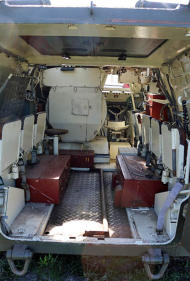
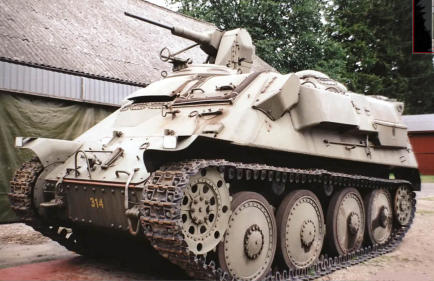
The tracked armored personnel carrier 301 (Pansarbandvagn 301 (Pbv 301)) was an armored personnel carrier used by the Swedish Army between 1962 and 1971. The Pbv 301 was developed as a temporary solution to provide armored units' riflemen with armored transport while awaiting delivery of the new armored personnel carrier 302 (Pbv 302). The vehicle consisted of a chassis from the now decommissioned m/1941 tank (Stridsvagn m/1941), but with a new superstructure. The vehicle was also fitted with a new 4-cylinder air-cooled boxer engine from Svenska Flygmotor AB (SFA). The conversion was carried out by Hägglund & Söner, and 220 vehicles were delivered between 1962 and 1963. The Pbv 301 was organized into an armored battalion in each armored brigade. The image shows the tracked armored personnel carrier 301 (Pansarbandvagn 301), No. 314. Image: Artillery Museum, ID: ART.200006. The crew consisted of a vehicle commander, gunner, and driver. The driver sat at the front right, and the gunner sat behind him. The vehicle commander sat diagonally behind the engine on the left. The Pbv 301 could transport seven soldiers in full combat gear, three on the left side and four on the right side. Entry and exit were through two doors at the rear of the vehicle. The soldiers could also fight from the vehicle through an opening in the roof, which was closed with two roof hatches. The Pbv 301 was armed with a 20 mm automatic cannon m/45 from the decommissioned Lansen J 21A fighter aircraft. The gun was given the new designation m/45B. It was placed above the gunner's observation hatch and was aimed and fired by the gunner. The vehicle also had three smoke launchers on each side of the front armor. Variants: The vehicle was available in three variants: troop transport vehicle, combat command tracked armored vehicle, and fire control tracked armored vehicle. Pbv 301: For troop transport. 185 were manufactured. Pbv 3011: combat command tracked armored vehicle. 20 were manufactured. Pbv 3012: Fire control tracked armored vehicle. 15 were manufactured. The image shows the interior of the tracked armored personnel carrier 301 (Pansarbandvagn 301). Image: Wikipedia. Specifications: Crew 3 Troops 7 Mass 11,700 kg Length 4.66 m Width 2.35 m Height 2.64 m Engine 5,15 l SFA B44, 4 cylinders, petrol, 160 hp Max. speed 45 km/h Armor 8 – 50 mm (upper front 20 mm in 55º) Main armament 20 mm automatic cannon m/45B Numbers 220 In Swedish service 1962 – 1971

Pansarbandvagn 302 (Tracked Armored Personnel Carrier 302)

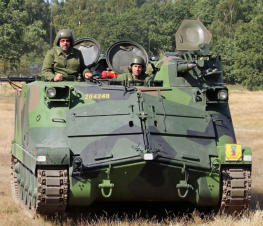
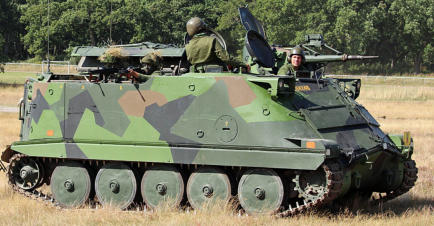
The tracked armored personnel carrier 302 (Pansarbandvagn 302 (PBV 302)) is a Swedish armored personnel carrier developed in the 1960s and used for armored infantry, troop transport, personnel transport, medical transport, and equipment transport. The PBV 302 was developed by Hägglund & Söner, with the first prototype completed in 1962. The series was manufactured between 1965 and 1972, and in 1966 the first PBV 302 entered service and began to gradually replace the Armored Personnel Carrier 301. Following defense decisions in the early 2000s, the PBV 302 began to be phased out of the military organization. In 2005, the first phase-out of 160 vehicles took place, which then continued based on the progress of the procurement of new combat vehicle systems. In 2018, it was reported that there were an estimated 180 armored personnel carriers PBV 302 remaining (with highly varying technical status), which were then placed in the unit or equipment reserve. In May 2024, the government announced that the entire remaining Swedish stock, approximately 250 units, of PBV 302 would be donated to Ukraine. The image shows a tracked armored personnel carrier 302 (pansarbandvagn 302) at Revingehed in 2015. Image: Wikipedia. The crew sits in the front and consists of a gunner, driver, and vehicle commander. The gunner sits at the front left under the weapon turret, the vehicle commander to the right, and the driver in the middle at the front. Troops transported in the rear combat compartment are not counted as part of the crew. The vehicle can transport nine troops, including a vehicle commander, with full combat equipment. They enter and exit through two doors at the rear of the vehicle. It is also possible to battle from two hatches on the roof. These are called combat hatches and are opened and closed hydraulically. Fighting from the combat hatches is called vehicle combat, and dismounted combat is called close combat. The image shows a tracked armored personnel carrier 302 (pansarbandvagn 302) at Revingehed. Image: Wikipedia. The armament of the PBV 302 consists of a 20 mm Hispano Suiza HS 804 automatic cannon (m/47D) in a weapon turret on the left side of the front of the vehicle. The periscope sight has eight times magnification and a ballistic reticle. Since 2009, there has been a permanent solution for exterior attachment of the machine gun 58 as secondary armament. The vehicle is also equipped with two smoke grenade launchers, each with three launch tubes for close-range smoke. In February 1966, the first production vehicle (No. 4002) was delivered to the Göta Life Guard Regiment in Enköping, followed by deliveries continuing until 1972. A total of 518 PBV 302 vehicles were manufactured in the troop transport version and 126 vehicles in special versions – 69 vehicles for combat control (Stripbv 3021), 48 vehicles for fire control (Epbv 3022) and 9 vehicles as battery position vehicles (bplpbv 3023). Variants: PBV 302A: the original standard troop transport/IFV variant (models 3021, 3022, 3023, 3024, and 3026). PBV 302B: a variant that incorporates internal splinter protection, also known as liners, along with additional external protection (3021B). PBV 302C: a variant similar to the 302B, it includes illuminating mortars, new lights, a new turbo engine, air conditioning, and reinforced suspension (models 3021C, 3022C, 3023C, 3024C, and 3025C). It has mainly been used for UN and KFOR missions. PBV 302H Specifications: Crew 3 Troops 8 Mass 14,000 kg Length 5.35 m Width 2.86 m Height 2.5 m Engine 9.6 L Volvo PENTA THD 100, 6-cylinder direct-injection supercharged diesel 201 kW (270 hp) Max. speed 66 km/h (road), 8 km/h (water) Armor 23 mm (front) Main armament 20 mm automatic cannon m/47 Sec. armament 7.62 mm machine gun 58 Manufactured 1965–1972 Numbers 644 (518 + 126) In Swedish service 1966 – 2005 (?)

Pansarbandvagn 401 (Tracked Armored Personnel Carrier 401)

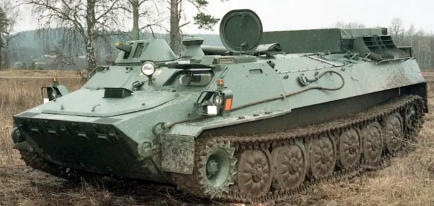
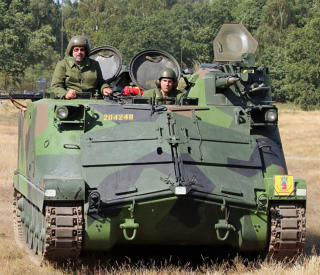
The tracked armored personnel carrier 401 (Pansarbandvagn 401 (PBV 401)) is the Swedish designation for the MT-LB vehicles purchased from reunified Germany in 1993 to provide the Norrland and Infantry Brigades with an armored off-road vehicle at a low price. The MT-LB was developed in the former Soviet Union in the late 1960s. When East Germany rejoined with West Germany in the early 1990s, a military surplus arose, which was sold at a very low cost. Sweden acquired a total of 1,016 vehicles. Of these, 460 PBV 401s and 90 tracked recovery vehicles 4012 were refurbished and transferred to Sweden. The remaining vehicles, including the 2S1 Gvozdika (228 units), were scrapped on-site in Germany for various reasons, including the recycling of spare parts. Today, there are no PBV 401 vehicles left in the Swedish Armed Forces. The image shows the tracked armored personnel carrier 401 (Pansarbandvagn 401 (PBV 401)). Image: Miliseum, ID: MILIF.024534. The crew consisted of a driver and a vehicle commander, and in the case of the PVRB 56 (missile system RBS 56), also a missile gunner. At the rear was a combat compartment for up to 11 troops, or alternatively extra radio equipment and work tables for the unit commander and staff. The armament consisted of a light machine gun (Ksp m/95) mounted in a small turret and operated by the vehicle commander. Variants: The PBV 401 tracked armored personnel carrier was available in a large number of variants. Specifications: Crew 2-3; driver, vehicle commander + possible missile operator. Troops 11 Mass 10,350 kg Length 6.45 m Width 2.85 m Height 1.87 m Engine JaMZ-238W V-8 diesel 177 kW (240 hp) Max. speed 61 km/h (road), 30 km/h (off-road), 6 km/h (water) Armor 3–14 mm Main armament 7.62mm PKT machine gun, 2.500 rounds In Swedish service 1995 - 2010 Numbers 460 + 90

Pansarbandvagn 501 (Tracked Armored Personnel Carrier 501)

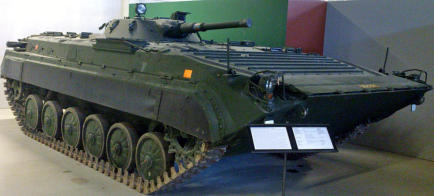
The tracked armored personnel carrier 501 (Pansarbandvagn 501 (PBV 501)) is an amphibious armored infantry fighting vehicle (IFV) created in the former Soviet Union under the designation BMP-1, which was developed in the early 1960s and built since 1966. At that time, it was the most powerful armored infantry fighting vehicle in the world. The BMP-1 had a 73 mm smoothbore cannon and a 9M14 Maljutka anti-tank missile. Production was discontinued in 1983. The BMP-1 was also used in Sweden under the designation PBV 501 (Pansarbandvagn 501) and was a transitional vehicle between the PBV 302 and the combat vehicle CV 90. The crew consists of a gunner, driver, and vehicle commander. The driver sits at the front left of the vehicle. Behind him, level with the turret, sits the vehicle commander. The vehicle can carry six troops. The troops can disembark at the rear through two large doors. There are roof hatches from which the troops can fight, as well as four small firing ports on each side and one in the left rear door. The armament consists of a 73 mm low-pressure cannon with a parallel-connected machine gun. The turret can be rotated 360°. The image shows the tracked armored personnel carrier 501 (Pansarbandvagn 501 (PBV 501)) in single-color camouflage. Image: Arsenalens fordonsmuseum, Strängnäs. In the Swedish defense decision of 1992, funds were allocated for, among other things, the mechanization of the infantry brigades. As a result, 609 MT-LB (PBV 401) tracked armored personnel vehicles with splinter protection were obtained from former East Germany. In 1993, the Swedish army wanted to purchase additional vehicles from Germany, as it was considered that the 609 PBV 401 vehicles already purchased were not sufficient to fill the infantry brigades. The army proposed the BMP-1 as an alternative. Five BMP-1 vehicles were procured for testing. In 1994, 433 armored personnel carriers of the BMP-1 SP-2, BMP-1P, and BMP-1A1 variants were purchased. Of these, 83 were used as spare parts for the remaining 350 vehicles that were planned to be included in the war organization. However, the tracked vehicles that were purchased were in great need of renovation, as many of them had been left outdoors without protection. The Czech business VOP 026 carried out the renovation of the 350 vehicles. After the final modifications were approved in 1996, the first deliveries began that same year. Deliveries continued at a rate of 12 vehicles per month until the end of 2001. In Sweden, the BMP-1 was designated Pansarbandvagn 501 (PBV 501). Of the 350 PBV 501s, only 120 were deployed to the units, while the remaining 230 were immediately placed in storage. In 2005, it was decided that 335 vehicles would be sold. In December 2008, the Czech state-owned company VOP-026 purchased 335 vehicles with associated equipment and spare parts. Several vehicles remain in Sweden at various museums. Specifications: Crew 3 Troops 8 Mass 13,500 kg Length 6.74 m Width 2.94 m Height 2.15 m Engine Diesel 225 kW (300 hp) Max. speed 65 km/h (road), 45 km/h (off-road), 7 km/h (water) Armor 33 mm (max) Main armament 73 mm 2A28 cannon (40 rounds), 9M14 Maljutka ATGM Sec. armament 7.62mm PKT machine gun In Swedish service 1996 - 2005 Numbers 350
xxxxx Swegen xxxxxxxxxxx

xxxxxxxxxxxxxxxxxxxxxxxx
Military Hans Högman
Copyright © Hans Högman 2025-09-08

Infantry Fighting Vehicles,

Sweden - 2

Introduction

Armored infantry fighting vehicles (AIFVs) [Swedish: Pansarskyttefordon (pskf)], also known as mechanized infantry combat vehicles (MICV), are armed armored vehicles on wheels or tracks designed to carry infantry soldiers (known as armored infantry) to, during, and from combat and to actively participate in combat in cooperation with the armored infantry. Armored infantry must be able to fight both from inside the vehicle through openings (mounted combat) and outside the vehicle in its immediate vicinity (dismounted combat). Armored infantry fighting vehicles should not be confused with similar troop transport vehicles, such as splinter-protected troop transport vehicles, which only transport troops to combat without actively participating in combat themselves. In Sweden, armored infantry fighting vehicles began to be developed in the mid-1930s to meet the need for protected transport for armored infantry in combat. Armored troops were formed as an independent branch of the armed forces in Sweden in 1942. This led to the creation of the armored wheeled off-road vehicle known as Terrängbil Tgb m/42 KP, Sweden's first true armored infantry fighting vehicle.

Infantry Fighting Vehicles,

Sweden

Listed below are the infantry fighting vehicles used in the Swedish Armed Forces during the 20th century and up to the present day.

List of Infantry Fighting Vehicles

Armored Car fm/1925 and fm/1926 Armored Car fm/1929 Armored Car m/1931 Armored Car m/1939 and m/1940 Armored Personnel Carrier m/1942 KP Armored Personnel Carrier 203 Armored Personnel Carrier 300 Armored Modular Vehicle 360 Tracked Armored Personnel Carrier 301 Tracked Armored Personnel Carrier 302 Tracked Armored Personnel Carrier 401 Tracked Armored Personnel Carrier 501

Tracked Armored Personnel

Carrier (Pansarbandvagn)

Pansarbandvagn 301 (Tracked Armored

Personnel Carrier 301)

The tracked armored personnel carrier 301 (Pansarbandvagn 301 (Pbv 301)) was an armored personnel carrier used by the Swedish Army between 1962 and 1971. The Pbv 301 was developed as a temporary solution to provide armored units' riflemen with armored transport while awaiting delivery of the new armored personnel carrier 302 (Pbv 302). The vehicle consisted of a chassis from the now decommissioned m/1941 tank (Stridsvagn m/1941), but with a new superstructure. The vehicle was also fitted with a new 4-cylinder air-cooled boxer engine from Svenska Flygmotor AB (SFA). The conversion was carried out by Hägglund & Söner, and 220 vehicles were delivered between 1962 and 1963. The Pbv 301 was organized into an armored battalion in each armored brigade. The image shows the tracked armored personnel carrier 301 (Pansarbandvagn 301), No. 314. Image: Artillery Museum, ID: ART.200006. The crew consisted of a vehicle commander, gunner, and driver. The driver sat at the front right, and the gunner sat behind him. The vehicle commander sat diagonally behind the engine on the left. The Pbv 301 could transport seven soldiers in full combat gear, three on the left side and four on the right side. Entry and exit were through two doors at the rear of the vehicle. The soldiers could also fight from the vehicle through an opening in the roof, which was closed with two roof hatches. The Pbv 301 was armed with a 20 mm automatic cannon m/45 from the decommissioned Lansen J 21A fighter aircraft. The gun was given the new designation m/45B. It was placed above the gunner's observation hatch and was aimed and fired by the gunner. The vehicle also had three smoke launchers on each side of the front armor. Variants: The vehicle was available in three variants: troop transport vehicle, combat command tracked armored vehicle, and fire control tracked armored vehicle. Pbv 301: For troop transport. 185 were manufactured. Pbv 3011: combat command tracked armored vehicle. 20 were manufactured. Pbv 3012: Fire control tracked armored vehicle. 15 were manufactured. The image shows the interior of the tracked armored personnel carrier 301 (Pansarbandvagn 301). Image: Wikipedia. Specifications: Crew 3 Troops 7 Mass 11,700 kg Length 4.66 m Width 2.35 m Height 2.64 m Engine 5,15 l SFA B44, 4 cylinders, petrol, 160 hp Max. speed 45 km/h Armor 8 – 50 mm (upper front 20 mm in 55º) Main armament 20 mm automatic cannon m/45B Numbers 220 In Swedish service 1962 – 1971

Pansarbandvagn 302 (Tracked Armored

Personnel Carrier 302)

The tracked armored personnel carrier 302 (Pansarbandvagn 302 (PBV 302)) is a Swedish armored personnel carrier developed in the 1960s and used for armored infantry, troop transport, personnel transport, medical transport, and equipment transport. The PBV 302 was developed by Hägglund & Söner, with the first prototype completed in 1962. The series was manufactured between 1965 and 1972, and in 1966 the first PBV 302 entered service and began to gradually replace the Armored Personnel Carrier 301. Following defense decisions in the early 2000s, the PBV 302 began to be phased out of the military organization. In 2005, the first phase-out of 160 vehicles took place, which then continued based on the progress of the procurement of new combat vehicle systems. In 2018, it was reported that there were an estimated 180 armored personnel carriers PBV 302 remaining (with highly varying technical status), which were then placed in the unit or equipment reserve. In May 2024, the government announced that the entire remaining Swedish stock, approximately 250 units, of PBV 302 would be donated to Ukraine. The image shows a tracked armored personnel carrier 302 (pansarbandvagn 302) at Revingehed in 2015. Image: Wikipedia. The crew sits in the front and consists of a gunner, driver, and vehicle commander. The gunner sits at the front left under the weapon turret, the vehicle commander to the right, and the driver in the middle at the front. Troops transported in the rear combat compartment are not counted as part of the crew. The vehicle can transport nine troops, including a vehicle commander, with full combat equipment. They enter and exit through two doors at the rear of the vehicle. It is also possible to battle from two hatches on the roof. These are called combat hatches and are opened and closed hydraulically. Fighting from the combat hatches is called vehicle combat, and dismounted combat is called close combat. The image shows a tracked armored personnel carrier 302 (pansarbandvagn 302) at Revingehed. Image: Wikipedia. The armament of the PBV 302 consists of a 20 mm Hispano Suiza HS 804 automatic cannon (m/47D) in a weapon turret on the left side of the front of the vehicle. The periscope sight has eight times magnification and a ballistic reticle. Since 2009, there has been a permanent solution for exterior attachment of the machine gun 58 as secondary armament. The vehicle is also equipped with two smoke grenade launchers, each with three launch tubes for close-range smoke. In February 1966, the first production vehicle (No. 4002) was delivered to the Göta Life Guard Regiment in Enköping, followed by deliveries continuing until 1972. A total of 518 PBV 302 vehicles were manufactured in the troop transport version and 126 vehicles in special versions – 69 vehicles for combat control (Stripbv 3021), 48 vehicles for fire control (Epbv 3022) and 9 vehicles as battery position vehicles (bplpbv 3023). Variants: PBV 302A: the original standard troop transport/IFV variant (models 3021, 3022, 3023, 3024, and 3026). PBV 302B: a variant that incorporates internal splinter protection, also known as liners, along with additional external protection (3021B). PBV 302C: a variant similar to the 302B, it includes illuminating mortars, new lights, a new turbo engine, air conditioning, and reinforced suspension (models 3021C, 3022C, 3023C, 3024C, and 3025C). It has mainly been used for UN and KFOR missions. PBV 302H Specifications: Crew 3 Troops 8 Mass 14,000 kg Length 5.35 m Width 2.86 m Height 2.5 m Engine 9.6 L Volvo PENTA THD 100, 6- cylinder direct-injection supercharged diesel 201 kW (270 hp) Max. speed 66 km/h (road), 8 km/h (water) Armor 23 mm (front) Main armament 20 mm automatic cannon m/47 Sec. armament 7.62 mm machine gun 58 Manufactured 1965–1972 Numbers 644 (518 + 126) In Swedish service 1966 – 2005 (?)

Pansarbandvagn 401 (Tracked Armored

Personnel Carrier 401)

The tracked armored personnel carrier 401 (Pansarbandvagn 401 (PBV 401)) is the Swedish designation for the MT-LB vehicles purchased from reunified Germany in 1993 to provide the Norrland and Infantry Brigades with an armored off-road vehicle at a low price. The MT-LB was developed in the former Soviet Union in the late 1960s. When East Germany rejoined with West Germany in the early 1990s, a military surplus arose, which was sold at a very low cost. Sweden acquired a total of 1,016 vehicles. Of these, 460 PBV 401s and 90 tracked recovery vehicles 4012 were refurbished and transferred to Sweden. The remaining vehicles, including the 2S1 Gvozdika (228 units), were scrapped on-site in Germany for various reasons, including the recycling of spare parts. Today, there are no PBV 401 vehicles left in the Swedish Armed Forces. The image shows the tracked armored personnel carrier 401 (Pansarbandvagn 401 (PBV 401)). Image: Miliseum, ID: MILIF.024534. The crew consisted of a driver and a vehicle commander, and in the case of the PVRB 56 (missile system RBS 56), also a missile gunner. At the rear was a combat compartment for up to 11 troops, or alternatively extra radio equipment and work tables for the unit commander and staff. The armament consisted of a light machine gun (Ksp m/95) mounted in a small turret and operated by the vehicle commander. Variants: The PBV 401 tracked armored personnel carrier was available in a large number of variants. Specifications: Crew 2-3; driver, vehicle commander + possible missile operator. Troops 11 Mass 10,350 kg Length 6.45 m Width 2.85 m Height 1.87 m Engine JaMZ-238W V-8 diesel 177 kW (240 hp) Max. speed 61 km/h (road), 30 km/h (off- road), 6 km/h (water) Armor 3–14 mm Main armament 7.62mm PKT machine gun, 2.500 rounds In Swedish service 1995 - 2010 Numbers 460 + 90

Pansarbandvagn 501 (Tracked Armored

Personnel Carrier 501)

The tracked armored personnel carrier 501 (Pansarbandvagn 501 (PBV 501)) is an amphibious armored infantry fighting vehicle (IFV) created in the former Soviet Union under the designation BMP-1, which was developed in the early 1960s and built since 1966. At that time, it was the most powerful armored infantry fighting vehicle in the world. The BMP-1 had a 73 mm smoothbore cannon and a 9M14 Maljutka anti-tank missile. Production was discontinued in 1983. The BMP-1 was also used in Sweden under the designation PBV 501 (Pansarbandvagn 501) and was a transitional vehicle between the PBV 302 and the combat vehicle CV 90. The crew consists of a gunner, driver, and vehicle commander. The driver sits at the front left of the vehicle. Behind him, level with the turret, sits the vehicle commander. The vehicle can carry six troops. The troops can disembark at the rear through two large doors. There are roof hatches from which the troops can fight, as well as four small firing ports on each side and one in the left rear door. The armament consists of a 73 mm low-pressure cannon with a parallel-connected machine gun. The turret can be rotated 360°. The image shows the tracked armored personnel carrier 501 (Pansarbandvagn 501 (PBV 501)) in single-color camouflage. Image: Arsenalens fordonsmuseum, Strängnäs. In the Swedish defense decision of 1992, funds were allocated for, among other things, the mechanization of the infantry brigades. As a result, 609 MT-LB (PBV 401) tracked armored personnel vehicles with splinter protection were obtained from former East Germany. In 1993, the Swedish army wanted to purchase additional vehicles from Germany, as it was considered that the 609 PBV 401 vehicles already purchased were not sufficient to fill the infantry brigades. The army proposed the BMP-1 as an alternative. Five BMP-1 vehicles were procured for testing. In 1994, 433 armored personnel carriers of the BMP- 1 SP-2, BMP-1P, and BMP-1A1 variants were purchased. Of these, 83 were used as spare parts for the remaining 350 vehicles that were planned to be included in the war organization. However, the tracked vehicles that were purchased were in great need of renovation, as many of them had been left outdoors without protection. The Czech business VOP 026 carried out the renovation of the 350 vehicles. After the final modifications were approved in 1996, the first deliveries began that same year. Deliveries continued at a rate of 12 vehicles per month until the end of 2001. In Sweden, the BMP-1 was designated Pansarbandvagn 501 (PBV 501). Of the 350 PBV 501s, only 120 were deployed to the units, while the remaining 230 were immediately placed in storage. In 2005, it was decided that 335 vehicles would be sold. In December 2008, the Czech state-owned company VOP-026 purchased 335 vehicles with associated equipment and spare parts. Several vehicles remain in Sweden at various museums. Specifications: Crew 3 Troops 8 Mass 13,500 kg Length 6.74 m Width 2.94 m Height 2.15 m Engine Diesel 225 kW (300 hp) Max. speed 65 km/h (road), 45 km/h (off- road), 7 km/h (water) Armor 33 mm (max) Main armament 73 mm 2A28 cannon (40 rounds), 9M14 Maljutka ATGM Sec. armament 7.62mm PKT machine gun In Swedish service 1996 - 2005 Numbers 350