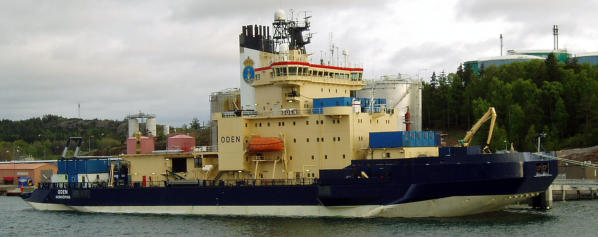
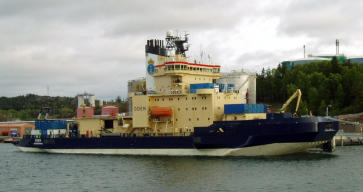
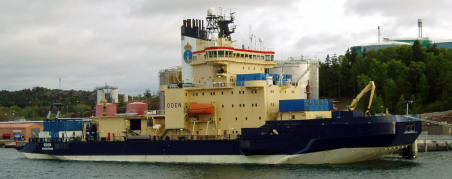
The photo above shows the Swedish state icebreaker Oden II, delivered to the Swedish Maritime Administration (Swedish: Sjöfartsverket) in 1989. She is built to Arctic ice class standards and is 108 m long and 31 m wide.
Introduction
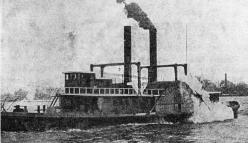
An icebreaker is a vessel that, thanks to its hull design and engine power, helps other vessels navigate through ice-covered waters. The basic principle is that these vessels, with a combination of a strong hull and high engine power, are capable of breaking the ice.Icebreakers are special ships capable of helping other vessels navigate through ice-covered waters. It is the icebreakers’ hull design and engine power that make such navigation possible—that is, they have a strong hull and powerful engines. This enables them to break through the ice. In the days of sailing ships, it was impossible to navigate ice-covered waters. This meant that the waters up here in Scandinavia became impassable, with no way to do anything about it. The ships were therefore forced to remain in port once the ice set in. During the second half of the 19th century, ships powered by steam—that is, steamships—became increasingly common. Once these ships began to be built of steel, they had sufficient power and hull strength to at least make their way through thinner ice.The first icebreakers were built solely for harbor and river traffic, not for breaking ice at sea. One of the very first icebreakers was the “City Ice Boat No. 1”. It was a paddle steamer with a wooden hull, built in 1837 to break ice on the Delaware River in Philadelphia, USA. The image shows the paddle steamer and icebreaker “City Ice Boat No. 1” on the Delaware River in Philadelphia, USA. Built in 1837. Photo: Wikipedia. The paddle steamer Norwich was built in 1836 for purposes other than icebreaking, but thanks to her icebreaking capabilities, she was commissioned as an icebreaker on the Hudson River in New York in the 1840s.
The Design of Icebreakers
In Hamburg, Germany, a competition was announced in 1871 to design a sturdy icebreaker so that merchant ships could operate in the harbor even during very harsh winters. The icebreaker was to have a sturdy hull and powerful engines to break through the ice. The competition was won by ship designer Ferdinand Steinhaus, whose basic concepts are still used today. His concept was a ship with a robust hull and a powerful engine, but the bow would be angled such that mass and force would work together to break the ice by driving the ship onto it, where its weight would then shatter it. The ideal was for icebreakers to have a length-to-width ratio of 4:1 to minimize the flat surfaces against which the ice could press. His ship, which was 40.5 meters long, 9.75 meters wide, and had a draft of 4.0 meters, was named Eisbrecher I and was later used to break ice on the Elbe River. Since the ship lived up to expectations, additional similar icebreakers were built.One icebreaker built based on this design was the Swedish icebreaker “Isbrytaren”, which was used to keep the Port of Gothenburg open during the winter. Like ordinary merchant ships, this type of icebreaker had only one propeller at the stern. This worked excellently on smooth, thin ice, such as that on the Elbe River, but was less effective on sea ice with ridges. In such cases, it was more effective to reverse through the ridges on the sea ice. In the United States, a train ferry was used on a river; it had propellers at both the bow and the stern. When ice formed on the river, this design proved to be significantly better at breaking through the ice than the Hamburger-type icebreaker, which had a propeller only at the stern.The inertia encountered when navigating through ice is not solely due to the ice that must be broken up ahead of the ship. The friction between the ice and the ship’s sides is at least as significant a factor in making it difficult for ships to move forward. Cargo ships are typically designed like shoeboxes with flat bottoms and smooth, straight sides, which is not advantageous when navigating through ice, as this results in large surfaces where friction can occur. This can be devastating if a ship becomes trapped in the ice, as the enormous forces of drifting ice can crush the ship’s hull or push it beneath the ice. The hulls of icebreakers, on the other hand, are egg-shaped, which helps avoid these dangers; the hull's side surfaces in contact with the ice are thus reduced, and when the ice presses against them from the sides, the icebreaker is pushed upward instead of downward. To further reduce friction between the ice and the hull, water is sprayed along the sides of the icebreaker so that the ice does not come into contact with the hull. The icebreaker’s bow propellers are not used to increase the force against the ice; rather, their function is to lubricate the hull with water. Another effect of the bow propellers is that they draw water away from under the ice immediately in front of the icebreaker, making it easier to break the ice.
Icebreaking in Sweden
Sweden is located in northern Europe and has a great need for icebreaking during the winter. This is especially true for the Gulf of Bothnia and the Bothnian Sea in the northern parts of the Baltic Sea.Icebreaking in Sweden is currently (2026) carried out by six government-owned icebreakers (state icebreakers) that break up ice along Sweden’s coasts to enable merchant ships to use Swedish ports year-round. In 2012, there were 10 icebreakers. The icebreaking season typically runs from New Year’s Day until the end of May. Icebreaking has been carried out in Sweden since the late 1800s, and since 1926, it has been managed by the government.Responsibility for icebreaking lies with the Swedish Maritime Administration (Swedish: Sjöfartsverket), and operations are managed from the icebreaker command center in Norrköping. The Swedish Navy previously provided the crews for the Swedish icebreakers, but since 2000 the crews have been civilian sailors. The Maritime Administration is the government agency in Sweden that provides services to the transport sector by keeping the sea lanes open and safe. One important service of the Swedish Maritime Administration is icebreaking.The Oden II is currently Sweden’s largest icebreaker.
The First Swedish Icebreakers
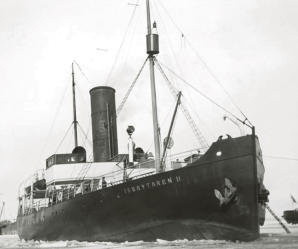
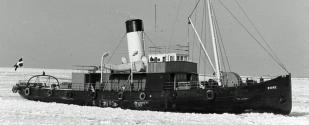
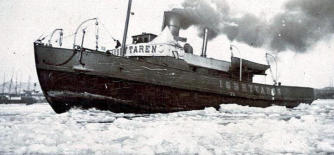
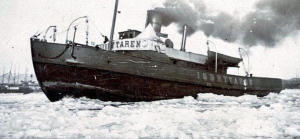
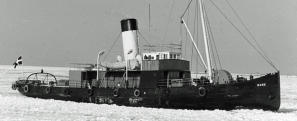
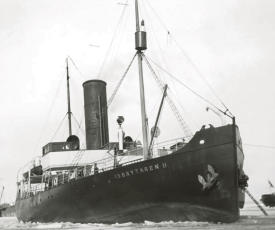
The first Swedish icebreakers were privately or municipally owned and were used to keep the larger ports open. The first Swedish icebreaker was the “Isbrytaren,” (The Icebreaker) launched in 1882 at the Lindholmen shipyard to keep the Port of Gothenburg ice-free even during harsh winters. The “Isbrytaren” could break through ice up to 60 cm thick without ice ridges. However, she performed less effectively in waters with broken ice.The image shows the icebreaker "Isbrytaren" in the port of Gothenburg, She was Sweden's first icebreaker, built in 1882. Photo: Gothenburg City Museum.In 1895, the “Isbrytaren II” was put into service. This icebreaker was of the Svensksund type. The type designation came from the fact that the icebreaker’s bow was modeled after the Swedish gunboat Svensksund, which proved to be very well suited for navigating through ice. The difference between this hull shape and that of earlier icebreakers was that the Svensksund-class had sharper concave lines in the bow. The “Isbrytaren II” (Gothenburg) performed so well that it soon replaced the “Isbrytaren” entirely.In 1932, the icebreaker S/S Göta Lejon entered service. She was built in 1932 at the Eriksberg Shipyard on behalf of the Port Authority of Gothenburg. The Göta Lejon was chartered by the Swedish Navy as a state icebreaker for missions along the west coast during the cold winters of the early 1940s. In the early 2000s, the Svensksund principle still served as the basis for the design of icebreakers around the world.In 1894, the Port of Malmö commissioned the Kockums shipyard to build the icebreaker S/S Bore, a Hamburg-class vessel with construction number 70 and the ship designation SELA, for icebreaking operations in the Port of Malmö. She is unique in that she is now the world’s oldest icebreaker. The S/S Bore was 40.54 m long and 8.90 m wide, with a draft of 5.50 m. She was in service from 1894 to 1968.The image shows the icebreaker S/S Bore, Malmö, in 1966. Launched in 1894. Image: City of Malmö.To keep Stockholm’s harbors open to maritime traffic, the City of Stockholm commissioned the construction of its first icebreaker, “Isbrytaren I,” in 1897, based on Steinhaus’s design. Another icebreaker was built in 1915 at the Finnboda Shipyard in Stockholm. It became Sweden’s first seagoing icebreaker and was named “Isbrytaren II”. The name “Isbrytaren II” was retained until 1958, when the vessel was converted from steam to oil fuel propulsion and renamed “Sankt Erik” after Stockholm’s patron saint, Saint Erik. In 1958, the command bridge was also enclosed so that the bridge officer no longer had to stand outdoors in the biting winter cold. The “Isbrytaren II” was not only larger than its predecessor, but it was also equipped with propellers at both the bow and stern. A heeling system with ballast tanks in the ship’s sides allowed it to “rock” its way through the ice. Advanced icebreakers were expensive to build, but thanks to a government grant, the City of Stockholm was able to cover the cost. The Navy had problems with the armored coastal defense ships’ poor maneuverability in ice, and the warships therefore risked becoming frozen in during harsh winters. In exchange for being allowed to use the new icebreaker for government operations in and around Stockholm, the government therefore contributed a substantial sum to the project. The “Isbrytaren II” has a total length of 61 m, a beam of 17 m, a displacement of 2,050 tons, a draft of 6 m, a maximum speed of 11 knots, and a crew of 30 (reduced to 25 after 1958). The ship is powered by two steam engines rated at 2,800 and 1,200 hp, respectively. During the harsh wartime winters of the 1940s, the ship was equipped with two machine guns and flew the naval ensign. The Isbrytaren II/Sankt Erik remained in service until 1977, and in 1980 the City of Stockholm donated her to the Maritime Museum as a museum ship. Today, she is moored at the Maritime Museum’s ship pier at Galärvarvet, Stockholm.The image shows the icebreaker "Isbrytaren II", later renamed “Sant Erik”, Stockholm. Launched in 1915. Image: Maritime Museum, ID: Fo259469DIA.
The government assumed responsibility for icebreaking operations in
Sweden in 1926
About the Swedish State Icebreakers
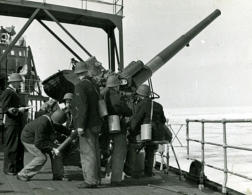
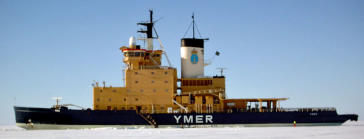
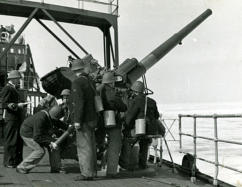
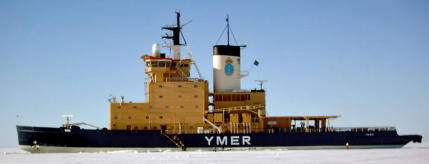
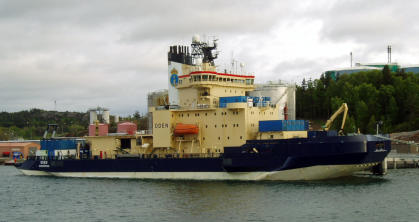
Since 1926, icebreaking has been carried out by the government. The first government-owned icebreaker (state icebreaker) was delivered in 1926 from the Lindholmen Shipyard in Gothenburg and was named “Statsisbrytaren.” Based on previous experience, she was equipped with one propeller in the bow and one in the stern. In 1932, the icebreaker Ymer (I) was delivered from the Kockums shipyard in Malmö; it was the world’s first icebreaker with diesel-electric propulsion. In 1930, “Statsisbrytaren” was renamed Atle. It was not until the Ymer was built that it became possible to conduct any real Swedish winter navigation. During World War II, the Ymer (I) was armed with four 75-mm anti-aircraft guns and four machine guns.The image shows a 75 mm anti-aircraft gun on the Ymer (I) in 1943. During World War II, the ship was armed with four 75 mm anti-aircraft guns and four machine guns. Image: Wikipedia.The icebreakers Atle (I) and Ymer (I) were the only government-owned icebreakers (state icebreakers) for twenty years, until the Thule was delivered from the naval shipyard in Karlskrona in 1953. The Thule was designed to have a shallower draft than the Atle and Ymer, as those vessels had too deep a draft to operate without difficulty in the Öresund Strait. With the Thule, Sweden’s icebreaker capacity was significantly expanded, but soon the Atle needed to be replaced. In 1957, the Oden (I)was delivered. The Oden was ordered from the Wärtsilä shipyard in Helsinki, Finland. The Oden was the first of seven future icebreakers to be built in Finland.In the early 1960s, expanding icebreaker operations was considered beneficial to the economy, not least because it kept Swedish ports in northern Sweden open during the winter. As the Ymer (I) neared the time when it would be placed in reserve, two new icebreakers—the Tor (delivered in 1964) and the Njord (delivered in 1969)—were acquired from Wärtsilä. In 1972, the icebreaker Ale was acquired from Wärtsilä. Ale was specially built to be able to pass through the Trollhätte Canal to Lake Vänern.The three Atle-class icebreakers: Atle (II), Frej, and Ymer (II): In the 1970s, there were also calls for further expansion of winter shipping along the Norrland coast (northern half of Sweden). Until the early 1970s, there were no icebreakers powerful enough to keep the entire Gulf of Bothnia open to maritime traffic during the winter. On May 10, 1971, the order was placed with the Wärtsilä shipyard in Helsinki for new icebreakers. In 1974, the Atle (II) was delivered to enable maritime traffic as far north as Umeå City under normal ice conditions. Two more Atle II-class icebreakers were delivered: the Frej (delivered in 1975) and the Ymer (II)(delivered in 1977).The image shows the state icebreaker Ymer (II) in the ice. Launched in 1976, it entered service in 1977 and is still in service (as of 2026). Length: 104.6 m, width: 23.8 m. Image: Wikipedia.In 1989, the Oden (II) was delivered from the Arendal Shipyard in Gothenburg to replace the Thule and the Oden (I). The Oden (II) was the last ship built at the Arendal Shipyard in Gothenburg. To enable year-round operation as an icebreaker, Oden (II) was built to Arctic ice class standards, allowing it to conduct expeditions to the Arctic and Antarctic. Oden's bow is wider than its stern, unlike other icebreakers. During the winter, Oden is used to break ice in the Gulf of Bothnia, and during the summer, it serves as a research platform for polar research. In September 1991, Oden became the world’s first non-nuclear-powered surface vessel to reach the North Pole.The image shows the state icebreaker Oden (II) refueling at the Preemraff oil refinery in Lysekil on Sweden’s west coast in preparation for the polar expedition in mid-2007. It has been in service since 1989 and remains in service (as of 2026). Length: 107.8 m, width: 31.2 m. Image: Wikipedia. The three icebreakers of the Viking class: The Viking class is a Swedish class of ships consisting of three vessels. Between 2000 and 2001, the three ships—Tor Viking II, Balder Viking, and Vidar Viking—were delivered from Havyard Leirvik in Norway to replace the older state-owned icebreakers Tor and Njord. The vessels are combined icebreakers and offshore support vessels. They were built primarily as offshore support vessels but were also designed to serve as icebreakers. For most of the year, the icebreakers lie idle, and during mild winters, some were not used at all. Nevertheless, they require maintenance, which is not cost-effective. In the 1990s, Finland had built a type of vessel that was used as an icebreaker in the winter and as an offshore vessel—such as a cable-laying ship—during the rest of the year. This vessel served as a model when the Viking class was designed.The Viking-class vessels were not owned by the Swedish Maritime Administration but were chartered during the winter months under a long-term cooperation agreement. Instead, the vessels were owned and operated by Viking Supply Ships AS. In exchange for the Swedish Maritime Administration paying 180 of the 900 million the ships cost, they could be deployed as icebreakers in the Baltic Sea during the ice season with ten days’ notice. This agreement ran through 2015, with the option to extend it for up to an additional 15 years. In the fall of 2012, the Swedish Maritime Administration terminated its contract for the use of the Vidar Viking after determining that it could manage operations using the two remaining Viking icebreakers. During severe winters, the Swedish Maritime Administration’s two supply ships, the Scandica and the Baltica, can also be deployed as reserve icebreakers. The three vessels Vidar Viking, Tor Viking, and Balder Viking were sold to Canada by Viking Supply Ships AS in August 2018. In August 2018, Since 2000, the Viking Supply Ships Group has also managed the operation of the Swedish icebreakers Ale, Atle, Frej, Oden, and Ymer on behalf of the Swedish Maritime Administration. The contract was extended in May 2015 by the Swedish Maritime Administration for a seven-year period. On July 1, 2024, however, the Swedish Maritime Administration decided to take over the operations itself.The Icebreaker Idun: In March 2024, the icebreaker Idun was purchased from the Norwegian shipping company GC Rieber Shipping to relieve the oldest and smallest icebreaker, Ale. The Idun was built in 2006 and is 74 m long, 17 m wide, and has a deadweight of approximately 1,300 tons. In terms of size, she falls right between the Atle class (Atle, Ymer, and Frej) and our smallest icebreaker, Ale. Idun is used to relieve Ale.Swedish icebreakers are often named after gods or other figures from Norse mythology.
Sweden's Icebreakers as of 2026
Sweden currently (2026) has six state icebreakers at its disposal: Ale, Atle (II), Frej, Idun, Oden (II), and Ymer (II). However, the support vessels Baltica and Scandica also have icebreaking capabilities. The Atle, Frej, and Ymer are dedicated icebreakers used exclusively for icebreaking assistance. The Oden is built to Arctic ice classstandards, which allows it to conduct expeditions to the Arctic and Antarctica. The Ale is specially built to navigate through the Trollhätte Canal to Lake Vänern. In 2024, the Idun was purchased from a Norwegian shipping company to relieve the oldest and smallest icebreaker, Ale.
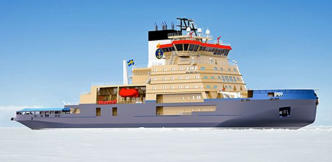
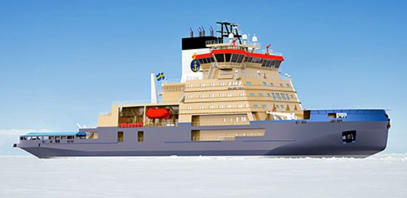
De befintliga svenska isbrytarna har varit i tjänst länge (från 70- och 80-talen) och börjar bli ålderstigna. År 2015 inledde Sjöfartsverket planeringsarbetet för ersättare för de fem statsisbrytarna Oden, Frej, Ymer II, Atle II och Ale. Målsättningen var då att det första nya fartyget skulle tas i drift runt år 2020. Kostnaden beräknades 2015 till ca 1–1,5 miljarder kronor per fartyg. I mars 2020 tecknade Sjöfartsverket ett avtal med finländska Trafikledsverket om ett gemensamt designunderlag för nya isbrytare i Östersjön.Infrastrukturminister Andreas Carlson (KD) meddelade i april 2026 att regeringen nu satsar 4,1 miljarder kronor för att införskaffa fler isbrytare. Upphandling av en ny isbrytare är klar, och Sjöfartsverket har undertecknat ett kontrakt med sydkoreanska varvet HD Hyundai Heavy Industries för tillverkningen av en ny isbrytare. Planen är att den nya isbrytaren (har ännu inte fått något namn), skall levereras under 2029. Regeringen har även aviserat att ytterligare medel kommer att skjutas till för att fortsätta förnyelsen av isbrytarflottan. I projektets inledning identifierades vilka förmågor en nybyggd isbrytare behöver idag. Sjöfartsverket har tillsammans med finska Trafikledsverket utvecklat en ny isbrytardesign. Ambitionen har varit att ta fram en så effektiv design som möjligt för att minska både driftskostnader och miljöpåverkan, utan att göra avkall på identifierade förmågor. Den nya isbrytaren kommer att vara 126 m lång och 28 m bred, dvs större än de nuvarande isbrytarna, och kan bryta en 32 m bred ränna (jämfört med dagens 24 m) samt är förberedd för att kunna drivas på metanol i framtiden. Bilden visar en skiss av Sveriges nya statsisbrytare, beställd 2026. Byggs i Sydkorea och levereras 2029. Bild: Sjöfartsverket.
Icebreaking in Our Nordic Neighboring Countries
Danmark har tre isbrytare. Norge med sin Atlantkust som aldrig fryser till gör att Norge inte behöver någon isbrytarflotta på samma sätt som Sverige och Finland. Men för att ha möjlighet att kunna bryta is har norska Kystvakten (Kustbevakningen) ett isbrytande fartyg. Finland har ett större behov av isbrytare än Sverige, bl.a. för att Finlands hamnar har mer trafik än Sveriges Östersjöhamnar (Sveriges största hamnar ligger i sydväst), och att vindarna ofta är västliga vilket blåser is österut. I Finland ligger ansvaret för isbrytning hos Trafikledsverket, som köper isbrytningstjänsterna från Arctia Shipping.
The Operation of Swedish Icebreakers
From 1926 to 2000 - The Navy
När riksdagen 1925 beställde statsisbrytaren Atle I, beslutade man även att isbrytningsverksamheten skulle vara en del av Marinen. Anledningen var att isbrytningen var en ny och annorlunda verksamhet, och Marinen var de som hade bäst organisation för att operera fartyg. Under den militära tiden utgjordes besättningen på statsisbrytarna av officerare och värnpliktiga från Flottan. År 1939 när andra världskriget bröt ut fanns i Sverige två statsisbrytare, Atle I, och Ymer I. När kriget bröt ut bestyckades Atle I med fyra kanoner m/1889, två i aktern och två i fören, samt med fyra kulsprutor för luftvärnseld. Samtidigt utökades dess besättningen från 44 till 71 man. Ymer I bestyckades med fyra 75 mm luftvärnskanoner och fyra kulsprutor och besättningen utökades från 42 till 85 man. Sedan dess har samtliga svenska isbrytare, byggts med fundament för bestyckning. Isbrytarna Tor, Njord och Atle-klassens 3 fartyg samt Oden var även utrustade med rälsar för minläggning på akterdäck och kunde därför också användas som minfartyg.Besättningarna var förr mycket större än var de är i dag. Det berodde bl.a. på att det fanns fler befattningar ombord då, som exempelvis sjukvårdare och köksmästare, men främst på att mycket av vad som i dag sköts automatiskt då sköttes för hand.
From 2000 - The Swedish Maritime Administration
År 1999 gav regeringen Försvarsmakten och Sjöfartsverket uppdraget att utreda frågan rörande övergång från militär till civil bemanning av isbrytarna. Utredningen visade att civil bemanning skulle bli mer kostnadseffektiv, och redan år 2000 genomfördes övergången då besättningarna blev civila och bestyckningen togs bort. När isbrytarverksamheten övergick till drift i civil regi bantades besättningarna drastiskt. Sju styrmän blev till fem, sex matroser blev till tre, och flera befattningar togs bort. Atle-klassens besättning minskade från 41 man till omkring 18, från början hade den varit 66 man. Sedan 2000 har isbrytarna drivits på kontrakt av först Trans Viking Icebreaking & Offshore, och senare Viking Supply Ships AS. Det senast avtalet slöts i maj 2015 för sju år framåt. Den 1 juli 2024 beslutade Sjöfartsverket att ta över isbrytarverksamheten helt i egen regi.
Home Port
Sveriges isbrytare Atle, Frej, Ymer och Oden har tidigare varit stationerade i Värtahamnen i Stockholm. För att öka effektiviteten har de nu Luleå som hemmahamn, medan de är registrerade i Norrköping. Sedan vintern 2007/2008 har även Ale legat stationerad tillsammans med de övriga isbrytarna i Luleå.
IMO number
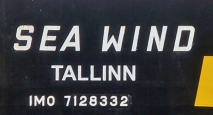
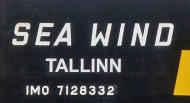
Ett IMO-nummer är ett unikt identitetsnummer för fartyg, som tilldelas av Lloyd's på uppdrag av Internationella sjöfartsorganisationen (IMO). IMO-nummer för fartyg är sedan 1996 obligatoriskt för de stater som skrivit under SOLAS. Det gäller passagerar- och lastfartyg över en viss storlek, och är frivilligt för flera andra typer av fartyg. Numret identifierar fartyget och ändras inte vid ägarbyten, ändring av registreringsland eller ändring av fartygsnamn. IMO-nummer för fartyg består av ordet IMO följt sju siffror (den sista är en kontrollsiffra). Mao, ett IMO-nummer är ett 7-siffrigt unikt nummer som följer ett fartyg under dess hela livstid. IMO-numret ska vara tydligt placerad på en synlig plats på fartyget samt ha en färg som kontrasterar mot skrovets färg. Bilden är ett exempel på ett fartygs IMO-nummer, i detta fall på fartyget Sea Wind, 2016. Bild: Wikipedia.
Swedish-Finnish ice class designations
Behovet av isbrytning varierar kraftigt beroende på isvintrarnas svårighetsgrad, som delas in i lindriga, normala och stränga. Normala isvintrar har ett istäcke på upp till 193 000 kvadratkilometer, vilket innebär att hela Bottenviken, Finska viken, Bottenhavet samt delar av Östersjön är istäckt. Under sådana isförhållanden krävs fyra eller fem av de svenska isbrytarna. Isbrytningssäsongen pågår normalt ifrån början av januari till mitten av maj, med maximal is-utbredning normalt i mars. Under isbrytningssäsongen ges varje isbrytare ett område den skall assistera i. Ju svårare isläget är, desto mindre är detta område och desto fler isbrytare behövs. Med isläget som underlag utfärdar Sjöfartsverket restriktioner för fartyg som skall trafikera istäckta farvatten. Endast de fartyg som uppfyller kraven på storlek och isklass kommer då att få assistans av isbrytare. Utgångspunkten är att inga fartyg skall behöva vänta längre än fyra timmar på isbrytarassistans. Man använder sig av ett konvojsystem då flera fartyg skall gå samma väg genom ett område. Isklassningen som används är den svensk-finska standarden som delar in fartyg enligt följande:För att samordna och organisera isbrytningsverksamheten använder sig den svenska och den finska isbrytartjänsten av ett gemensamt lednings- och informationssystem kallat IBNet (IceBreakerNet).
The photo above shows the Swedish state icebreaker Oden II, delivered to the Swedish Maritime Administration (Swedish: Sjöfartsverket) in 1989. She is built to Arctic ice class standards and is 108 m long and 31 m wide.
Introduction
An icebreaker is a vessel that, thanks to its hull design and engine power, helps other vessels navigate through ice-covered waters. The basic principle is that these vessels, with a combination of a strong hull and high engine power, are capable of breaking the ice.Icebreakers are special ships capable of helping other vessels navigate through ice-covered waters. It is the icebreakers’ hull design and engine power that make such navigation possible—that is, they have a strong hull and powerful engines. This enables them to break through the ice. In the days of sailing ships, it was impossible to navigate ice-covered waters. This meant that the waters up here in Scandinavia became impassable, with no way to do anything about it. The ships were therefore forced to remain in port once the ice set in. During the second half of the 19th century, ships powered by steam—that is, steamships—became increasingly common. Once these ships began to be built of steel, they had sufficient power and hull strength to at least make their way through thinner ice.The first icebreakers were built solely for harbor and river traffic, not for breaking ice at sea. One of the very first icebreakers was the “City Ice Boat No. 1”. It was a paddle steamer with a wooden hull, built in 1837 to break ice on the Delaware River in Philadelphia, USA. The image shows the paddle steamer and icebreaker “City Ice Boat No. 1” on the Delaware River in Philadelphia, USA. Built in 1837. Photo: Wikipedia. The paddle steamer Norwich was built in 1836 for purposes other than icebreaking, but thanks to her icebreaking capabilities, she was commissioned as an icebreaker on the Hudson River in New York in the 1840s.
The Design of Icebreakers
In Hamburg, Germany, a competition was announced in 1871 to design a sturdy icebreaker so that merchant ships could operate in the harbor even during very harsh winters. The icebreaker was to have a sturdy hull and powerful engines to break through the ice. The competition was won by ship designer Ferdinand Steinhaus, whose basic concepts are still used today. His concept was a ship with a robust hull and a powerful engine, but the bow would be angled such that mass and force would work together to break the ice by driving the ship onto it, where its weight would then shatter it. The ideal was for icebreakers to have a length-to-width ratio of 4:1 to minimize the flat surfaces against which the ice could press. His ship, which was 40.5 meters long, 9.75 meters wide, and had a draft of 4.0 meters, was named Eisbrecher I and was later used to break ice on the Elbe River. Since the ship lived up to expectations, additional similar icebreakers were built.One icebreaker built based on this design was the Swedish icebreaker “Isbrytaren”, which was used to keep the Port of Gothenburg open during the winter. Like ordinary merchant ships, this type of icebreaker had only one propeller at the stern. This worked excellently on smooth, thin ice, such as that on the Elbe River, but was less effective on sea ice with ridges. In such cases, it was more effective to reverse through the ridges on the sea ice. In the United States, a train ferry was used on a river; it had propellers at both the bow and the stern. When ice formed on the river, this design proved to be significantly better at breaking through the ice than the Hamburger-type icebreaker, which had a propeller only at the stern.The inertia encountered when navigating through ice is not solely due to the ice that must be broken up ahead of the ship. The friction between the ice and the ship’s sides is at least as significant a factor in making it difficult for ships to move forward. Cargo ships are typically designed like shoeboxes with flat bottoms and smooth, straight sides, which is not advantageous when navigating through ice, as this results in large surfaces where friction can occur. This can be devastating if a ship becomes trapped in the ice, as the enormous forces of drifting ice can crush the ship’s hull or push it beneath the ice. The hulls of icebreakers, on the other hand, are egg-shaped, which helps avoid these dangers; the hull's side surfaces in contact with the ice are thus reduced, and when the ice presses against them from the sides, the icebreaker is pushed upward instead of downward. To further reduce friction between the ice and the hull, water is sprayed along the sides of the icebreaker so that the ice does not come into contact with the hull. The icebreaker’s bow propellers are not used to increase the force against the ice; rather, their function is to lubricate the hull with water. Another effect of the bow propellers is that they draw water away from under the ice immediately in front of the icebreaker, making it easier to break the ice.
Icebreaking in Sweden
Sweden is located in northern Europe and has a great need for icebreaking during the winter. This is especially true for the Gulf of Bothnia and the Bothnian Sea in the northern parts of the Baltic Sea.Icebreaking in Sweden is currently (2026) carried out by six government-owned icebreakers (state icebreakers) that break up ice along Sweden’s coasts to enable merchant ships to use Swedish ports year-round. In 2012, there were 10 icebreakers. The icebreaking season typically runs from New Year’s Day until the end of May. Icebreaking has been carried out in Sweden since the late 1800s, and since 1926, it has been managed by the government.Responsibility for icebreaking lies with the Swedish Maritime Administration (Swedish: Sjöfartsverket), and operations are managed from the icebreaker command center in Norrköping. The Swedish Navy previously provided the crews for the Swedish icebreakers, but since 2000 the crews have been civilian sailors. The Maritime Administration is the government agency in Sweden that provides services to the transport sector by keeping the sea lanes open and safe. One important service of the Swedish Maritime Administration is icebreaking.The Oden II is currently Sweden’s largest icebreaker.
The First Swedish Icebreakers
The first Swedish icebreakers were privately or municipally owned and were used to keep the larger ports open. The first Swedish icebreaker was the “Isbrytaren,” (The Icebreaker) launched in 1882 at the Lindholmen shipyard to keep the Port of Gothenburg ice-free even during harsh winters. The “Isbrytaren” could break through ice up to 60 cm thick without ice ridges. However, she performed less effectively in waters with broken ice.The image shows the icebreaker "Isbrytaren" in the port of Gothenburg, She was Sweden's first icebreaker, built in 1882. Photo: Gothenburg City Museum.In 1895, the “Isbrytaren II” was put into service. This icebreaker was of the Svensksund type. The type designation came from the fact that the icebreaker’s bow was modeled after the Swedish gunboat Svensksund, which proved to be very well suited for navigating through ice. The difference between this hull shape and that of earlier icebreakers was that the Svensksund-class had sharper concave lines in the bow. The “Isbrytaren II” (Gothenburg) performed so well that it soon replaced the “Isbrytaren” entirely.In 1932, the icebreaker S/S Göta Lejon entered service. She was built in 1932 at the Eriksberg Shipyard on behalf of the Port Authority of Gothenburg. The Göta Lejon was chartered by the Swedish Navy as a state icebreaker for missions along the west coast during the cold winters of the early 1940s. In the early 2000s, the Svensksund principle still served as the basis for the design of icebreakers around the world.In 1894, the Port of Malmö commissioned the Kockums shipyard to build the icebreaker S/S Bore, a Hamburg-class vessel with construction number 70 and the ship designation SELA, for icebreaking operations in the Port of Malmö. She is unique in that she is now the world’s oldest icebreaker. The S/S Bore was 40.54 m long and 8.90 m wide, with a draft of 5.50 m. She was in service from 1894 to 1968.The image shows the icebreaker S/S Bore, Malmö, in 1966. Launched in 1894. Image: City of Malmö.To keep Stockholm’s harbors open to maritime traffic, the City of Stockholm commissioned the construction of its first icebreaker, “Isbrytaren I,” in 1897, based on Steinhaus’s design. Another icebreaker was built in 1915 at the Finnboda Shipyard in Stockholm. It became Sweden’s first seagoing icebreaker and was named “Isbrytaren II”. The name “Isbrytaren II” was retained until 1958, when the vessel was converted from steam to oil fuel propulsion and renamed “Sankt Erik” after Stockholm’s patron saint, Saint Erik. In 1958, the command bridge was also enclosed so that the bridge officer no longer had to stand outdoors in the biting winter cold. The “Isbrytaren II” was not only larger than its predecessor, but it was also equipped with propellers at both the bow and stern. A heeling system with ballast tanks in the ship’s sides allowed it to “rock” its way through the ice. Advanced icebreakers were expensive to build, but thanks to a government grant, the City of Stockholm was able to cover the cost. The Navy had problems with the armored coastal defense ships’ poor maneuverability in ice, and the warships therefore risked becoming frozen in during harsh winters. In exchange for being allowed to use the new icebreaker for government operations in and around Stockholm, the government therefore contributed a substantial sum to the project. The “Isbrytaren II” has a total length of 61 m, a beam of 17 m, a displacement of 2,050 tons, a draft of 6 m, a maximum speed of 11 knots, and a crew of 30 (reduced to 25 after 1958). The ship is powered by two steam engines rated at 2,800 and 1,200 hp, respectively. During the harsh wartime winters of the 1940s, the ship was equipped with two machine guns and flew the naval ensign. The Isbrytaren II/Sankt Erik remained in service until 1977, and in 1980 the City of Stockholm donated her to the Maritime Museum as a museum ship. Today, she is moored at the Maritime Museum’s ship pier at Galärvarvet, Stockholm.The image shows the icebreaker "Isbrytaren II", later renamed “Sant Erik”, Stockholm. Launched in 1915. Image: Maritime Museum, ID: Fo259469DIA.
The government assumed
responsibility for icebreaking
operations in Sweden in 1926
About the Swedish State Icebreakers
Since 1926, icebreaking has been carried out by the government. The first government-owned icebreaker (state icebreaker) was delivered in 1926 from the Lindholmen Shipyard in Gothenburg and was named “Statsisbrytaren.” Based on previous experience, she was equipped with one propeller in the bow and one in the stern. In 1932, the icebreaker Ymer (I) was delivered from the Kockums shipyard in Malmö; it was the world’s first icebreaker with diesel-electric propulsion. In 1930, “Statsisbrytaren” was renamed Atle. It was not until the Ymer was built that it became possible to conduct any real Swedish winter navigation. During World War II, the Ymer (I) was armed with four 75-mm anti-aircraft guns and four machine guns.The image shows a 75 mm anti-aircraft gun on the Ymer (I) in 1943. During World War II, the ship was armed with four 75 mm anti-aircraft guns and four machine guns. Image: Wikipedia.The icebreakers Atle (I) and Ymer (I) were the only government-owned icebreakers (state icebreakers) for twenty years, until the Thule was delivered from the naval shipyard in Karlskrona in 1953. The Thule was designed to have a shallower draft than the Atle and Ymer, as those vessels had too deep a draft to operate without difficulty in the Öresund Strait. With the Thule, Sweden’s icebreaker capacity was significantly expanded, but soon the Atle needed to be replaced. In 1957, the Oden (I) was delivered. The Oden was ordered from the Wärtsilä shipyard in Helsinki, Finland. The Oden was the first of seven future icebreakers to be built in Finland.In the early 1960s, expanding icebreaker operations was considered beneficial to the economy, not least because it kept Swedish ports in northern Sweden open during the winter. As the Ymer (I) neared the time when it would be placed in reserve, two new icebreakers—the Tor (delivered in 1964) and the Njord (delivered in 1969)—were acquired from Wärtsilä. In 1972, the icebreaker Ale was acquired from Wärtsilä. Ale was specially built to be able to pass through the Trollhätte Canal to Lake Vänern.The three Atle-class icebreakers: Atle (II), Frej, and Ymer (II): In the 1970s, there were also calls for further expansion of winter shipping along the Norrland coast (northern half of Sweden). Until the early 1970s, there were no icebreakers powerful enough to keep the entire Gulf of Bothnia open to maritime traffic during the winter. On May 10, 1971, the order was placed with the Wärtsilä shipyard in Helsinki for new icebreakers. In 1974, the Atle (II) was delivered to enable maritime traffic as far north as Umeå City under normal ice conditions. Two more Atle II-class icebreakers were delivered: the Frej (delivered in 1975) and the Ymer (II) (delivered in 1977).The image shows the state icebreaker Ymer (II) in the ice. Launched in 1976, it entered service in 1977 and is still in service (as of 2026). Length: 104.6 m, width: 23.8 m. Image: Wikipedia.In 1989, the Oden (II) was delivered from the Arendal Shipyard in Gothenburg to replace the Thule and the Oden (I). The Oden (II) was the last ship built at the Arendal Shipyard in Gothenburg. To enable year-round operation as an icebreaker, Oden (II) was built to Arctic ice class standards, allowing it to conduct expeditions to the Arctic and Antarctic. Oden's bow is wider than its stern, unlike other icebreakers. During the winter, Oden is used to break ice in the Gulf of Bothnia, and during the summer, it serves as a research platform for polar research. In September 1991, Oden became the world’s first non-nuclear-powered surface vessel to reach the North Pole.The image shows the state icebreaker Oden (II) refueling at the Preemraff oil refinery in Lysekil on Sweden’s west coast in preparation for the polar expedition in mid-2007. It has been in service since 1989 and remains in service (as of 2026). Length: 107.8 m, width: 31.2 m. Image: Wikipedia. The three icebreakers of the Viking class: The Viking class is a Swedish class of ships consisting of three vessels. Between 2000 and 2001, the three ships—Tor Viking II, Balder Viking, and Vidar Viking—were delivered from Havyard Leirvik in Norway to replace the older state-owned icebreakers Tor and Njord. The vessels are combined icebreakers and offshore support vessels. They were built primarily as offshore support vessels but were also designed to serve as icebreakers. For most of the year, the icebreakers lie idle, and during mild winters, some were not used at all. Nevertheless, they require maintenance, which is not cost-effective. In the 1990s, Finland had built a type of vessel that was used as an icebreaker in the winter and as an offshore vessel—such as a cable-laying ship—during the rest of the year. This vessel served as a model when the Viking class was designed.The Viking-class vessels were not owned by the Swedish Maritime Administration but were chartered during the winter months under a long-term cooperation agreement. Instead, the vessels were owned and operated by Viking Supply Ships AS. In exchange for the Swedish Maritime Administration paying 180 of the 900 million the ships cost, they could be deployed as icebreakers in the Baltic Sea during the ice season with ten days’ notice. This agreement ran through 2015, with the option to extend it for up to an additional 15 years. In the fall of 2012, the Swedish Maritime Administration terminated its contract for the use of the Vidar Viking after determining that it could manage operations using the two remaining Viking icebreakers. During severe winters, the Swedish Maritime Administration’s two supply ships, the Scandica and the Baltica, can also be deployed as reserve icebreakers. The three vessels Vidar Viking, Tor Viking, and Balder Viking were sold to Canada by Viking Supply Ships AS in August 2018. In August 2018, Since 2000, the Viking Supply Ships Group has also managed the operation of the Swedish icebreakers Ale, Atle, Frej, Oden, and Ymer on behalf of the Swedish Maritime Administration. The contract was extended in May 2015 by the Swedish Maritime Administration for a seven-year period. On July 1, 2024, however, the Swedish Maritime Administration decided to take over the operations itself.The Icebreaker Idun: In March 2024, the icebreaker Idun was purchased from the Norwegian shipping company GC Rieber Shipping to relieve the oldest and smallest icebreaker, Ale. The Idun was built in 2006 and is 74 m long, 17 m wide, and has a deadweight of approximately 1,300 tons. In terms of size, she falls right between the Atle class (Atle, Ymer, and Frej) and our smallest icebreaker, Ale. Idun is used to relieve Ale.Swedish icebreakers are often named after gods or other figures from Norse mythology.
Sweden's Icebreakers as of 2026
Sweden currently (2026) has six state icebreakersat its disposal: Ale, Atle (II), Frej, Idun, Oden (II), and Ymer (II). However, the support vessels Baltica and Scandica also have icebreaking capabilities. The Atle, Frej, and Ymer are dedicated icebreakers used exclusively for icebreaking assistance. The Oden is built to Arctic ice classstandards, which allows it to conduct expeditions to the Arctic and Antarctica. The Ale is specially built to navigate through the Trollhätte Canal to Lake Vänern. In 2024, the Idun was purchased from a Norwegian shipping company to relieve the oldest and smallest icebreaker, Ale.
History of Icebreakers - 1
New Swedish Icebreaker Ordered in 2026
De befintliga svenska isbrytarna har varit i tjänst länge (från 70- och 80-talen) och börjar bli ålderstigna. År 2015 inledde Sjöfartsverket planeringsarbetet för ersättare för de fem statsisbrytarna Oden, Frej, Ymer II, Atle II och Ale. Målsättningen var då att det första nya fartyget skulle tas i drift runt år 2020. Kostnaden beräknades 2015 till ca 1–1,5 miljarder kronor per fartyg. I mars 2020 tecknade Sjöfartsverket ett avtal med finländska Trafikledsverket om ett gemensamt designunderlag för nya isbrytare i Östersjön.Infrastrukturminister Andreas Carlson (KD) meddelade i april 2026 att regeringen nu satsar 4,1 miljarder kronor för att införskaffa fler isbrytare. Upphandling av en ny isbrytare är klar, och Sjöfartsverket har undertecknat ett kontrakt med sydkoreanska varvet HD Hyundai Heavy Industries för tillverkningen av en ny isbrytare. Planen är att den nya isbrytaren (har ännu inte fått något namn), skall levereras under 2029. Regeringen har även aviserat att ytterligare medel kommer att skjutas till för att fortsätta förnyelsen av isbrytarflottan. I projektets inledning identifierades vilka förmågor en nybyggd isbrytare behöver idag. Sjöfartsverket har tillsammans med finska Trafikledsverket utvecklat en ny isbrytardesign. Ambitionen har varit att ta fram en så effektiv design som möjligt för att minska både driftskostnader och miljöpåverkan, utan att göra avkall på identifierade förmågor. Den nya isbrytaren kommer att vara 126 m lång och 28 m bred, dvs större än de nuvarande isbrytarna, och kan bryta en 32 m bred ränna (jämfört med dagens 24 m) samt är förberedd för att kunna drivas på metanol i framtiden. Bilden visar en skiss av Sveriges nya statsisbrytare, beställd 2026. Byggs i Sydkorea och levereras 2029. Bild: Sjöfartsverket.
Icebreaking in Our Nordic
Neighboring Countries
Danmark har tre isbrytare. Norge med sin Atlantkust som aldrig fryser till gör att Norge inte behöver någon isbrytarflotta på samma sätt som Sverige och Finland. Men för att ha möjlighet att kunna bryta is har norska Kystvakten (Kustbevakningen) ett isbrytande fartyg. Finland har ett större behov av isbrytare än Sverige, bl.a. för att Finlands hamnar har mer trafik än Sveriges Östersjöhamnar (Sveriges största hamnar ligger i sydväst), och att vindarna ofta är västliga vilket blåser is österut. I Finland ligger ansvaret för isbrytning hos Trafikledsverket, som köper isbrytningstjänsterna från Arctia Shipping.
The Operation of Swedish
Icebreakers
From 1926 to 2000 - The Navy
När riksdagen 1925 beställde statsisbrytaren Atle I, beslutade man även att isbrytningsverksamheten skulle vara en del av Marinen. Anledningen var att isbrytningen var en ny och annorlunda verksamhet, och Marinen var de som hade bäst organisation för att operera fartyg. Under den militära tiden utgjordes besättningen på statsisbrytarna av officerare och värnpliktiga från Flottan. År 1939 när andra världskriget bröt ut fanns i Sverige två statsisbrytare, Atle I, och Ymer I. När kriget bröt ut bestyckades Atle I med fyra kanoner m/1889, två i aktern och två i fören, samt med fyra kulsprutor för luftvärnseld. Samtidigt utökades dess besättningen från 44 till 71 man. Ymer I bestyckades med fyra 75 mm luftvärnskanoner och fyra kulsprutor och besättningen utökades från 42 till 85 man. Sedan dess har samtliga svenska isbrytare, byggts med fundament för bestyckning. Isbrytarna Tor, Njord och Atle-klassens 3 fartyg samt Oden var även utrustade med rälsar för minläggning på akterdäck och kunde därför också användas som minfartyg.Besättningarna var förr mycket större än var de är i dag. Det berodde bl.a. på att det fanns fler befattningar ombord då, som exempelvis sjukvårdare och köksmästare, men främst på att mycket av vad som i dag sköts automatiskt då sköttes för hand.
From 2000 - The Swedish Maritime
Administration
År 1999 gav regeringen Försvarsmakten och Sjöfartsverket uppdraget att utreda frågan rörande övergång från militär till civil bemanning av isbrytarna. Utredningen visade att civil bemanning skulle bli mer kostnadseffektiv, och redan år 2000 genomfördes övergången då besättningarna blev civila och bestyckningen togs bort. När isbrytarverksamheten övergick till drift i civil regi bantades besättningarna drastiskt. Sju styrmän blev till fem, sex matroser blev till tre, och flera befattningar togs bort. Atle-klassens besättning minskade från 41 man till omkring 18, från början hade den varit 66 man. Sedan 2000 har isbrytarna drivits på kontrakt av först Trans Viking Icebreaking & Offshore, och senare Viking Supply Ships AS. Det senast avtalet slöts i maj 2015 för sju år framåt. Den 1 juli 2024 beslutade Sjöfartsverket att ta över isbrytarverksamheten helt i egen regi.
Home Port
Sveriges isbrytare Atle, Frej, Ymer och Oden har tidigare varit stationerade i Värtahamnen i Stockholm. För att öka effektiviteten har de nu Luleå som hemmahamn, medan de är registrerade i Norrköping. Sedan vintern 2007/2008 har även Ale legat stationerad tillsammans med de övriga isbrytarna i Luleå.
IMO number
Ett IMO-nummer är ett unikt identitetsnummer för fartyg, som tilldelas av Lloyd's på uppdrag av Internationella sjöfartsorganisationen (IMO). IMO-nummer för fartyg är sedan 1996 obligatoriskt för de stater som skrivit under SOLAS. Det gäller passagerar- och lastfartyg över en viss storlek, och är frivilligt för flera andra typer av fartyg. Numret identifierar fartyget och ändras inte vid ägarbyten, ändring av registreringsland eller ändring av fartygsnamn. IMO-nummer för fartyg består av ordet IMO följt sju siffror (den sista är en kontrollsiffra). Mao, ett IMO-nummer är ett 7-siffrigt unikt nummer som följer ett fartyg under dess hela livstid. IMO-numret ska vara tydligt placerad på en synlig plats på fartyget samt ha en färg som kontrasterar mot skrovets färg. Bilden är ett exempel på ett fartygs IMO-nummer, i detta fall på fartyget Sea Wind, 2016. Bild: Wikipedia.
Swedish-Finnish ice class designations
Behovet av isbrytning varierar kraftigt beroende på isvintrarnas svårighetsgrad, som delas in i lindriga, normala och stränga. Normala isvintrar har ett istäcke på upp till 193 000 kvadratkilometer, vilket innebär att hela Bottenviken, Finska viken, Bottenhavet samt delar av Östersjön är istäckt. Under sådana isförhållanden krävs fyra eller fem av de svenska isbrytarna. Isbrytningssäsongen pågår normalt ifrån början av januari till mitten av maj, med maximal is-utbredning normalt i mars. Under isbrytningssäsongen ges varje isbrytare ett område den skall assistera i. Ju svårare isläget är, desto mindre är detta område och desto fler isbrytare behövs. Med isläget som underlag utfärdar Sjöfartsverket restriktioner för fartyg som skall trafikera istäckta farvatten. Endast de fartyg som uppfyller kraven på storlek och isklass kommer då att få assistans av isbrytare. Utgångspunkten är att inga fartyg skall behöva vänta längre än fyra timmar på isbrytarassistans. Man använder sig av ett konvojsystem då flera fartyg skall gå samma väg genom ett område. Isklassningen som används är den svensk-finska standarden som delar in fartyg enligt följande:För att samordna och organisera isbrytningsverksamheten använder sig den svenska och den finska isbrytartjänsten av ett gemensamt lednings- och informationssystem kallat IBNet (IceBreakerNet).