Copyright © Hans Högman 2025-03-19


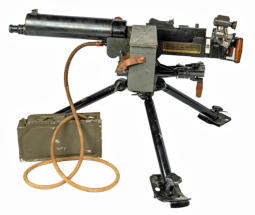
Machine Gun, Ksp m/1914
In Sweden, the Schwarzlose M.7/12 machine gun
was adopted as the 6.5 mm Machine Gun m/1914
(Swedish: 6.5 mm Kulspruta m/1914) for licensed
production at the Carl Gustav Stads Gevärsfaktori,
Sweden. Schwarzlose is an Austrian water-cooled
machine gun that operates on the principle of a
heavy bolt.
The Swedish Army had only had machine guns in
the position artillery before 1914, and the machine
gun m/1914 was introduced in connection with the
establishment of machine gun companies in the
infantry regiments.
At the outbreak of World War II, there were about
2,000 m/1914 machine guns in Sweden. Starting in
1943, these were transferred to the Home Guard,
where they were replaced by the Machine Gun
m/1936 around 1960.
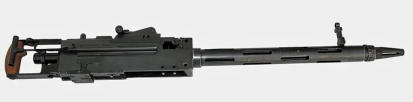
The m/1914-29 machine gun is a hybrid where a
Browning M1917 is combined with the mount and
cooling jacket from the m/1914 machine gun. The
machine gun itself is not of Schwarzlose's design.
Specifications Ksp m/1914:
•
Type
Machine gun
•
Caliber
6.5 mm
•
Barrel length
600 mm
•
Cartridge
8 x 50 mm R Mannlicher
•
Feed system
250-round cloth belt
•
Action
Toggle-delayed blowback
•
Length
1,170 mm
•
Mass
18 kg, 36 kg with a mount
•
Rate of fire
8 rounds/s
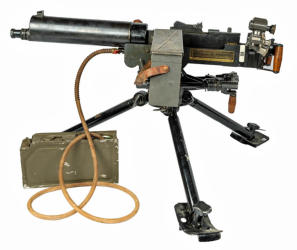
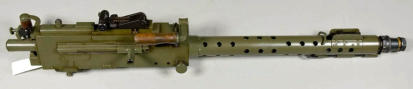
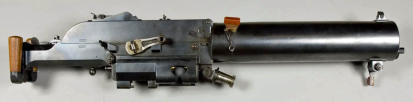
The upper image shows the machine gun m/1914
(Ksp m/1914). Image: Armémuseum, ID:
AM.036760.
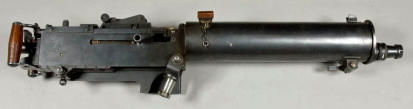
The lower image shows the machine gun m/1914-
29 (Ksp m/1914-29). Image: Armémuseum, ID:
AM.006990.
Machine Gun, Ksp m/1936
The machine gun m/1936 (Swedish: Kulspruta
m/1936 (Ksp m/1936)) is a water-cooled machine
gun of Browning's design and largely corresponds
to the American Browning M1917A1.
The machine gun m/1936 was an improved variant
of the machine gun m/14-29, which was adopted by
the Navy and the army's armored vehicles in 1929.
The machine gun was primarily used as a support
weapon for the infantry, in caliber 6.5 × 55 mm,
and mounted on a standard tripod. It was
equipped, among other things, with a spring-loaded
gun cradle and sights for indirect fire.
The machine gun m/1936 was also available in
single or double configurations as an anti-aircraft
machine gun, in caliber 8 mm cartridge m/32,
placed on an anti-aircraft mount or mounted on the
roof of a vehicle. But it was also used as fixed
armament in some tanks.
In the mid-1970s, the barrels were replaced so that
the same ammunition as for the Ak 4 and machine
gun m/1958 could be used, namely caliber 7.62 ×
51 mm NATO.
The machine gun m/1936 was phased out of the
Swedish Armed Forces during the 1990s.
Specifications:
•
Caliber
6.5 mm / 8 mm
•
Length
1,357 mm
•
Mass
23 kg
with cooling water
43 kg
•
Sight
Bow sight and front sight
•
Feed system
250-round cloth belt
•
Firing range
4,500 m (6,5 mm) / 5,500 m
(8 mm)
•
Max. rate of fire
750 rounds/min
•
Normal rate
250 rounds/min
The image shows the
machine gun m/1936
(Ksp m/1936)
mounted on a tripod.
Image:
Armémuseum, ID:
AM.068890.
Machine Gun, Ksp m/1939
The machine gun m/1939 (Swedish: Kulspruta
m/1939 (Ksp m/1939)) is a machine gun developed
in Sweden and based on John Moses Browning's
M1917 machine gun design, which was licensed
and manufactured by the Carl Gustafs stads
gevärsfaktori, Sweden.
It resembles the American Browning M1919 a lot,
but the m/1939 was a simplified air-cooled variant
of the m/1936 machine gun, which was developed
from the machine gun m/1914-29, which in turn
was based on the Browning M1917 A1.
The machine gun m/1939 was primarily used as
fixed armament in tanks and gun turrets but could
also be mounted on the tripod m/1914 for, for
example, anti-aircraft purposes.
The machine gun m/1939 originally came with two
types of barrels, one for the 6.5 mm cartridge
m/94 and one for the 8 mm cartridge m/32; but in
the early 1970s, an additional barrel was
introduced, this one for the 7.62 × 51 mm NATO
cartridge, designated in Sweden as 7.62 mm
cartridge 10.
Despite its age, the 7.62 mm machine gun m/1939
is still in use today in the Swedish Armed Forces,
primarily as a tank machine gun in the armored
infantry vehicles Combat Vehicles CV9040 A and B.
The machine gun m/1939 is available in variants A,
B, and C, both as right-fed and left-fed. Combat
Vehicle CV90 A & B use the left-feeding variant of
m/1939C in the turret.
Specifications:
•
Cartridge:
6.5 mm cartridge m/94
8 mm cartridge m/32
7.62 mm cartridge 10
•
Action
Recoil
•
Rate of fire
600-720 rounds/min
•
Max. firing range
1,800 - 2,400 m
•
Feed system
250-round cloth belt
•
Sight
Iron
•
Cooling
Air cooled
The image shows the machine gun m/1939B (Ksp
m/1939B). Image: Gotlands Försvarsmuseum, ID:
GFM.000032.
Machine Gun, Ksp m/1942
The machine gun m/1942 (Swedish: Kulspruta
m/1942 (Ksp m/1942)) is an air-cooled machine
gun of Browning's design. It resembles the machine
gun m/1939 and a heavily modified, license-built
derivative of the American M1919A6.
The m/1942 machine gun was used as a support
weapon for the infantry, mounted on a standard
tripod. It was originally available in caliber 6.5 mm
(6.5 × 55 mm) and caliber 8 mm (8 × 63 mm), but
since it lacked a spring-loaded cradle and the recoil
was absorbed by the weapon and mount, firing
with the more powerful 8 mm ammunition was
later prohibited.
In the early 1950s, there was a need for a lighter
machine gun for the infantry, and a number of the
m/1942 machine gun were modified to include a
rifle stock and a simple bipod. They were then
called machine gun m/1942B.
In the mid-1970s, the barrels were replaced so that
they could use the 7.62 × 51 mm NATO caliber.
Specifications:
•
Type
Machine gun
•
Barrel length
607 mm
•
Cartridge:
6,5 × 55 mm
8 × 63 mm patron m/32
7,62 × 51 mm NATO
•
Length
1,351 mm
•
Mass
16 kg
•
Action
Recoil
•
Rate of fire
600-720 rounds/min
•
Firing range
1,800 - 2,000 m
•
Feed system
Belt
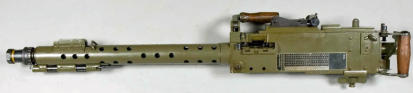
The images show the machine gun m/1942 (Ksp
m/1942). Image: Armémuseum, ID: AM.106711.
Machine Gun, Ksp m/1958
The machine gun m/1958 (Swedish: Kulspruta
m/1958 (Ksp m/1958)) is a general-purpose
machine gun developed by the Belgian Fabrique
Nationale de Herstal (FN), where it is known as the
FN MAG. The machine gun is fully automatic and
air-cooled with a gas-operated open bolt
mechanism, originally chambered for the Swedish
cartridge 6.5 × 55 mm, but since the 1970s re-
chambered to 7.62 × 51 mm NATO.
It was adopted by the Swedish Armed Forces in
1958 to replace the older water-cooled and
significantly heavier m/1936 machine gun for all
mobile army units from around 1960.
Nowadays, the weapon is widespread within the
entire Swedish Armed Forces and is most
commonly used as a support weapon with a two-
man crew.
It is also used as a close protection weapon on
vehicles and ships.
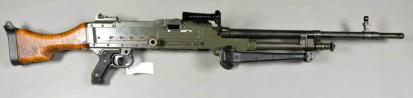
The m/1958 (Ksp 58) is fed with ammunition in
metal belts, each holding 50 cartridges (in fact 49).
The belts are stored either in a belt box or in a
cassette.
Variants: Ksp 58A, Ksp 58B, Ksp 58C, Ksp 58 strv,
Ksp 58D and Ksp 58E.
•
Ksp 58A: Introduced in 1958 in caliber 6.5 × 55
mm. The letter A was added with the adoption of
Ksp 58B.
•
Ksp 58B: In the early 1970s, the Ksp 58 was
modified and renamed Ksp 58B. At the same
time, the barrels were replaced with new ones in
caliber 7.62 × 51 mm.
•
Ksp 58C: On the Combat Vehicle 90 model C (CV
90C), the Ksp 58 replaces the Ksp m/1939 used in
the A and B versions. The delivery of Ksp 58C to
the Armed Forces began in the autumn of 2004.
•
Ksp 58 Strv: Is a variant without a rifle stock and
was primarily mounted as fixed armament in
tanks. It was phased out with the tank 103.
•
Ksp 58D: The name is reserved for the renovated
and modified version of Ksp 58B in the ground
version. It entails a series of changes compared
to previous versions.
•
Ksp 58E: Used in the helicopters Hkp 10
(Eurocopter AS332 Super Puma) and Hkp 15
(Agusta A109 LUHS) as armament. The machine
gun is fitted on a mount in either the left or right
door opening.
Specifications:
•
Modern designation
Kulspruta 58 (Ksp
58)
•
Mass
11.6 kg with a bipod
•
Length
1,275 mm
•
Barrel length
545 mm
•
Cartridge:
6.5 × 55 mm patron m/94:
Ksp 58A
7.62 × 51 mm patron 10: Ksp
58B
•
Action
Gas-operated, open bolt
•
Rate of fire
600–850 rounds/min
•
Muzzle velocity
830 m/s
•
Maximum firing range
1,800 m
•
Effective firing range
600 m
•
Feed system
Belt box of 249 rounds
•
Cassette
Cassette of 49 rounds
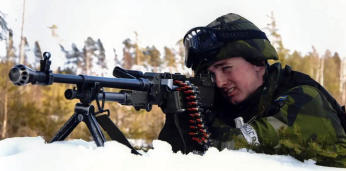
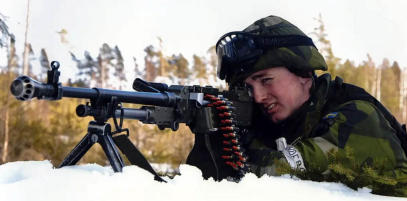
The upper image shows a soldier with the machine
gun 58 with a bipod. Image: Miliseum, ID:
MILIF.023315.
The lower image shows the machine gun m/1958
(Kulspruta 58 / Ksp m/1958 / Ksp 58). Caliber: 6.5
mm. Image: Armémuseum, ID: AM.106673.
Machine Gun 88, Ksp 88
The Machine Gun 88 (Swedish: Kulspruta 88 (Ksp
88)) is a powerful weapon that can be used for air
defense, ground combat, as well as for support and
combat from a combat vessel (e.g. CB 90), for
example, during an amphibious landing.
The Ksp 88 is a fully automatic, air-cooled machine
gun and short recoil-operated. The weapon can be
used on a ground mount but is usually installed on
various types of vehicles and vessels.
The machine gun was originally designed by
Browning (M2). The Swedish variant is the FN M2
HB QCB from FN Herstal. Machine Gun 88 was
previously referred to as the Heavy Machine Gun
12.7 mm (Tksp 12.7). The designation Kulspruta 88
(Machine Gun 88) was introduced in the early
2000s.
The weapon has a relatively large caliber of
12.7mm and can destroy light armored vehicles
with armor-piercing ammunition.
The Machine Gun 88 is used, among other things,
on the Combat Boat 90 (CB 90), which is equipped
with three of them. It is also used as a support
weapon for mechanized units on armored
personnel carriers.
The Ksp 88 was originally procured to arm the
Armored Personnel Carrier 180 (Swedish:
Pansarterrängbil 180) with a 12.7 mm heavy
machine gun in the late 1980s.
The Ksp 88 is fitted in different configurations
depending on the vehicle. Combat Boat 90H (CB
90H), for example, is equipped with three Ksp 88s,
two fixed in the bow and one in a movable turret
ring on the mid-deck.
Specifications:
•
International designation:
FN M2HB-QCB
•
Cartridge
12.7x99 mm
•
Mass
ca 38 kg
•
Rate of fire
450-650 rounds/min
•
Muzzle velocity
800 – 900 m/s
•
Max. practical firing range
1,300 m
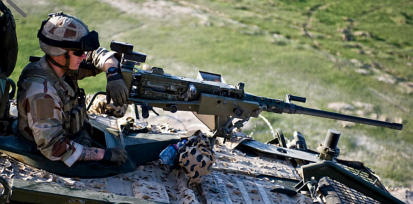
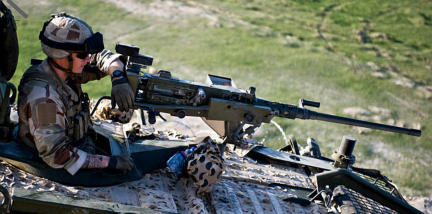
The image shows the Machine Gun 88 (Ksp 88).
Caliber 12.7 mm. It was previously referred to as
Heavy Machine Gun 12.7 mm (Tksp 12.7). Photo:
Anna Norén/Swedish Armed Forces.
Machine Gun 90, Ksp 90
The Machine Gun 90 (Swedish: Kulspruta 90 (Ksp
90)) is a Belgian fully automatic, air-cooled light
machine gun designed by Fabrique Nationale based
on the gas-operated principle, known as the FN
Minimi.
The weapon is a lightweight, portable machine gun
that can be operated by one person.
The machine gun can be loaded either with
standard NATO 5.56 mm magazines (the same as
the assault rifle Ak 5 uses) or with belts from a
cassette.
There are two variants of the Ksp 90 in the Swedish
Armed Forces, one with a fixed stock (Ksp 90) and
one with an adjustable stock and shorter barrel
(Ksp 90B). The Ksp 90 is now being phased out in
favor of the Ksp 90B.
The Ksp 90 was procured in the early 1990s, and it
was initially the Air Force and the Navy that
purchased the weapon for their ranger units. The
original version had a longer barrel, a fixed stock,
and open sights.
Later, the army purchased a shorter variant that
was designated Ksp 90B. The Ksp 90B had a
shortened barrel, a retractable stock, and the
option of a red dot sight. The Ksp 90B has since
been further modified with, among other things, a
new handguard that allows additional accessories
to be mounted on the weapon, such as a laser
pointer. This variant is designated Ksp 90C and is
primarily used today.
The weapon can be loaded either with a freely
hanging belt, a cassette with 200 cartridges, or with
an AK 5 magazine with 30 cartridges. Caliber 5.56
mm.
Specifications:
•
International designation:
FN MINIMI
•
Cartridge
5.56 x 45 mm
•
Length
1,040 mm
•
Max. practical firing range
400 m
•
Mass:
weapon
ca 7 kg
Cassette 200 rounds
ca 3 kg
•
Rate of fire
ca 800 rounds/min
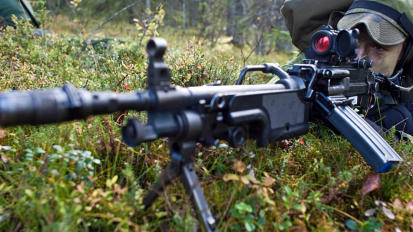
The image shows the Machine Gun 90 (Ksp 90).
Photo: Torbjörn F. Gustafsson/Swedish Armed
Forces.
Arms in the Swedish Armed
Forces - 1
Introduction
A machine gun, MG, (Swedish: Kulspruta (Ksp)) is a
small-caliber fully automatic rifled firearm designed
for sustained direct fire with rifle cartridges. They
have a high ammunition capacity intended to deliver
automatic fire over extended periods, usually at
longer distances from a fixed position or fixed mount
in vehicles. The purpose of sustained automatic fire
is mainly to engage a larger number of targets and to
increase the chances of hitting evasive targets.
Machine guns are frequently not categorized as
firearms since they require support or a mount for
proper operation.
Machine Guns, 20th Century to
Present
Listed below, in chronological order, are the machine
guns used in the Swedish Armed Forces during the
20th century and up to the present day.
List of machine guns
•
Machine gun m/1914
•
Machine gun m/1936
•
Machine gun m/1939
•
Machine gun m/1942
•
Machine gun m/1958
•
Machine gun 88
•
Machine gun 90