Copyright © Hans Högman 2025-03-19


Rocket-Propelled Grenade (RPG) m/1949
and m/1951
In Sweden, the 8 cm rocket launcher m/1949
(Swedish: Raketgevär m/1949 (Rg m/1949)) and the 8
cm rocket launcher m/1951 (Swedish: Raketgevär
m/1951(Rg m/1951) were used during the Cold War,
but these have now been replaced by other man-
portable anti-tank weapons such as anti-tank
missiles and recoilless rifles.
The rocket launcher was available in two variants:
the m/1949B and m/1951B. They differed from
each other in that the m/1951B rocket launcher was
foldable and had a firing mechanism of a more
modern design.
Specifications, rocket launcher m/1949B:
•
Mass
7 kg
•
Length
1,700 mm
•
Caliber
8 cm
•
Grading of the sight
0-350 m
•
Practical rate of fire
ca 6 rounds/min
•
Practical maximum range
against moving targets
150 m
Specifications, rocket launcher m/1951B:
•
Mass
9.6 kg
•
Length
1,700 mm (folded 900
mm)
•
Caliber
8 cm
•
Grading of the sight
0-350 m
•
Practical rate of fire
ca 6 rounds/min
•
Practical maximum range
against moving targets
150 m
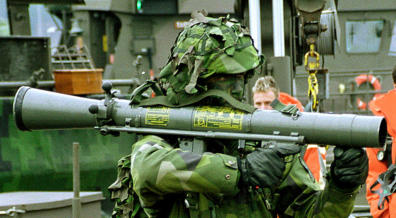
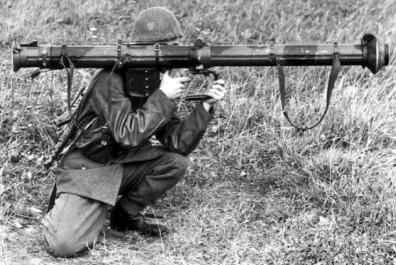
The image shows a Swedish army ranger in a firing
position with a rocket launcher.
The rocket launcher is the m/1951B (Rg m/1951B).
Image: Karlsborgs fästningsmuseum, ID:
KBGF.011924.
Recoilless Rifle m/1948
Recoilless rifles have been in use since the 1940s
and are still modern, with capabilities to combat
armored vehicles and take out fortifications, among
other things.
The Recoilless Rifle m/1948 (Swedish: Granatgevär
m/1948 (Grg m/1948 / Carl Gustaf 84 mm)) is a
Swedish-developed recoil-free, man-portable anti-
tank weapon in caliber 8.4 cm, constructed
according to the back-blast principle. This means
that when the weapon is fired, the forces in the
gunpowder gases flowing backward will be equal to
the forces driving the projectile forward, which
means the shooter will not experience any recoil.
The weapon is, in relation to its weight, very
powerful.
The recoilless rifle is a Swedish design from the
mid-1940s, and the weapons were manufactured at
FFV (The Defense Manufacturing Plant) in
Eskilstuna, Sweden, and later in Karlskoga by Saab
Bofors, where production is still ongoing.
The recoilless rifles are reloadable, and fire can be
delivered with different types of ammunition:
armor-piercing grenades for armored personnel
carriers, explosive grenades for combating troops
and buildings, and smoke grenades to limit
visibility. The sights consist of open sights, aiming
devices, or red dot sights.
Variants:
•
Carl Gustaf M1. In Sweden, the M1 from 1948 is
designated as 8.4 cm granatgevär m/1948 (8.4
cm Grg m/48).
•
Carl Gustaf M2. The M2 variant from 1964 has
not been used in Sweden. Shortened barrel.
Specifications Grg m/1948:
•
International designation
Carl-Gustaf 84 mm
Recoilless Rifle
•
Caliber
8.4 cm
•
Max. practical firing distance:
Armor-piercing grenade
200 m
Explosive grenade
700 m
Smoke grenade
1,000 m
Illuminating grenade
2,800 m
•
Mass
14 kg
•
Length
ca: 1,100 mm
•
Mass, grenade
ca: 3 kg
•
Muzzle velocity
230-300 m/s (depending
on the type of grenade)
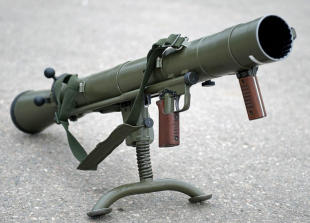
The image shows the recoilless rifle 8.4 cm
Granatgevär m/1948 (Grg m/1948). Image:
Wikipedia.
Recoilless Rifle m/1986
The recoilless rifles m/1948 and m/1986 are
fundamentally the same and have the same
origin and handling. What distinguishes them is
that the Grg m/1948 is made entirely of steel, while
the Grg m/1986 has only a thin steel barrel that is
then reinforced with composite materials of carbon
fiber and epoxy, making the weapon several
kilograms lighter than its predecessor. In terms of
appearance, the m/1986 differs from the m/1948 in
that the m/1986 has a carrying handle on the top.
Variants:
•
Carl Gustaf M3. In Sweden, the M3 from 1986 is
designated as the 8.4 cm recoilless rifle m/86
(8.4 cm Grg m/86). Composite barrel, weight
reduction.
•
Carl Gustaf M4. In Sweden, the M4 from 2018 is
designated as the 8.4 cm recoilless rifle m/18
(8.4 cm Grg m/18 or 8.4 cm Grg 2018). New
barrel, laser rangefinder, weight reduction,
programmable ammunition.
Specifications Grg m/1986:
•
International designation
Carl-Gustaf 84 mm
Recoilless Rifle
•
Caliber
8.4 cm
•
Max. practical firing distance:
Armor-piercing grenade
200 m
Explosive grenade
700 m
Smoke grenade
1,000 m
Illuminating grenade
2,800 m
•
Mass
9.5 kg
•
Length
ca: 1,100 mm
•
Mass, grenade
ca: 3 kg
•
Muzzle velocity
230-300 m/s (depending
on the type of grenade)
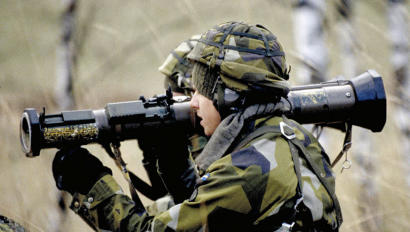
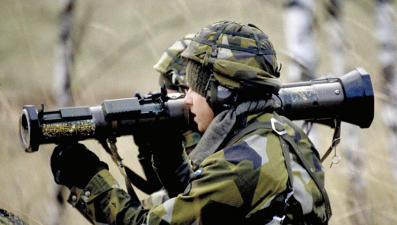
The image shows the recoilless rifle 8.4 cm
Granatgevär m/86 (Grg m/86). Image: Swedish
Armed Forces.
Anti-tank Missiles, m/1945 and m/1946
An anti-tank missile (Swedish: Pansarskott
(pskott)) is a man-portable, hand-fired, close-range
anti-tank weapon designed for single use against
armored vehicles and other protected targets at
short distances.
The Panzerfaust was an anti-tank weapon
developed in Germany during World War II for
single use. The weapon was a simple, recoil-free,
and man-portable anti-tank weapon that could be
fired by one person and operated according to the
shaped charge principle (hollow charge) [Swedish:
Riktad sprängverkan (RSV)].
The weapon was also pirated in Sweden under the
names Pansarskott m/1945 and Pansarskott
m/1946. The Swedish Defence Materiel
Administration (FMV) ordered a copy of the
Panzerfaust design from the arms manufacturer
Bofors, and it was manufactured based on
Panzerfaust weapons acquired from Finland and the
Danish resistance movement.
The Swedish version of the weapon was designated
as the Pansarskott m/1945, and 10,000 copies
were ordered by the Swedish Armed Forces at the
end of 1945.
Even though the Pansarskott m/1945 was
considered effective against contemporary tanks,
its muzzle velocity was low and its effective range
was only about 70 meters.
The Pansarskott m/1945 was quickly upgraded by
replacing the black powder charge with smokeless
powder. The resulting weapon, the Pansarskott
m/1946, had an effective range of about 90 meters.
One of the most significant upgrades to the
Pansarskott m/1946 (anti-tank missile m/1946) was
the addition of a funnel at the rear of the barrel,
which reduced backblast.
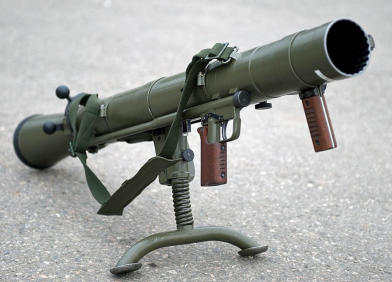
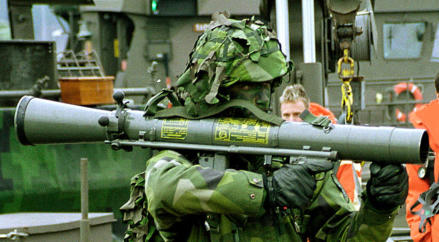
The upper image shows the Pansarskott m/1945
(Pskott m/1945) with the high-explosive anti-tank
grenade m/1945. Image: Armémuseum, ID:
AM.049256.
The lower image shows the Pansarskott m/1946
(Pskott m/1946) with the high-explosive anti-tank
grenade m/1950, dummy. Image: Armémuseum, ID:
AM.053199.


Arms in the Swedish Armed
Forces- 1
Anti-tank Systems, Introduction
Anti-tank warfare refers to the military strategies,
tactics, and weapon systems designed to counter
and destroy enemy armored vehicles, particularly
tanks.
Handheld medium- and large-caliber weapons such
as man-portable anti-tank systems (anti-tank
missiles, recoilless rifles, rocket-propelled grenades
(rocket launchers), etc.) are usually distinguished
from small arms.
Man-portable anti-tank systems (Swedish:
Närpansarvapen) such as recoilless rifles, rocket
launchers, and anti-tank unguided missiles are based
on a weapon principle called the back-blast principle,
which makes them what are commonly referred to
as recoilless weapons or back-blasters.
A recoilless rifle (RR) / recoilless launcher
(Swedish: Granatgevär, (Grg) is a recoilless, man-
portable anti-tank weapon used to combat armored
vehicles and destroy fortifications. A recoilless
launcher typically consists of a rifled barrel designed
to fire dedicated cartridges according to the back-
blast principle with propellant grenades. They are
mostly fitted with fixed sights and a firing
mechanism..
A rocket-propelled grenade (RPG) / rocket
launcher (Swedish: Raketgevär (Rakg)), is a recoilless,
man-portable close-combat weapon primarily used
to combat armored vehicles and tanks. It is a
shoulder-fired anti-tank weapon that launches
rockets equipped with a shaped-charge explosive
warhead. Rocket launchers consist of a barrel
designed to fire dedicated rocket projectiles, that is,
fin-stabilized projectiles propelled by a rocket motor.
The barrels are usually about 1.5 meters long and
equipped with fixed sights and a firing mechanism.
An anti-tank missile (AT) (Swedish: Pansarskott
(Pskott)) is a man-portable, disposable, shoulder-
fired, and recoilless unguided anti-tank weapon
(designed for single use) intended for combating
armored vehicles and other armored targets at short
distances. It consists of a lightweight recoilless barrel
fitted with a pre-loaded grenade projectile and a
propellant charge and is discarded after use.
An anti-tank guided missile (ATGM) (Swedish:
Pansarvärnsrobot (Pvrb)) is a guided missile whose
primary purpose is to destroy heavily armored tanks
and other armored vehicles. Anti-tank guided
missiles come in all sizes, from shoulder-fired
weapons that can be carried by a soldier to larger
systems fired from launchers. Modern anti-tank
missiles use warheads with shaped charges,
specifically designed to penetrate armor.
A weapon that uses the back-blast principle must
be open at the back and needs to fire ammunition
that allows a portion of the propellant's gunpowder
gases to expand and flow out the back of the
weapon during firing. This should create a
sufficiently high pressure to propel the projectile
from the weapon at high speed, which generates
recoil, but as the propellant gases simultaneously
flow out the back of the weapon, this should
counteract the recoil and make the weapon
effectively recoil-free.
Behind all breech-loading weapons, there is a risk
zone in the shape of a cone. Due to this, no
unwanted persons or larger objects should be within
this cone during firing.
Anti-tank Systems, 20th Century
to Present
Listed below, in chronological order, are the anti-tank
systems used in the Swedish Armed Forces during
the 20th century and up to the present day.
List of man-portable anti-tank systems
•
Rocket-propelled grenade m/1949
and m/1951
•
Recoilless rifle m/1948
•
Recoilless rifle m/1986
•
Anti-tank missile m/1945 and
m/1946
•
Anti-tank missile m/1968
•
Anti-tank missile m/1986
•
Anti-tank missile fm/1995
•
Anti-tank guided missile 56
•
Anti-tank guided missile 57
•
Anti-tank guided missile 58
Anti-Tank Missile m/1968 (Miniman)
The anti-tank missile m/1968 (Swedish: Pansarskott
m/1968 (Pskott m/1968)), also known as Miniman,
was a lightweight, single-use anti-tank weapon
designed for engaging infantry fighting vehicles from
all angles and tanks from the side. The weapon was
the predecessor to the Pansarskott m/1986 and was
developed in Sweden.
The Pansarskott m/1968 was developed as an
advancement of the recoilless rifle m/1948 (Carl-
Gustaf) and the Pansarskott m/1946. The armor-
piercing grenade included a charge with a directed
explosive impact. The caliber was 74 mm. The sights
were foldable and consisted of a rear and a front
sight. On the barrel, there was also a label with
aiming instructions.
Specifications:
•
Mass
2.9 kg
•
Length
0.9 m
•
Crew
1–2
•
Mass, cartridge
0.88 kg
•
Caliber
74 mm
•
Muzzle velocity
160 m/s
•
Effective fire range:
150 m (moving targets),
250 m (stationary targets)
•
Max. fire range
250 m
•
Sight
foldable, rear and front sight
•
In use
1968–1986
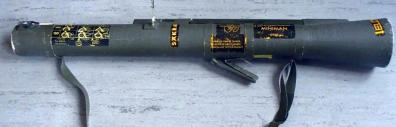
The image shows the Pansarskott m/1968 (Miniman).
Image: Garnisonsmuseet Skaraborg, ID: GMS.008809.
Anti-Tank Missile m/1986
The m/1986 anti-tank missile (Swedish: Pansarskott
m/1986 (Pskott m/1986)), with the export name AT4,
is a Swedish unguided, man-portable, disposable
anti-tank weapon manufactured by Saab Dynamics
AB.
The weapon is standard armament for its class in the
Swedish Armed Forces. The explosive power of the
Pansarskott 86 is not fully sufficient to destroy a
modern main battle tank, but it is still useful against
lighter armored vehicles and fortifications.
The weapon is recoilless, and the casing is made of
fiberglass-reinforced epoxy.
The Pansarskott m/1986 replaced the earlier model
Pansarskott m/1968 during the second half of the
1980s.
Because the weapon is a single-use device, it is
preloaded with a grenade and discarded after use, as
it cannot be reloaded in combat. The weapon is easy
to use and can be given to regular infantry soldiers
who do not have training or a position as a grenade
launcher operator. Since the weapon is recoil-free, it
can be shoulder-fired with high accuracy.
The AT4 anti-tank weapon has been sold to over 15
countries, including the USA.
Specifications:
•
International designation:
Bofors AT-4, AT-4CS
•
Mass
6.7 kg
•
Length
102 cm
•
Caliber
84 mm
•
Muzzle velocity
290 m/s
•
Effective fire range:
Targets with lateral speed
− 150 m
Targets without lateral speed
− 200 m
Max. fire range
− 400 m
The image shows the 8.4 cm Pansarskott m/1986
AT4. Image: Armémuseum, ID: AM.126306.
Anti-Tank Missile fm/1995
In the 1990s, Sweden planned to develop a heavy
anti-tank weapon, the anti-tank missile fm/1995
(experimental model) (Swedish: Pansarskott fm/1995
(Pskott 95)). It was relatively light, 12 kg, and could
potentially disable a tank from the front. The tests,
however, showed that it could not take out modern
tanks from the front, and since the Cold War was now
over, this project was discontinued because Pskott
95 would not provide significantly greater
effectiveness than what Pskott 86 (see above) already
offered.
Instead, the much superior Anti-Tank Guided Missile
57 (MBT LAW/Rb 57) was developed.
Anti-Tank Guided Missile 56 BILL
The Bofors BILL (Bofors Infantry Light and Lethal anti-
tank missile) is a Swedish anti-tank guided missile
system with medium range developed by Bofors in
the early 1980s. It is a SACLOS wire-guided anti-tank
missile.
The Swedish Armed Forces refer to it as Robot 56 (Rb
56), or Robotsystem 56 (Rbs 56), for the entire
system.
The guided missile was developed in collaboration
with the Swedish army and adapted for infantry
soldiers. The Bofors BILL 56 is easy to move and
operate. Assembly takes only a few seconds, and the
missile is aimed and fired by pressing the trigger.
Series delivery to the Swedish Armed Forces began in
1988. The Bofors BILL 56 can destroy all types of
battle tanks. It operates according to the OTA
principle (Over-fly Top Attack), which means it strikes
directly from above.
Bofors produced two major variations of the missile:
•
BILL 1 – Anti-Tank Guided Missile 56A (Robot 56A
/ RB 56A), which is outfitted with a forward-angled
shaped charge warhead in the middle of the
guided missile at a 30° angle from horizontal.
•
BILL 2 – Anti-Tank Guided Missile 56B (Robot 56B
/ RB 56B), equipped with two downward-facing
shaped charges, one front and one rear, which
function as tandem charges against reactive roof
armor.
The Swedish army received the first deliveries of
the BILL 2 in 1999.
The 56 BILL (Robot 56) was operational until 2013,
when it was totally superseded by the anti-tank
guided missile 57 (Robot 57).
But in December 2021, the Swedish Defense Materiel
Administration (FMV) signed a contract with Saab to
reacquire the anti-tank guided missile 56 BILL for
the Armed Forces. This is pending the arrival of the
new anti-tank guided missile 58 (Robot 58 (MMP)) in
2025.
Specifications:
•
Length
900 mm
•
Mass
34.5 kg / 43.5 kg (with night vision)
•
Diameter
150 mm
•
Fire range
150–2,200 m
•
Max. speed
250 m/s
•
Final speed
ca 135 m/s
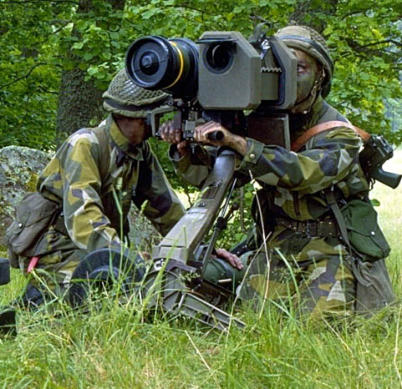
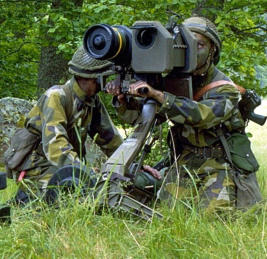
The image shows the Bofors anti-tank guided missile
56 BILL (Pansarvärnsrobot 56 Bill / Robot 56 (Rb 56)).
Image: Swedish Armed Forces.
Anti-Tank Guided Missile 57
The anti-tank guided missile 57 [Swedish: Robot 57
(Rb 57) or Pansarvärnsrobot 57 (Pvrb 57) – NLAW]
is a fire-and-forget, lightweight, shoulder-fired, and
disposable (single-use) line of sight (LOS) missile
system designed for infantry use. The missile was
developed in Sweden during the 2000s on behalf of
the British Ministry of Defence and was designated
NLAW - Next-generation Light Anti-tank Weapon -
during its development. In addition to the United
Kingdom, the weapon has been acquired by, among
others, the armed forces of Sweden and Finland.
The Swedish Armed Forces made their first order for
the system in December 2005, with delivery starting
in 2009. In the Swedish Armed Forces, as of now
(2022), the Robot 57 is the only man-portable anti-
tank weapon with effective capability even against
the most modern tanks, including those with active
armor.
It can carry out an overfly top attack (OTA) on an
armored vehicle or a direct attack (DA) on structures,
non-armoured vehicles, and helicopters.
NLAW is what is sometimes called a close-range anti-
tank missile, a shoulder-fired, short-range, disposable
anti-tank missile system, which means that the
missile tube comes pre-loaded with a missile and is
to be discarded after firing.
The shooter who fires the weapon can set the
distance at which the missile's warhead should be
armed: 20 or 100 meters. Robot 57 can also be fired
from inside buildings and tight spaces. This is thanks
to the tube containing a saline solution that reduces
the force of the recoil. The entire system weighs just
over 12 kg when loaded and is equipped with a
weapon sling for easy hanging on a soldier's back
when the weapon is not in use.
Specifications:
•
Mass
12.4 kg
•
Length
1,016 mm
•
Caliber:
150 mm
•
Weight, missile
7 kg
•
Effective firing range
20-800 m
•
Max. firing range
1,000 m
The image shows the anti-tank guided missile 57
(Pansarvärnsrobot 57 (Rb 57)). Image: Wikipedia.
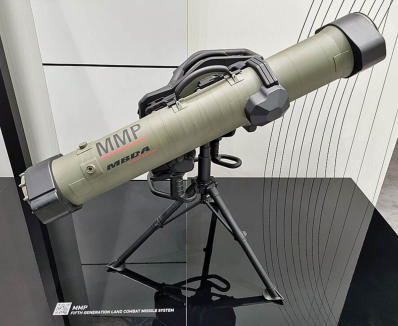
Anti-Tank Guided Missile 58
Sweden and France signed a bilateral agreement in
2023 regarding cooperation on the new anti-tank
missile system, Robotsystem 58 (RBS 58). The
agreement follows the letter of intent signed on July
1, 2021, between the Swedish Defense Materiel
Administration (FMV) and the Direction Générale de
l’armement (DGA) in France.
RBS 58 is known internationally as Akeron MP and is
manufactured by MBDA. In France, the missile is
called Missile Moyenne Portée (MMP) and is a portable
anti-tank guided missile.
Since 2022, trials have been conducted at the 12th
Motorized Infantry Battalion at the Life Guards,
Sweden.
Specifications:
•
International designation
Akeron MP
•
Firing range
4,000 m
•
Length
1,3 m
•
Caliber
140 mm
•
Mass, ready to fire
15 kg
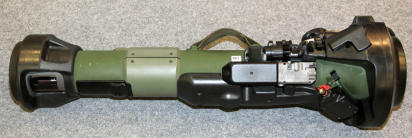
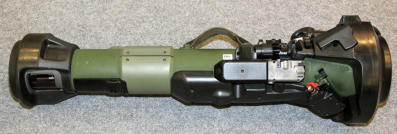
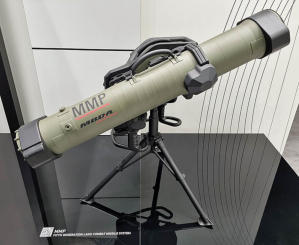
The image shows the anti-tank guided missile 58
(Pansarvärnsrobot 58 / Robot 58 (Rb 58)). The fire
tube to MMP. Image: Wikipedia, 2021.